The Makkah Defence Alliance between Pakistan, Saudi Arabia and Turkiye could eventually expand to include other countries, including Iran, according to Turkish Parliament Speaker Numan Kurtulmus. His remarks come as the three founding members continue building the institutional framework of the defence arrangement signed in August. The agreement treats an armed attack on one member as an attack on all three.
Turkey Discusses Wider Membership
Speaking to reporters in Ankara, Kurtulmus said international agreements require parliamentary approval before they can formally take effect. He indicated that the Makkah agreement could reach the Turkish parliament after lawmakers return from recess in October.
Kurtulmus also addressed questions about whether the pact was intended to counter Iran. He rejected that interpretation, saying Turkiye does not view the agreement as targeting a particular country.
Instead, he described it as an arrangement focused on the security of regional states during a period of continuing conflict and instability. He also said Iran could potentially join the agreement in the future.
The Turkish speaker expressed hope that the arrangement could eventually develop into a wider security framework involving countries across the Muslim world.
Agreement Signed in August
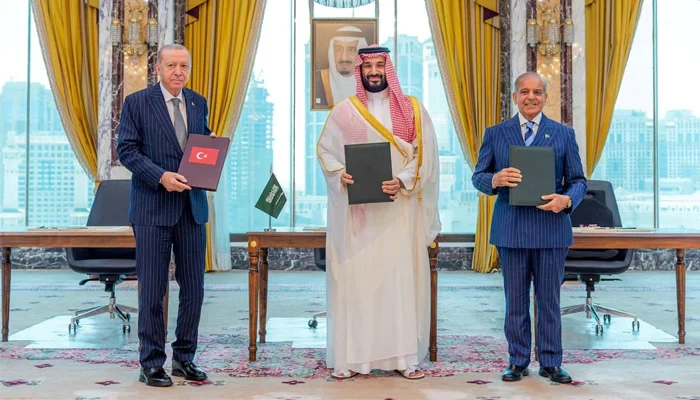
Pakistan, Saudi Arabia and Turkiye signed the Makkah Joint Defence Agreement on August 7 during a trilateral summit in Makkah. The agreement established a collective-defence principle under which an attack against one member is treated as an attack against all members.
The agreement was subsequently given an institutional structure at a meeting in Istanbul on August 31. The three countries agreed to establish a permanent secretariat in Riyadh, with Pakistan providing the first secretary general for an initial three-year term.
Retired Lieutenant General Nauman Mahmood was appointed the first secretary general of the Makkah Defence Alliance on September 23. His office will oversee the secretariat being established in Riyadh.
The alliance is expected to coordinate defence cooperation, joint activities and other mechanisms designed to strengthen collective deterrence.
Ratification Still Required
Although the agreement has already been signed, the process of fully implementing it is still developing.
Kurtulmus said parliamentary approval is required for international agreements in Turkiye. His comments suggest that the Turkish parliament could begin considering the agreement after its October return.
Pakistan has also emphasized that the alliance is still in its early institutional phase. On September 10, Pakistan’s Foreign Office said expansion was not immediately under discussion and that the three founding members first needed to consolidate the organization and establish its procedures.
This means that potential expansion remains a future possibility rather than an established development.
Saudi Arabia’s Security Needs
The defence arrangement has gained additional attention as Saudi Arabia faces increased security concerns linked to attacks launched by Yemen’s Houthi movement.
Turkiye has previously indicated that it could assist Saudi Arabia with military requirements, particularly technical needs. Turkish Foreign Minister Hakan Fidan said such assistance could be provided under the framework of the agreement, while emphasizing that the pact does not replace existing alliances.
The three countries have continued consultations on how the agreement should operate and how cooperation can support Saudi security.
On September 25, Pakistani Foreign Minister Ishaq Dar met his Saudi and Turkish counterparts on the sidelines of the UN General Assembly in New York. The officials reviewed progress on institutionalizing the agreement and discussed regional security developments. They also discussed arrangements for an urgent meeting of the three countries’ military chiefs.
Iran’s Possible Role
The possibility of Iranian participation is particularly notable because Tehran has important relationships with both Pakistan and Turkiye, while Saudi-Iran relations have historically faced periods of tension.
Kurtulmus’s comments represent the Turkish position that the Makkah Defence Alliance should not be structured as an anti-Iran grouping. However, Pakistan has previously taken a more cautious position on expansion, with its Foreign Office saying in September that no immediate discussions were taking place about adding new members.
Pakistan’s military leadership has similarly described the pact as defensive and focused on collective deterrence rather than broader regional ambitions.
A Developing Regional Framework
The future shape of the Makkah Defence Alliance remains uncertain. Its three founding members are still establishing the secretariat, committees and procedures needed to make the agreement operational.
At the same time, recent discussions show that the alliance could eventually become a platform for broader regional security cooperation. Whether other countries join will depend on decisions by the founding governments and the completion of the necessary legal and institutional processes.
For now, Pakistan, Saudi Arabia and Turkiye remain the agreement’s three members, while suggestions about Iranian or wider Muslim-world participation remain proposals rather than confirmed expansions.
The Makkah Defence Alliance is therefore entering a significant implementation phase, with parliamentary procedures, institutional development and regional security concerns likely to shape its next stage.