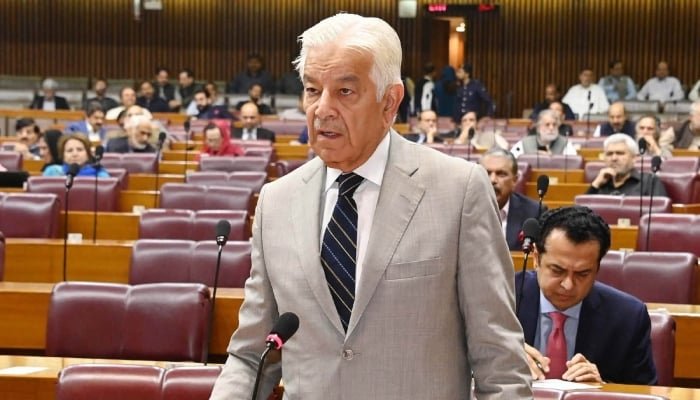
Pakistan’s debate over administrative restructuring has gained momentum after Defence Minister Khawaja Asif voiced support for creating up to 12 provinces in Pakistan. He said the country could consider increasing the number of provinces from four to 12, provided the new administrative units were established on governance requirements rather than ethnic, linguistic or political interests.
Speaking exclusively to Geo News in Sialkot on Sunday, Asif said discussions about creating new provinces had been taking place for approximately two months, with different opinions emerging from across the country.
He argued that Pakistan’s growing population required a more effective administrative structure to improve public service delivery and ensure that government resources reached people across different regions.
Khawaja Asif Calls for Smaller Administrative Units
The defence minister said Pakistan needed smaller administrative units to make governance more accessible and efficient. According to him, important administrative decisions and powers should not remain concentrated in provincial capitals such as Lahore, Karachi, Quetta and Peshawar.
Asif maintained that decentralising authority could help address administrative challenges and bring government institutions closer to ordinary citizens.
He also emphasised that the creation of 12 provinces in Pakistan should not be driven by language, ethnicity or political interests. Instead, the proposed changes should focus on administrative convenience, population needs and improved governance.
His position suggests that the debate should centre on how effectively government services can be delivered rather than on political competition between different regions.
Financial Resources and Local Governments
Asif also criticised the existing system for distributing financial resources, particularly the relationship between provincial governments and local government institutions.
He said funds transferred by the federal government remained largely under the control of provincial administrations, even though the resources were ultimately intended to support local institutions and development activities.
According to the minister, local governments continued to depend on provincial authorities for financial resources and administrative powers, limiting their ability to address problems at the grassroots level.
He urged politicians to reconsider their approach towards exercising authority, arguing that elected representatives should recognise power as a responsibility entrusted to them by the public.
Asif remarked that politicians often wanted to retain control over decision-making instead of transferring authority to institutions that directly served local communities.
His comments indicate that administrative restructuring, in his view, should involve more than simply drawing new provincial boundaries. It should also include meaningful financial and administrative decentralisation.
How the Proposed 12-Provinces Plan Could Divide Pakistan
Asif’s remarks came as reports emerged about a proposal to reorganise Pakistan’s existing four provinces into 12 smaller administrative units.
According to a report published in The News, the proposed arrangement could divide the provinces in the following way:
- Punjab: Four provinces instead of one.
- Khyber Pakhtunkhwa: Three provinces.
- Balochistan: Three provinces.
- Sindh: Two provinces.
If implemented, the arrangement would increase Pakistan’s total number of provinces from four to 12.
The proposal reportedly envisages a nationwide referendum to seek public opinion before proceeding with a possible 28th Constitutional Amendment.
Sources familiar with the discussions suggested that preparatory work could begin in the first quarter of 2027, while the constitutional amendment could be considered during the first half of that year.
However, these timelines remain tentative. No final decision has been announced regarding provincial boundaries, administrative arrangements or the constitutional process required to implement the proposed changes.
One Unit History and Afghanistan Example
During his remarks, Asif also referred to Pakistan’s administrative history, recalling the One Unit scheme under which the country’s provinces were merged into a single administrative unit before the arrangement was eventually reversed.
He also cited Afghanistan as an example of administrative restructuring, noting that its number of provinces had increased from approximately eight or 10 to more than 30.
By referring to these examples, the defence minister highlighted how countries can reorganise administrative structures to address changing governance requirements.
However, Pakistan’s circumstances involve its own constitutional, political and financial considerations, making any major restructuring a complex process.
Major Challenges Facing the 12-Provinces Proposal
Although the idea of creating 12 provinces in Pakistan has received support from some political figures, implementing such a plan would require agreement on several sensitive matters.
One major issue would be the distribution of financial resources under the National Finance Commission (NFC) Award. Changes to provincial boundaries could require a revised approach to sharing federal revenues among the proposed units.
Water distribution, existing financial liabilities and the division of administrative responsibilities would also need careful consideration.
Reports suggest that even if constitutional legislation progresses in 2027, actual implementation could take longer, with the proposed restructuring potentially taking effect after the 2029 general elections.
These challenges underline why the proposal remains a matter of discussion rather than an approved government decision.
Khawaja Asif’s support has added momentum to the national debate over creating smaller provinces and decentralising administrative authority.
The proposed restructuring could bring government services closer to citizens, but its success would depend on fair resource distribution, constitutional agreement and effective local institutions.
The idea of 12 provinces in Pakistan remains under consideration. Whether political parties can reach a consensus and translate the proposal into practical reforms will determine the future of the country’s administrative structure.