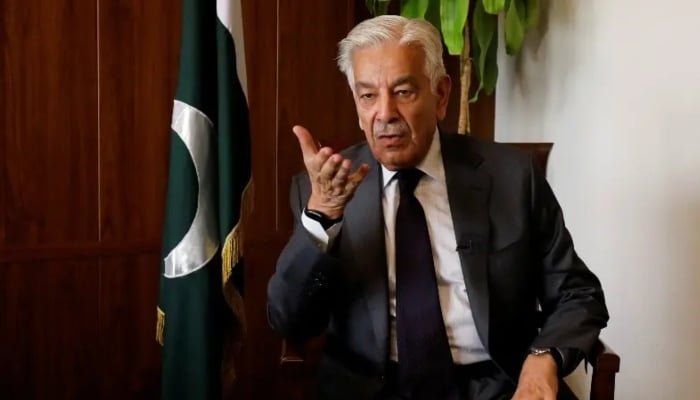
Defence Minister Khawaja Asif has warned that any Houthi aggression against Saudi Arabia could trigger the Makkah Defence Alliance, a tripartite defence agreement between Pakistan, Saudi Arabia and Turkiye. Speaking on Geo News programme Aaj Shahzeb Khanzada Kay Saath, Asif said the agreement treats aggression against one member as aggression against all three.
The warning came after Houthi attacks reportedly targeted several Saudi cities, leaving at least 71 people injured and raising fresh concerns about regional security. Prime Minister Shehbaz Sharif strongly condemned the attacks and reaffirmed Pakistan’s support for Saudi Arabia’s sovereignty, security and territorial integrity.
Asif Warns of Collective Defence Response
Discussing the situation, Khawaja Asif said the Makkah Defence Alliance would be operationalised if aggression against Saudi territory occurred under circumstances covered by the agreement.
“There is no ambiguity” about the collective defence commitment, the defence minister said, stressing that Pakistan is bound by the terms of the pact and would honour its obligations if necessary.
Asif described any unprovoked aggression or spillover of the conflict from Yemen into Saudi Arabia as a situation that could activate the agreement.
His remarks underline the significance of the trilateral defence arrangement, particularly as tensions continue across the Middle East.
At the same time, the minister expressed hope that the situation would eventually be brought under control. He indicated that Islamabad would prefer regional tensions to decline rather than see the situation develop into a wider confrontation.
Agreement Links Pakistan, Saudi Arabia and Turkiye
The Makkah Defence Alliance was signed by Pakistan, Saudi Arabia and Turkiye on August 7, according to the information provided. The agreement establishes a framework for collective security and defence cooperation among the three countries.
The pact has gained additional attention because of the wider instability affecting the region. With Saudi Arabia facing potential security threats linked to the conflict in Yemen, questions have emerged over how the three countries would respond if one of them came under direct attack.
Asif’s comments suggest that Islamabad views the agreement as a serious security commitment rather than simply a diplomatic arrangement.
For Pakistan, the agreement also reinforces its longstanding strategic relationship with Saudi Arabia while expanding defence cooperation with Turkiye.
Prime Minister Condemns Saudi Attacks
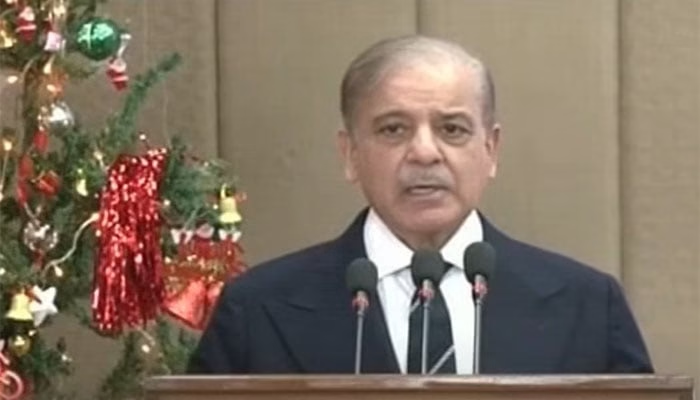
Prime Minister Shehbaz Sharif also condemned the reported attacks on Saudi Arabia, describing them as a “cowardly” act that endangered innocent people and threatened regional peace and security.
The prime minister reaffirmed Pakistan’s support for the kingdom’s sovereignty and territorial integrity.
The reported injuries have added urgency to concerns about the potential expansion of regional conflicts. Any sustained attacks on Saudi territory could have implications beyond the immediate countries involved, particularly if other states become directly involved through existing defence commitments.
The possibility of the Makkah Defence Alliance being activated therefore represents a significant consideration in assessing how the regional situation could develop.
Pakistan Continues Mediation Efforts
While warning about the defence agreement, Asif also said Pakistan’s diplomatic efforts between the United States and Iran were continuing.
According to the defence minister, Islamabad wants to create conditions that could reduce tensions and encourage communication between the two sides. He said contacts were taking place, even if some of them were indirect.
Pakistan has sought to position itself as a mediator during the broader regional crisis, encouraging dialogue and de-escalation rather than further military confrontation.
The government’s diplomatic efforts are taking place alongside its security commitments to regional partners, creating a delicate balance for Islamabad.
Broader Middle East Tensions
The Makkah Defence Alliance emerged amid heightened regional tensions following the conflict that began on February 28, when the United States and Israel reportedly launched joint strikes against Iran.
The resulting escalation has increased pressure on countries across the region to manage security threats while preventing the conflict from expanding further.
Asif said Pakistan would continue working toward peace and hoped international pressure would contribute to reducing tensions.
He also argued that Israel would prefer the conflict between Iran and the United States to continue, while expressing confidence that peace could eventually be established in the region.
What the Alliance Could Mean
The latest warnings have placed the Makkah Defence Alliance at the centre of attention as concerns grow over possible attacks on Saudi territory.
If aggression covered by the agreement occurs, Pakistan, Saudi Arabia and Turkiye would face questions about how their collective defence commitments should be implemented. However, Asif’s remarks also make clear that Islamabad hopes such a situation can be avoided.
Pakistan appears to be pursuing two parallel objectives: maintaining its defence commitments to Saudi Arabia while continuing diplomatic efforts aimed at reducing wider regional tensions.
The coming developments will determine whether the Makkah Defence Alliance remains a framework for cooperation or faces its first major test amid the continuing instability in the Middle East.