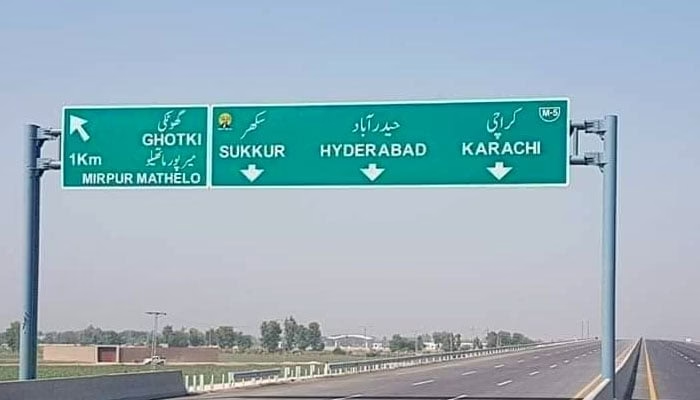
The M6 Motorway project Pakistan is gaining major momentum after a landmark agreement between the National Highway Authority and the Asian Development Bank. This long-awaited development marks a turning point in the country’s infrastructure journey, aiming to connect Karachi with Sukkur through a modern, high-speed motorway.
Federal Minister for Communications Abdul Aleem Khan welcomed the agreement, calling it a strategic milestone for national progress. According to him, the M6 Motorway project Pakistan is not just another road,it is a crucial step toward economic transformation. After being delayed for more than three decades, the project is finally moving forward with clear timelines and strong financial backing.
The motorway is part of Pakistan’s broader vision to strengthen its North-South transport corridor. This corridor plays a vital role in connecting the country’s southern ports with its northern regions. Once completed, the M6 Motorway project Pakistan will enable seamless travel from Karachi’s ports all the way to cities like Peshawar and even further toward Gilgit. This improved connectivity is expected to reduce travel time, cut transportation costs, and boost trade efficiency.
Spanning approximately 306 kilometers, the motorway will be a six-lane, state-of-the-art highway equipped with modern tolling systems and advanced safety features. It will include 15 interchanges and 10 service areas designed to provide convenience for travelers and commercial transporters. The scale and design of the M6 Motorway project Pakistan highlight its importance as a backbone for the country’s logistics and trade network.
One of the most notable aspects of this initiative is its financing model. The project is being developed under a Public-Private Partnership (PPP), which allows both government and private sector participation. This approach ensures transparency while also attracting investment from local and international stakeholders. In addition to the Asian Development Bank, institutions like the Islamic Development Bank and the OPEC Fund have also approved funding for different sections of the motorway.
The M6 Motorway project Pakistan is divided into multiple sections, with key portions such as Hyderabad to Nawabshah being developed through PPP arrangements. This phased approach allows construction to progress efficiently while ensuring that financial resources are managed effectively. The government has set an ambitious target to complete the entire motorway within the next two years.
Beyond infrastructure, the economic impact of the project is expected to be significant. By connecting major industrial and commercial hubs, the motorway will create new opportunities for investment and business growth. It will also enhance the efficiency of supply chains, benefiting industries ranging from agriculture to manufacturing. The M6 Motorway project Pakistan is therefore seen as a catalyst for long-term economic development.
Another important benefit is regional connectivity. Pakistan’s strategic location makes it a key player in regional trade, and improved road networks can strengthen its position further. With the completion of this motorway, goods transported from Karachi’s ports will be able to move quickly and efficiently across the country. This will not only support domestic trade but also facilitate cross-border commerce with neighboring regions.
Minister Abdul Aleem Khan has described the project as the “missing economic link” in Pakistan’s transport network. His statement reflects the critical role that this motorway will play in completing the country’s motorway system. The M6 Motorway project Pakistan will fill a major gap, ensuring uninterrupted connectivity along the entire North-South route.
For everyday travelers, the motorway promises a safer and more comfortable journey. Modern infrastructure, better road quality, and well-equipped service areas will significantly improve the travel experience. At the same time, transporters will benefit from faster delivery times and reduced operational costs, making logistics more efficient and reliable.
The M6 Motorway project Pakistan represents a major leap forward in the country’s infrastructure development. With strong financial backing, a clear execution plan, and a focus on economic growth, the project has the potential to transform Pakistan’s transport and trade landscape. As construction moves ahead, it brings with it the promise of better connectivity, increased investment, and a more prosperous future for the nation.