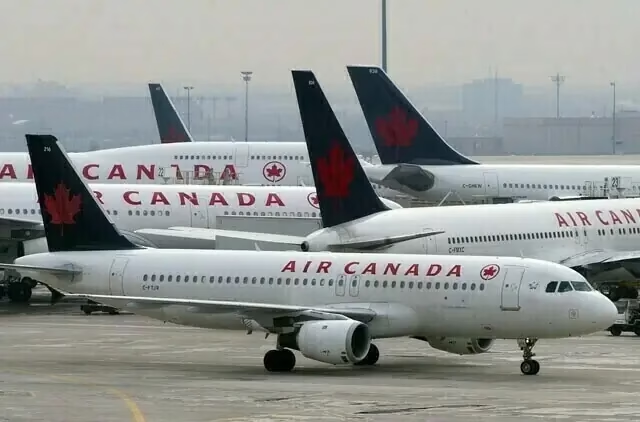
Air Canada Cuba flight suspension has become a major talking point in the global travel industry after the airline announced it is ending its services to Cuba indefinitely. The decision reflects growing instability on the island, where political pressure, fuel shortages, and economic disruption have severely affected tourism and daily life.
Air Canada Cuba flight suspension reflects rising uncertainty
The Air Canada Cuba flight suspension was confirmed on Friday when the airline stated that it could no longer maintain regular operations due to “political and economic uncertainty” in Cuba. Earlier in the year, the carrier had already paused flights until November, but the situation has worsened to the point where a full indefinite suspension was deemed necessary.
Air Canada said the move is meant to provide clearer expectations for passengers, many of whom rely on Canada-Cuba routes for tourism and family visits. The Air Canada Cuba flight suspension highlights how external geopolitical tensions are increasingly influencing airline decisions and international connectivity.
Tourism industry hit hard by Air Canada Cuba flight suspension
Cuba has long depended on international tourism as a key source of foreign revenue, with Canadian travelers making up a significant portion of annual arrivals. However, the Air Canada Cuba flight suspension adds to a series of setbacks that have already weakened the sector.
Other travel companies have also begun pulling back. Blue Diamond Resorts recently shut down dozens of properties across the island, signaling reduced confidence in Cuba’s short-term tourism recovery. The Air Canada Cuba flight suspension further compounds the decline, leaving hotels, resorts, and local businesses with fewer international visitors.
Economic pressure and infrastructure strain
The broader context behind the Air Canada Cuba flight suspension includes severe economic pressure on Cuba’s infrastructure. A fuel embargo has restricted access to diesel needed for electricity generation, leading to frequent and prolonged power outages across the country. In some regions, blackouts last more than 20 hours a day.
These disruptions have also affected water supply systems, transportation networks, and food distribution channels. As a result, Cuba has become increasingly dependent on international aid shipments from countries such as Mexico and China. Against this backdrop, the Air Canada Cuba flight suspension is seen as part of a wider withdrawal of foreign commercial confidence.
Political tensions influencing travel decisions
Another key factor behind the Air Canada Cuba flight suspension is rising political tension between Cuba and the United States. Intensified sanctions and diplomatic pressure have contributed to instability, discouraging foreign investment and tourism.
Airlines typically rely on predictable regulatory and economic environments to operate efficiently. However, with uncertainty increasing, companies like Air Canada are reassessing their risk exposure. The Air Canada Cuba flight suspension reflects a broader trend where political developments directly impact global aviation routes.
Impact on travelers and local economy
For travelers, the Air Canada Cuba flight suspension means fewer direct options to reach the island from Canada, one of Cuba’s largest tourism markets. Many Canadian tourists who regularly visit Cuba for winter vacations will now need to seek alternative destinations or indirect routes.
For Cuba’s economy, the consequences are more severe. Tourism supports thousands of jobs in hospitality, transport, and local services. With the Air Canada Cuba flight suspension reducing visitor numbers further, economic pressure on small businesses and workers is expected to increase.
Outlook for Cuba’s tourism sector
The future of Cuba’s tourism industry remains uncertain. While the government continues to seek international support and investment, structural challenges remain significant. Without improvements in energy supply, infrastructure, and political stability, more international carriers could follow Air Canada’s decision.
The Air Canada Cuba flight suspension may therefore serve as a warning sign of deeper challenges facing the island’s economy. Until conditions stabilize, Cuba’s recovery in the global tourism market is likely to remain slow and uncertain.
The Air Canada Cuba flight suspension is more than just an airline route change—it reflects a combination of political pressure, economic hardship, and infrastructure challenges affecting Cuba. As international carriers reassess their operations, the island’s tourism-dependent economy faces an increasingly difficult path forward.