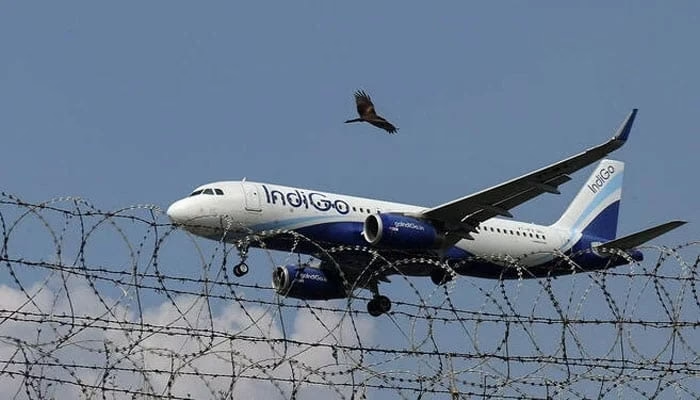
The ongoing Pakistan airspace ban on Indian aircraft has been extended once again, further impacting regional aviation operations and adding another layer to the tense relationship between the two neighboring countries. According to the latest Notice to Airmen (NOTAM) issued by the Pakistan Airports Authority (PAA), the restrictions will remain in effect until 4:59am on June 24.
The extension applies to all Indian-owned and Indian-operated aircraft, including commercial airlines and military planes. Pakistani authorities also confirmed that aircraft leased by Indian airlines will continue to be restricted from using Pakistani airspace.
The latest decision regarding the Pakistan airspace ban reflects the continued diplomatic and political tensions between Islamabad and New Delhi. Relations between the two countries have remained strained following recent security incidents, border tensions, and disagreements over regional matters.
According to officials from the Pakistan Airports Authority, the restrictions came into effect immediately after the previous deadline approached expiration. The earlier airspace ban was scheduled to end on May 24, but authorities decided to continue the closure for another month.
The airspace restrictions have reportedly caused major financial losses for Indian airlines. Aviation experts say Indian carriers have faced increased fuel costs, longer flight routes, and operational delays due to the inability to use Pakistani airspace for westbound international flights.
In contrast, the overall impact of the Pakistan airspace ban on Pakistan’s aviation sector has been comparatively limited. Since many Pakistani airlines operate on different regional routes, the financial pressure on local aviation companies has remained relatively lower.
The latest restrictions are linked to the broader tensions between Pakistan and India that escalated after the Pahalgam attack in Indian Illegally Occupied Jammu and Kashmir (IIOJK). Following the attack, India accused Pakistan of involvement, allegations that Islamabad strongly rejected while also calling for an independent and transparent investigation.
The situation worsened after India suspended the Indus Waters Treaty and both countries exchanged diplomatic and strategic measures. Pakistan responded by closing its airspace to Indian flights, while India later imposed similar restrictions on Pakistani airlines.
The current Pakistan airspace ban also comes after the military escalation between the two countries in May 2025. During that period, India launched attacks on several Pakistani cities, leading to a large-scale response by Pakistan’s armed forces under Operation Bunyanum Marsoos.
The conflict lasted for several days before ending through a ceasefire reportedly brokered by the United States. Although tensions later reduced, political and strategic disagreements between the two countries have continued to affect trade, diplomacy, and transportation links.
Aviation analysts note that airspace closures between neighboring countries can have significant economic consequences. Airlines are often forced to take longer routes, increasing fuel consumption, flight durations, and operational costs. Passengers may also experience higher ticket prices and scheduling disruptions as a result.
Historically, the Pakistan airspace ban is not an unprecedented development. Pakistan has previously closed its airspace to Indian flights during periods of military and political conflict, including the 1999 Kargil conflict and the 2019 Pulwama crisis. In both situations, Indian airlines reportedly faced greater operational challenges due to route limitations.
The geography of South Asia makes Pakistani airspace strategically important for Indian airlines traveling toward Europe, the Middle East, and North America. Without access to Pakistani air corridors, flights often require longer alternate paths over the Arabian Sea or other neighboring regions.
Experts believe that the continuation of airspace restrictions highlights how geopolitical disputes can directly affect civilian industries such as aviation. Airlines, passengers, tourism sectors, and international logistics companies all feel the impact when air routes are disrupted for extended periods.
The extension of the Pakistan airspace ban may also influence future diplomatic discussions between the two countries. Aviation restrictions are often viewed not only as operational decisions but also as political signals during periods of strained relations.
At the same time, many observers believe that long-term regional stability requires dialogue and diplomatic engagement instead of prolonged restrictions and retaliatory measures. Improved communication between both countries could eventually help restore normal aviation operations and reduce economic losses for the airline industry.
Despite ongoing tensions, international aviation authorities continue monitoring the situation closely to ensure flight safety and regional air traffic management remain stable. Airlines operating in South Asia are also adapting schedules and routes to manage disruptions caused by the restrictions.
The continuation of the Pakistan airspace ban signals that tensions between Islamabad and New Delhi remain unresolved. While the move primarily affects aviation operations, it also reflects the broader political and security challenges shaping relations between the two nuclear-armed neighbors.