AJK Political Crisis has intensified after the Azad Jammu and Kashmir government officially declared the Jammu Kashmir Joint Awami Action Committee (JAAC) a proscribed organisation under anti-terrorism laws. The decision came ahead of the group’s planned protest on June 9 and has sparked strong political reactions across the region.
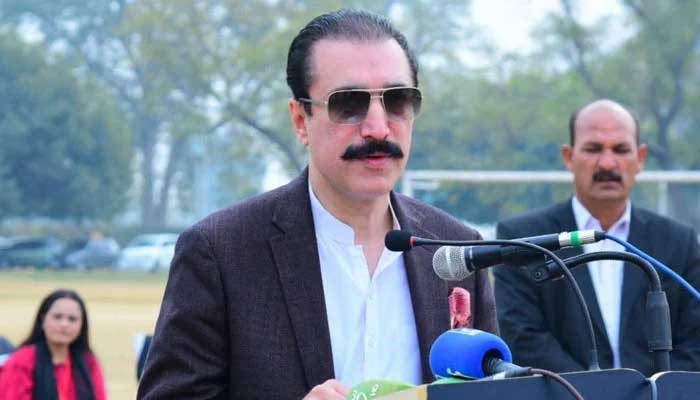
Azad Jammu and Kashmir Prime Minister Faisal Mumtaz Rathore stated that the government would no longer negotiate with individuals or groups involved in creating unrest under the cover of politics. His remarks highlighted the administration’s tougher stance toward protests and political movements that authorities believe threaten public order and state security.
The AJK Political Crisis escalated further after police arrested at least 72 members of the banned JAAC during security operations carried out across different areas of Azad Kashmir. According to officials, weapons, communication devices, and suspicious documents were recovered from the detained individuals.
Government officials claim that the organisation had crossed legal boundaries by encouraging confrontation and disorder. The Home Department’s notification stated that JAAC was involved in activities that created fear, promoted hatred, and disturbed peace within the state.
Prime Minister Rathore, while addressing the media, said that peaceful protest is a democratic right, but blackmailing the state and attacking institutions would never be tolerated. Without directly naming specific groups, he alleged that elements involved in violent demonstrations, sit-ins, and riots had links with supporters of banned extremist organisations.
The AJK Political Crisis has attracted significant public attention because JAAC had previously gained support through large-scale protests related to economic issues and political rights. The organisation had organized demonstrations demanding relief from inflation, electricity costs, and governance concerns. Some of those protests turned violent in the past, leading to clashes with law enforcement agencies.
According to government officials, repeated attempts were made to hold talks with JAAC leadership in previous months. However, Prime Minister Rathore claimed that the group refused to participate in meaningful negotiations despite multiple invitations from the government.
He further stated that JAAC leaders had openly declared they would not step back from confronting the state. This, according to the government, forced authorities to take strict legal action to maintain law and order before the planned demonstrations.
The current AJK Political Crisis is also linked to the controversial issue of refugee seats in the Azad Jammu and Kashmir Legislative Assembly. JAAC’s latest protest movement focused on demanding the abolition of 12 seats reserved for refugees from Indian Illegally Occupied Jammu and Kashmir (IIOJK) who migrated to Pakistan after 1947.
The government said it had requested one week to discuss the issue and consider possible reforms, but JAAC reportedly refused to delay its protest plans. Officials argue that political dialogue requires patience and cooperation from all sides, while protesters claim that promises without action have continued for too long.
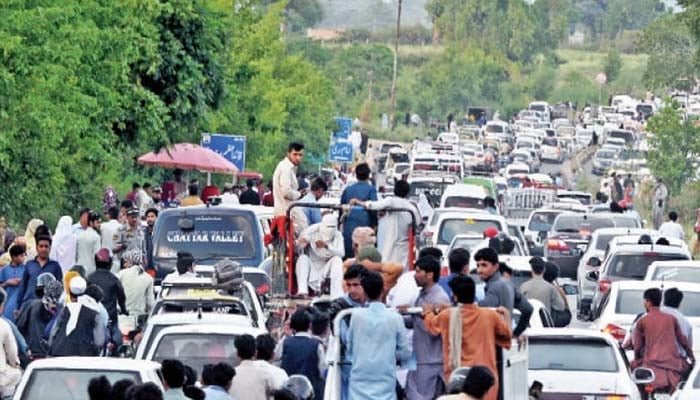
Security arrangements across Azad Kashmir have now been strengthened to prevent any possible unrest. Police and law enforcement agencies remain on high alert, particularly in areas considered sensitive. Authorities fear that protests could turn violent if strict measures are not implemented in advance.
The AJK Political Crisis has also sparked debate among political observers and civil society members. Some believe the government’s decision was necessary to maintain peace and prevent further instability. Others argue that banning political groups may increase tensions and reduce opportunities for democratic dialogue.
Political analysts say the situation reflects deeper governance and representation challenges in Azad Jammu and Kashmir. Economic difficulties, unemployment, inflation, and political frustrations have contributed to rising public dissatisfaction in recent years.
At the same time, security concerns remain a major factor in the region’s political environment. Authorities are attempting to balance the right to protest with the need to maintain stability and public safety.
The government insists that all peaceful and constitutional political activities remain protected under the law. However, officials have warned that any group involved in violence, destruction of public property, or threats against institutions will face strict legal consequences.
The AJK Political Crisis now places additional pressure on both the government and opposition groups to find a peaceful path forward. Continued confrontation could increase instability and deepen divisions among different political and social groups in the region.
Many citizens hope that tensions can be reduced through responsible leadership, dialogue, and democratic engagement. Public opinion in Azad Kashmir remains divided, with some supporting tougher action against violent protests while others call for greater political inclusion and reforms.
As the situation develops, all eyes remain on how authorities handle future demonstrations and whether meaningful political negotiations can still take place. The coming days may prove crucial in determining whether the region moves toward stability or faces further political unrest.