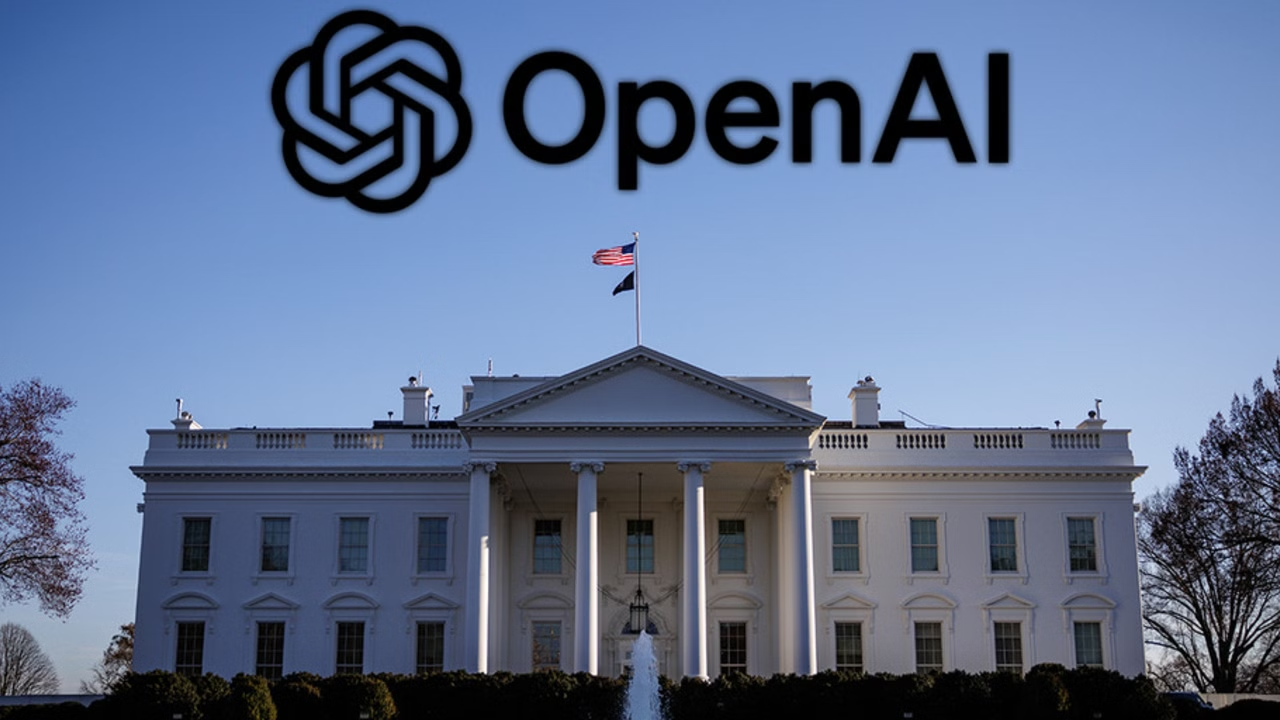
The idea of a US government stake in OpenAI has moved from speculation to active discussion, with reports confirming that senior officials and OpenAI CEO Sam Altman have been in ongoing talks for over a year. The concept of a US government stake in OpenAI reflects a broader shift in how Washington is thinking about artificial intelligence—not just as a technology sector, but as a national strategic asset.
If such an arrangement moves forward, it could mark one of the most unusual public-private partnerships in modern tech history. Instead of simply regulating AI companies from the outside, the government would potentially hold a direct financial interest in one of the most influential AI firms in the world.
Why the Idea Is Being Discussed
At the heart of the US government stake in OpenAI discussions is a growing belief in Washington that artificial intelligence will shape economic dominance in the same way oil, semiconductors, and the internet did in earlier eras. By holding equity—directly or indirectly—the government could potentially benefit from AI-driven economic growth.
According to reports, one concept under review involves OpenAI contributing equity into a structure similar to a public wealth fund. This would allow the broader public to potentially share in the financial upside of AI expansion, rather than all gains remaining in private markets.
Supporters of the idea argue that this could align national interests with technological progress, ensuring that AI development also contributes to public prosperity. Critics, however, warn that a US government stake in OpenAI could blur the line between regulation and ownership, raising questions about independence, oversight, and political influence over AI systems.
How the Talks Reached This Point
Discussions between OpenAI leadership and US officials reportedly began in informal settings more than a year ago and have gradually evolved into structured policy conversations. CEO Sam Altman has previously raised ideas related to public participation in AI-driven economic growth, including proposals tied to sovereign wealth-style mechanisms.
The Trump administration has also shown interest in expanding federal involvement in strategic technologies. In parallel, Washington has already taken or considered stakes in industries such as semiconductors and critical minerals, signaling a broader industrial policy shift.
Within that context, a US government stake in OpenAI is being explored not as an isolated idea, but as part of a wider strategy to secure American leadership in artificial intelligence.
Economic and Strategic Implications
If implemented, a US government stake in OpenAI could reshape the relationship between Silicon Valley and Washington. OpenAI is already valued at hundreds of billions of dollars, and any equity arrangement would tie public finances—directly or indirectly—to the company’s long-term success.
This raises both opportunity and risk. On one hand, the government could gain financial returns that support public programs or innovation funds. On the other hand, losses or market volatility in AI could expose taxpayers to indirect financial risks.
There is also a strategic dimension. AI models are increasingly viewed as dual-use technologies with both civilian and national security applications. A US government stake in OpenAI could give policymakers deeper visibility into AI development, but it could also raise global concerns about state influence over widely used commercial systems.
Political Debate and Public Reaction
The proposal has already sparked debate across political lines. Some lawmakers see it as a forward-thinking approach to ensure citizens benefit from technological disruption. Others, including fiscal conservatives and civil liberties advocates, question whether government ownership in a private AI company sets a risky precedent.
During recent discussions, officials emphasized that no final agreement exists and that the structure—if any—is still under development. Even supporters of the idea acknowledge that designing a fair and transparent model for a US government stake in OpenAI would be complex and politically sensitive.
What Happens Next
For now, the discussions remain exploratory. OpenAI continues to grow rapidly, attracting massive private investment and preparing for a potential future public offering. At the same time, US policymakers are accelerating efforts to regulate and integrate AI into national strategy.
Whether or not the US government stake in OpenAI materializes, the conversation itself signals a turning point. Artificial intelligence is no longer just a private sector race—it is becoming a central pillar of economic and geopolitical planning.
The outcome of these talks could define not only the future of OpenAI, but also the broader relationship between governments and the most powerful technology companies of the AI era.