The SpaceX Google compute deal has quickly become one of the most significant technology infrastructure agreements in recent years, highlighting how aggressively Big Tech is scaling artificial intelligence capacity. The SpaceX Google compute deal reportedly involves billions in monthly payments and access to vast GPU resources, signaling a new phase in the global AI arms race.
This partnership, announced in a regulatory filing, shows how companies like Google are increasingly relying on external infrastructure providers to meet exploding demand for AI workloads. It also underscores how SpaceX is expanding beyond aerospace into large-scale computing infrastructure tied to its broader data ambitions.
Inside the SpaceX–Google Agreement
At the core of the SpaceX Google compute deal is a long-term arrangement under which Google will pay approximately $920 million per month starting in October 2026 and continuing through mid-2029. Over the full term, the agreement is expected to exceed $20 billion.
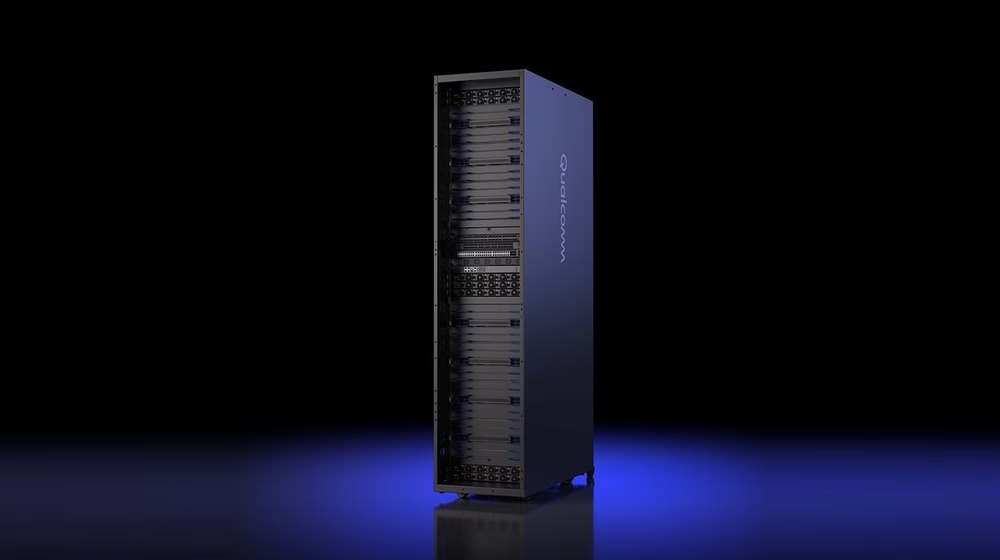
In return, Google will gain access to around 110,000 high-performance computing components, including NVIDIA GPUs, CPUs, memory systems, and supporting hardware. This capacity is intended to support Google’s expanding AI ecosystem, particularly its enterprise-focused AI tools and next-generation model deployment.
The SpaceX Google compute deal is not just a simple cloud contract—it represents access to one of the largest concentrated pools of AI computing power currently being assembled outside traditional hyperscale cloud providers.
Why Google Needs External Compute
Google already operates one of the largest AI infrastructures in the world, but demand for advanced models has been growing faster than internal capacity expansions. Products like enterprise AI agents, generative tools, and multimodal systems require enormous and continuous GPU availability.
According to statements from Google, the agreement is designed to provide “bridge capacity” to handle surging customer demand. In simple terms, the SpaceX Google compute deal helps Google scale faster without waiting for its own long-term data center expansions to come online.
This approach is becoming more common across the industry, where companies temporarily outsource compute needs to avoid slowing down AI deployment cycles.
SpaceX’s Expanding Role in AI Infrastructure
While SpaceX is best known for rockets and satellite internet, the company is increasingly positioning itself as a major player in AI infrastructure through its data center ecosystem. The SpaceX Google compute deal follows a similar arrangement SpaceX signed with Anthropic, suggesting a broader strategy of monetizing large-scale compute capacity.
These agreements indicate that SpaceX is leveraging its massive physical infrastructure projects—such as Colossus data centers—to serve not just internal AI efforts, but also external enterprise clients.
The SpaceX Google compute deal also aligns with Elon Musk’s broader vision of vertically integrated AI and compute systems, where hardware, data centers, and AI models are tightly connected across companies in his ecosystem.
A Growing Pattern of Mega Compute Contracts
The SpaceX Google compute deal is part of a wider trend in the AI industry: multi-billion-dollar compute leasing contracts that lock in capacity years in advance.
Similar agreements, such as SpaceX’s deal with Anthropic, show how AI companies are effectively pre-purchasing computing power at industrial scale. These arrangements are reshaping how cloud computing works, shifting from flexible on-demand services to long-term locked-in infrastructure commitments.
In this context, the SpaceX Google compute deal is not an isolated event but part of a structural shift in how AI infrastructure is financed and allocated.
Financial Stakes and IPO Timing
The timing of the SpaceX Google compute deal is also notable because it comes just ahead of SpaceX’s anticipated IPO. The company is reportedly preparing one of the largest public offerings in history, with valuations potentially reaching trillions of dollars.
For Google, the agreement ensures access to critical infrastructure during a period of unprecedented AI demand. For SpaceX, it guarantees long-term revenue stability from one of the world’s largest tech companies.
The SpaceX Google compute deal also highlights the deep financial interdependence between major AI and tech players, many of which are simultaneously competitors and partners.
What Comes Next
The SpaceX Google compute deal may represent the beginning of even larger partnerships involving orbital data centers, distributed compute networks, and hybrid cloud systems.
As AI models grow more complex, demand for compute will likely continue to outpace supply, pushing companies to secure infrastructure years in advance. Deals like this one suggest that the future of AI will not just be defined by software innovation, but by who controls and allocates the world’s most powerful computing resources.
The SpaceX Google compute deal reflects a new reality: in the AI era, compute is the new currency—and securing it at scale is becoming as important as building the models themselves.