The recent announcement regarding the US troop withdrawal from Europe has triggered fresh debate about NATO’s future security strategy and the changing priorities of the United States in global defense planning. While NATO officials insist the decision will not weaken the alliance, many European leaders remain concerned about the long-term implications.
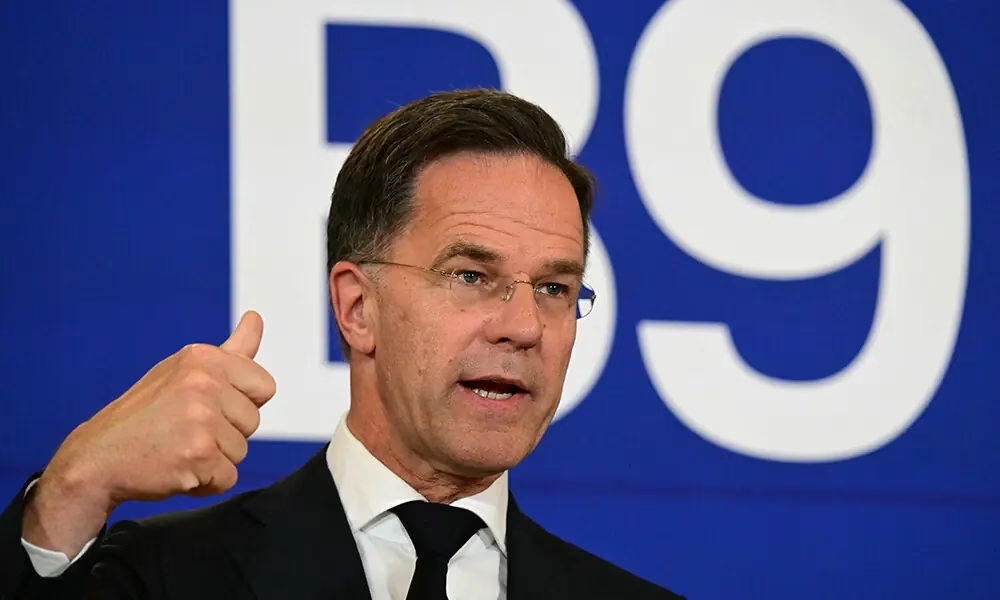
NATO Secretary General Mark Rutte addressed the issue during a press briefing, stating that the withdrawal of around 5,000 American troops from Europe would not negatively affect NATO’s defense plans. According to him, the move mainly involves rotational forces and is part of a broader restructuring process already expected by alliance members.
The discussion surrounding the US troop withdrawal from Europe intensified after Washington confirmed plans to reduce military presence in Germany following political tensions between US President Donald Trump and German Chancellor Friedrich Merz over the Iran conflict.
Although American officials later clarified that some troop deployments to Poland were delayed rather than canceled, the sudden nature of the announcement created uncertainty among European allies. Many governments worry that reduced American military involvement could weaken deterrence capabilities at a time of growing geopolitical tensions.
Despite these concerns, Mark Rutte argued that the US troop withdrawal from Europe should not come as a surprise. He explained that the United States has been signaling for years that it intends to shift greater strategic attention toward Asia and other global regions.
According to NATO officials, the adjustment will happen gradually and in a structured manner. The Pentagon has already confirmed plans to reduce the number of US brigades stationed in Europe from four to three, effectively returning troop levels to what they were in 2021.
The issue has once again highlighted Europe’s dependence on American military support. For decades, the United States has played a central role in NATO’s collective defense system by providing troops, equipment, intelligence, and strategic leadership.
Now, the US troop withdrawal from Europe is raising questions about whether European countries are prepared to take on greater responsibility for their own security. Many defense analysts believe Europe may need to significantly increase military spending and strengthen regional defense coordination in response to changing US priorities.
President Trump has repeatedly criticized European NATO members over defense spending and burden-sharing within the alliance. He has often argued that the United States contributes disproportionately to NATO while some European countries fail to meet agreed defense investment targets.
The latest developments have therefore added to existing tensions between Washington and several European capitals. While NATO leaders continue emphasizing alliance unity, uncertainty over future American military commitments remains a major concern for policymakers.
The debate surrounding the US troop withdrawal from Europe is also closely connected to broader geopolitical shifts. The United States is increasingly focusing on strategic competition in the Indo-Pacific region, particularly regarding China’s growing influence.
As a result, American defense planners are reassessing military deployments worldwide to better align resources with emerging global priorities. NATO officials acknowledge that such adjustments are part of evolving international security dynamics rather than a complete abandonment of Europe.
US Vice President JD Vance recently stated that the troop deployment changes involving Poland were delayed rather than fully canceled. However, uncertainty surrounding the final distribution of forces continues to create concern among NATO’s eastern members.
European diplomats are expected to seek further clarification from US Secretary of State Marco Rubio during upcoming meetings in Sweden and Brussels. NATO members are also preparing for a major summit in Turkey later this year, where defense commitments and alliance strategy will likely dominate discussions.
Another important aspect of the US troop withdrawal from Europe involves NATO’s broader force model. Reports suggest the United States may also reduce the overall number of troops it commits to NATO operations during potential crises.
The NATO force model refers to the pool of military personnel available to alliance commanders within 180 days if rapid deployment becomes necessary. Any reduction in American contributions could increase pressure on European members to expand their own military readiness.
Despite growing concerns, NATO leadership continues to insist that the alliance remains strong and operationally prepared. Mark Rutte described the planned adjustments as normal business and emphasized that strategic changes are expected as global security challenges evolve.
Still, the US troop withdrawal from Europe has become a symbol of shifting international priorities and the uncertain future of transatlantic defense relations. European leaders now face increasing pressure to strengthen independent defense capabilities while maintaining close cooperation with Washington.
As NATO navigates these changes, the alliance’s ability to adapt to new geopolitical realities will play a crucial role in shaping global security in the years ahead.