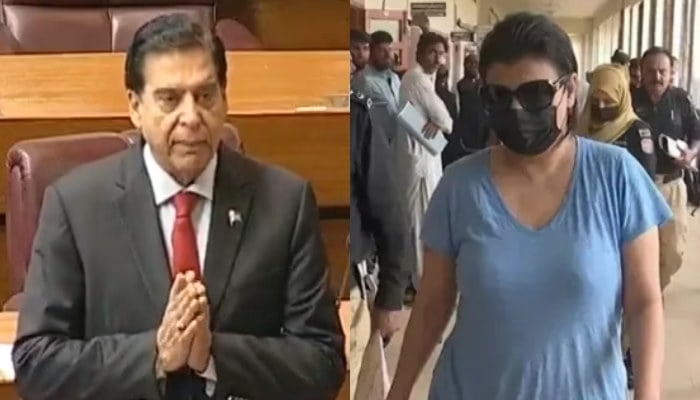
The ongoing Pinky drug case has sparked major political discussion in Pakistan after former prime minister Raja Pervaiz Ashraf publicly expressed shock over allegations linked to his name during a court appearance by the accused woman known as Anmol alias Pinky.
Speaking in the National Assembly, Raja Pervaiz Ashraf addressed the controversy and clarified that he was surprised to hear his name mentioned in connection with the case. According to the senior Pakistan Peoples Party (PPP) leader, a video clip surfaced on May 18 in which the alleged drug suspect referred to him.
Ashraf told parliament that he was confused about which “Raja Pervaiz Ashraf” the suspect was referring to. He also stated that the accused later claimed she had been pressured into making the allegation, raising concerns about the credibility of the statements circulating online.
The Pinky drug case has quickly become one of the most talked-about criminal investigations in Pakistan due to its political implications and the possibility of links to influential individuals. Authorities are continuing investigations while public debate intensifies on social media and television platforms.
During his speech, Raja Pervaiz Ashraf emphasized the importance of due process and fair investigations. He urged the public and media not to spread allegations before investigations are completed and facts are confirmed. According to him, every citizen has the constitutional right to be considered innocent until proven guilty by a court of law.
The controversy surrounding the Pinky drug case also prompted a response from National Assembly Speaker Ayaz Sadiq. During the parliamentary session, the speaker questioned Law Minister Azam Nazeer Tarar about whether cybercrime authorities should take action against what he described as false propaganda circulating online.
In response, the law minister expressed support for Raja Pervaiz Ashraf and reaffirmed that the parliament stood with the senior PPP leader. The exchange highlighted how the case has now moved beyond criminal investigation and entered the political arena.
The suspect at the center of the Pinky drug case, Anmol alias Pinky, was arrested from an apartment in Karachi’s Garden area. However, she has denied some of the official claims regarding her arrest. According to the suspect, she was initially detained in Lahore nearly two weeks before being transferred to Karachi.
Authorities say the accused is not only facing narcotics-related charges but is also involved in murder cases. She remains in police custody on physical remand while investigators continue questioning and evidence collection.
Meanwhile, Sindh Inspector General of Police Javed Alam Odho recently stated that the investigation could reveal several important names connected to drug trafficking networks. Speaking at a press conference in Karachi, the Sindh police chief said authorities are working to identify individuals allegedly linked to narcotics operations.
The Pinky drug case has also led to the formation of a special task force aimed at tackling organized drug trafficking. Officials are encouraging citizens to cooperate with law enforcement agencies and provide testimony if they have relevant information regarding narcotics networks.
According to police officials, multiple cases have already been registered against the suspect, including cases by the Anti-Narcotics Force (ANF). Investigators believe the probe may uncover broader criminal connections and expose additional individuals involved in illegal drug activities.
The case has generated widespread public interest because of the alleged involvement of influential names and the serious nature of the accusations. In Pakistan, high-profile criminal investigations often attract intense media attention, especially when politicians or well-known personalities are mentioned during proceedings.
At the same time, legal experts have warned against drawing conclusions before investigations are completed. They argue that public accusations without verified evidence can damage reputations and influence public perception unfairly.
The growing attention surrounding the Pinky drug case also reflects broader concerns about narcotics trafficking and organized crime in major cities such as Karachi. Law enforcement agencies have repeatedly stated that drug-related crimes continue to pose serious social and security challenges across the country.
Political analysts believe the case could become even more controversial if additional high-profile names emerge during investigations. However, officials insist that the inquiry will proceed according to legal procedures and evidence rather than public pressure.
Raja Pervaiz Ashraf has firmly denied any connection to the allegations and has called for responsible reporting and restraint until the investigation reaches a clear conclusion. His remarks in parliament underline the sensitivity of the matter and the potential political impact of unverified claims.
As the Pinky drug case continues to unfold, both the public and political circles remain closely focused on the investigation, waiting to see what further developments may emerge in the coming days.