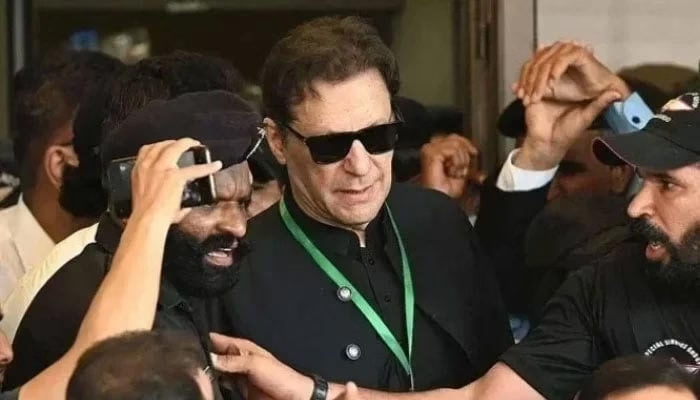
Imran Khan has once again become the center of political discussion after senior leaders of Pakistan Tehreek-e-Insaf raised serious concerns about his health and prison conditions. The growing issue surrounding Imran Khan health concerns has intensified political tensions in Pakistan, with party leaders alleging that the former prime minister is facing worsening medical problems while in custody.
Speaking to reporters outside the Supreme Court of Pakistan in Islamabad, PTI Secretary General Salman Akram Raja claimed that Imran Khan had lost vision in one eye and continued to face significant health risks during imprisonment.
The statements regarding Imran Khan health concerns came shortly after reports confirmed that the former premier underwent another intravitreal eye injection at Pakistan Institute of Medical Sciences as part of ongoing treatment for a serious eye condition known as central retinal vein occlusion (CRVO).
According to medical details presented before the court, CRVO occurs when the main vein responsible for draining blood from the retina becomes blocked. Doctors often associate the condition with health factors such as high blood pressure, cholesterol problems, diabetes, and cardiovascular disease.
The issue of Imran Khan health concerns has now become both a medical and political matter. PTI leaders claim the former prime minister is not receiving the constitutional rights and facilities he is entitled to while in prison. Salman Akram Raja alleged that meetings with Khan and his wife, Bushra Bibi, were being restricted despite court orders regarding visitation rights.
Raja also claimed that even legal documentation processes, including signatures on vakalatnamas, were facing obstacles. According to him, only selected individuals are being allowed to meet the PTI founder, while family members including his sisters have allegedly been denied access despite his medical condition.
The growing discussion around Imran Khan health concerns reflects the broader political polarization currently shaping Pakistan’s political environment. Since his removal from office in 2022, Khan has remained one of the country’s most influential and controversial political figures.
His imprisonment and multiple legal cases have continued to dominate national political discourse. Supporters view the cases as politically motivated, while critics argue that legal accountability should apply equally to all political leaders.
PTI leaders have repeatedly accused authorities of unfair treatment toward the former prime minister. During the recent media interaction, Salman Akram Raja argued that all legal avenues were being exhausted without meaningful relief. He claimed the judiciary was under pressure and that constitutional protections were not being properly implemented.
The debate surrounding Imran Khan health concerns has also reignited conversations about prison conditions, human rights, and judicial independence in Pakistan. Political activists and supporters have increasingly raised questions regarding access to medical care and transparency surrounding high-profile detainees.
At the same time, government supporters reject many of PTI’s allegations and maintain that legal procedures are being followed according to the law. Officials have not publicly confirmed claims regarding torture or deliberate mistreatment related to Khan’s health condition.
The medical treatment itself has drawn public attention because central retinal vein occlusion can be a serious condition requiring ongoing monitoring and injections to prevent worsening vision problems. Health experts note that timely treatment is important to reduce the risk of permanent vision loss.
The continued focus on Imran Khan health concerns also comes during a politically sensitive period for Pakistan. The country is facing economic difficulties, security challenges, and increasing political polarization between the ruling coalition and opposition parties.
Salman Akram Raja used the occasion to criticize the broader political and economic situation, claiming that the economy had suffered severe damage and that instability continued to grow in regions such as Khyber Pakhtunkhwa.
He further alleged that restrictions being imposed on political activities and legal access were unprecedented. Comparing current conditions to colonial-era governance, Raja argued that the judiciary had weakened under political pressure.
The issue of Imran Khan health concerns has therefore expanded beyond personal medical treatment into a symbol of the ongoing political struggle between PTI and state institutions. Public reactions remain deeply divided, with supporters demanding greater transparency while opponents accuse PTI of politicizing health-related matters.
Political analysts believe the situation may continue to influence Pakistan’s political climate in the coming months. Questions surrounding Khan’s legal cases, prison conditions, and political future remain central to national debate.
The former prime minister continues to maintain strong support among large segments of the population despite his imprisonment. PTI leadership has repeatedly indicated that the party plans to continue mobilizing public support through political campaigns and legal challenges.
The growing discussion surrounding Imran Khan health concerns highlights the intersection of politics, law, and public perception in Pakistan’s current political environment. Allegations regarding medical treatment, visitation rights, and legal restrictions have intensified debate across the country.
As legal proceedings continue and political tensions remain high, the issue is likely to stay at the center of Pakistan’s national conversation. Whether viewed as a human rights issue, a political controversy, or a legal matter, the situation surrounding Imran Khan continues to shape the country’s evolving political landscape.