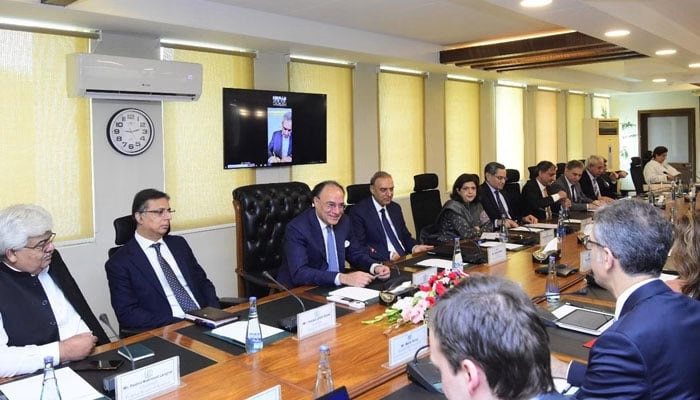
Muhammad Aurangzeb recently held important discussions with a visiting delegation from the International Monetary Fund as Pakistan continues efforts to stabilize its economy and strengthen long-term financial sustainability. The latest talks around Pakistan IMF reforms focused on macroeconomic stability, structural changes, fiscal discipline, and preparations for the upcoming federal budget.
The meeting was led by IMF Mission Chief Iva Petrova and covered several key areas linked to Pakistan’s economic recovery plan. Government officials and IMF representatives discussed ongoing reform implementation, export growth, external sector improvements, and strategies aimed at reducing economic vulnerabilities.
The discussions surrounding Pakistan IMF reforms come at a critical time for the country’s economy. After facing years of inflation, foreign exchange shortages, rising debt pressures, and recurring balance-of-payments crises, Pakistan is now attempting to build a more stable and sustainable economic framework.
During the meeting, Aurangzeb highlighted positive developments in Pakistan’s external sector. According to the finance minister, exports and remittances have shown encouraging growth trends in recent months, reflecting signs of resilience within the economy.
Improving exports remains a major priority under the broader Pakistan IMF reforms agenda. Policymakers believe export-led growth is essential for reducing dependence on external borrowing and strengthening Pakistan’s long-term economic position.
The government has repeatedly emphasized that short-term stabilization alone is not enough. Instead, officials aim to implement deeper structural reforms that can improve productivity, enhance competitiveness, and support sustainable economic growth over the coming years.
A major focus of the Pakistan IMF reforms strategy is ending the country’s repeated boom-and-bust economic cycles. Pakistan’s economy has historically experienced periods of rapid growth followed by severe financial instability, forcing repeated reliance on IMF assistance and emergency external financing.
To address this pattern, the government is working on reforms related to taxation, deregulation, energy sector restructuring, state-owned enterprises, and fiscal management. Officials believe these measures can create a stronger economic foundation capable of withstanding both domestic and global shocks.
Aurangzeb told the IMF delegation that the reform agenda was developed through consultation with international economists and financial experts. He stressed that current policy measures are part of a long-term transformation strategy rather than temporary political decisions.
The ongoing Pakistan IMF reforms also place significant emphasis on fiscal discipline. Pakistan continues to face challenges related to budget deficits, debt servicing costs, and public sector inefficiencies. IMF-backed reforms typically require governments to improve revenue collection while reducing unnecessary expenditures.
Tax reforms remain one of the most politically sensitive aspects of the process. Expanding the tax base and improving documentation of the economy have long been key IMF recommendations for Pakistan. Policymakers argue that stronger tax collection is necessary to reduce reliance on borrowing and create space for development spending.
The IMF delegation acknowledged the progress Pakistan has made despite difficult regional and global conditions. Representatives appreciated the government’s efforts to maintain macroeconomic stability while continuing to implement reform measures.
Still, experts caution that the success of Pakistan IMF reforms depends heavily on consistent implementation. Many previous reform programs in Pakistan faced delays or reversals due to political pressures, institutional weaknesses, or economic shocks.
One important challenge remains balancing economic reforms with public expectations. Measures linked to IMF programs often involve subsidy reductions, higher utility costs, stricter taxation, and spending controls, which can increase pressure on ordinary citizens and businesses.
At the same time, supporters of the reform process argue that avoiding structural change would create even greater long-term risks for the economy. Without reforms, Pakistan could continue facing recurring financial crises, currency instability, and limited investor confidence.
The discussions also focused on the upcoming federal budget, which is expected to play a central role in advancing Pakistan IMF reforms. Analysts expect the budget to include measures aimed at increasing revenue, controlling spending, and supporting export-oriented sectors.
The IMF has consistently emphasized the importance of structural reforms that encourage investment, industrial productivity, and private sector growth. Improving the business environment and reducing regulatory barriers are considered essential for attracting both domestic and foreign investment.
Another important element of the Pakistan IMF reforms framework is improving governance and transparency. International financial institutions have repeatedly stressed the need for stronger accountability mechanisms, digital monitoring systems, and better institutional coordination across economic sectors.
The finance minister also reiterated Pakistan’s commitment to maintaining reform momentum despite economic and political challenges. According to government officials, continued cooperation with the IMF is important for preserving market confidence and ensuring financial stability.
Investors and international markets closely monitor IMF discussions because they often influence broader perceptions regarding a country’s economic direction and credibility. Positive engagement with the IMF can improve investor confidence and support access to external financing sources.
The latest talks demonstrate that both Pakistan and the IMF remain committed to continued cooperation. The IMF mission reaffirmed its support for Pakistan’s reform program and stressed the importance of maintaining policy consistency in the months ahead.
The ongoing Pakistan IMF reforms represent a critical phase in the country’s economic recovery strategy. While signs of stabilization and export improvement are encouraging, long-term success will depend on whether structural reforms are implemented effectively and consistently.
Pakistan now faces the challenge of balancing economic discipline with growth, public welfare, and political realities. The coming federal budget and future IMF reviews will likely determine how successfully the country can transition from short-term stabilization toward durable and sustainable economic progress.