
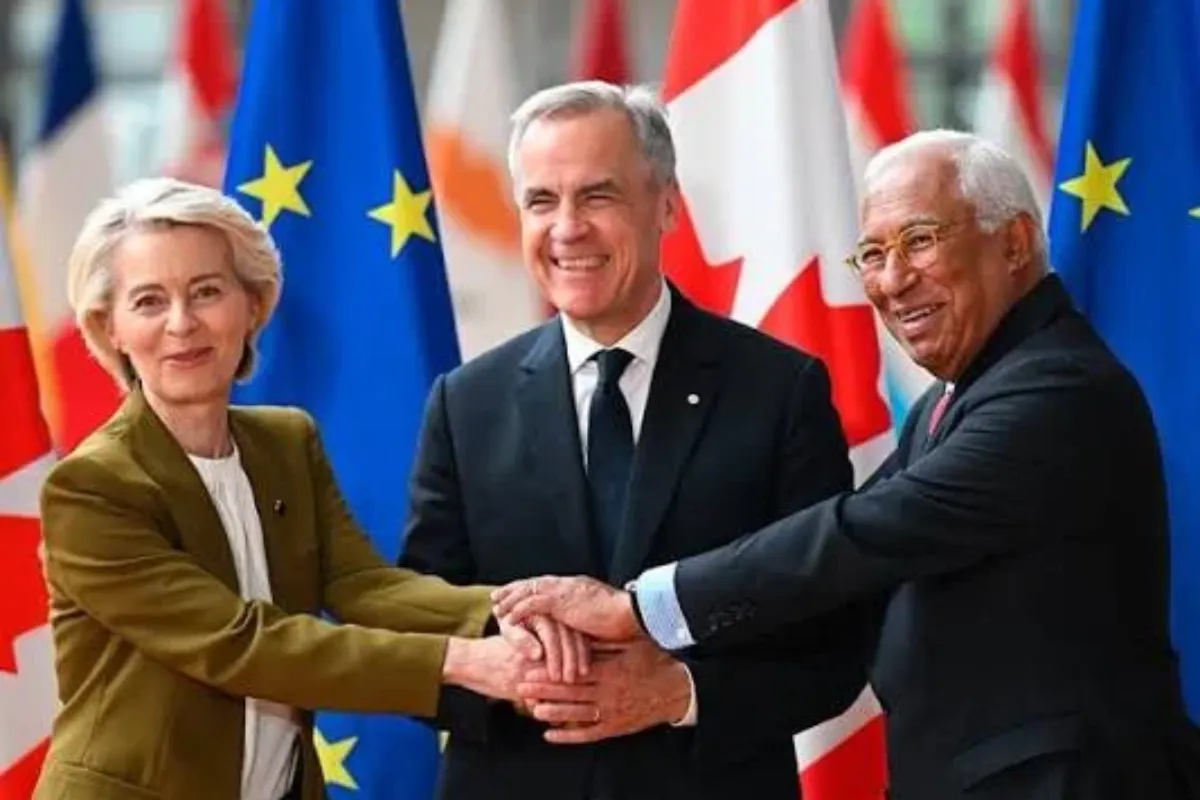
The EU-Canada partnership is set to enter a new phase as both sides seek closer economic, technological and defence cooperation amid changing global trade dynamics. Leaders from the European Union and Canada are expected to use their summit in Montréal, Quebec, to advance joint initiatives covering artificial intelligence, investment, critical minerals, climate policy and Arctic security.
The discussions come at a time when international trade relationships are facing growing pressure under US President Donald Trump’s administration. With economic uncertainty and geopolitical competition influencing global markets, Europe and Canada are exploring ways to diversify their partnerships and strengthen their long-term economic resilience.
Trade and Investment at the Centre of Discussions
Trade diversification is expected to be one of the main priorities of the summit. Both partners want to expand economic cooperation and create stronger commercial links that can help businesses access new markets.
European and Canadian officials are looking at opportunities to increase investment, improve supply-chain cooperation and support industries that are important to their economies.
Rather than presenting the initiative as an effort against the United States, European officials have described it as a strategy to diversify international relationships and protect rules-based trade.
For both sides, maintaining reliable access to international markets is increasingly important. Businesses depend on stable trade arrangements, predictable regulations and secure supply chains. Closer cooperation could help reduce exposure to economic disruptions and strengthen commercial opportunities across the Atlantic.
Artificial Intelligence and Technology Cooperation
Artificial intelligence is another major area of interest in the proposed EU-Canada partnership.
Both sides are exploring joint technology initiatives that could support innovation, research and the development of advanced digital industries. Cooperation in AI could create opportunities for universities, technology companies, research institutions and businesses working on emerging technologies.
The discussions also reflect a wider interest in developing technological capabilities while maintaining appropriate standards for security, privacy and responsible innovation.
Closer collaboration could allow Canada and European countries to share expertise, support research projects and improve access to technology-related investment.
As AI becomes increasingly important in manufacturing, healthcare, financial services and public administration, stronger international cooperation may help both economies remain competitive.
Critical Minerals and Supply Chain Security
Securing critical mineral supplies is another important priority.
Critical minerals are essential for several modern industries, including electric vehicle manufacturing, renewable energy, batteries, electronics and defence technology. Reliable access to these resources has become a strategic concern for major economies.
Canada has significant natural resources, while European countries have industries that require dependable supplies of minerals and processed materials.
Through closer cooperation, the two partners could explore opportunities to strengthen supply chains, encourage investment and reduce dependence on limited sources of essential materials.
The proposed EU-Canada partnership could therefore create benefits for businesses involved in mining, processing, manufacturing and clean-energy technologies.
However, building secure supply chains will require long-term investment, infrastructure development and cooperation between governments and private companies.
Defence Manufacturing and Arctic Security
Defence and security cooperation are also expected to feature prominently in the summit discussions.
Both sides are considering ways to connect their defence manufacturing capabilities and strengthen cooperation on security-related issues. Better coordination could support industrial capacity, improve procurement opportunities and encourage collaboration between defence companies.
The Arctic is another important area of shared interest. As the region becomes increasingly significant in international security and economic discussions, cooperation between Canada and European partners could help address emerging challenges.
The proposed initiatives include closer coordination on Arctic affairs and broader security matters. For Canada, which has extensive Arctic territory, and European countries with interests in the region, maintaining stability and protecting strategic interests are important considerations.
Could Canada Gain Closer Ties With EU Institutions?
One of the more unusual proposals under discussion is the possibility of an associate membership arrangement that would give Canada closer institutional ties with the European Union.
Such an arrangement could potentially allow Canada to participate more closely in selected EU programmes and cooperation structures without becoming a full EU member.
However, the idea has encountered internal debate and administrative challenges. The exact structure, responsibilities and practical benefits of any arrangement would need to be discussed before it could move forward.
The proposal highlights how far the relationship could develop beyond traditional trade and diplomatic cooperation.
Leaders Push for a Stronger Relationship
European Commission President Ursula von der Leyen and Canadian leaders are expected to use the Montréal summit to advance the relationship.
Speaking at the C.D. Howe Institute in Montréal, von der Leyen highlighted the opportunities available through closer cooperation, stating, “It has become clear that there’s much more that we can do together.”
Her remarks reflect the shared interest in building stronger economic and strategic connections at a time of changing international conditions.
What the Partnership Could Mean for Global Relations
The EU-Canada partnership reflects a broader effort by both sides to strengthen strategic autonomy and diversify their international relationships.
Closer cooperation in trade, AI, defence, critical minerals and Arctic security could create new opportunities for businesses while improving economic and security coordination.
The United States remains an important partner for both Canada and European countries. However, diversifying trade and investment relationships can provide additional options when global economic conditions become uncertain.
The Montréal summit is an important step in defining the future direction of this relationship. The real impact will depend on whether both sides can turn their proposals into practical agreements, investments and long-term joint projects.