
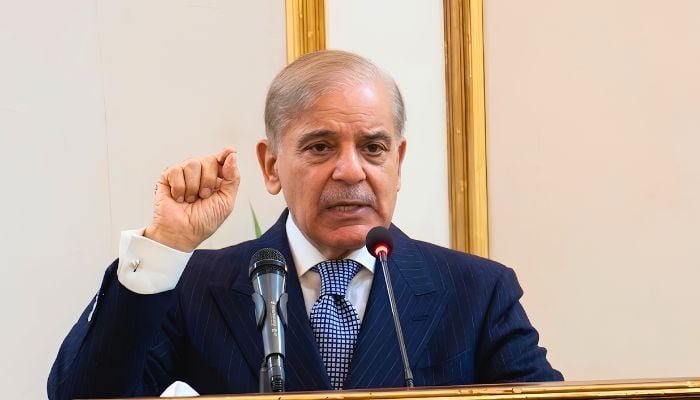
Prime Minister Shehbaz Sharif has called for prioritising immediate development initiatives in Khyber Pakhtunkhwa (KP), arguing that people need practical improvements in their daily lives rather than waiting years for major infrastructure projects. The Shehbaz Sharif KP development plan focuses on short-term measures such as improving law and order, building schools and ensuring hospitals have essential medicines.
Addressing a Pakistan Muslim League-Nawaz (PML-N) parliamentary party meeting in the province on Saturday, the prime minister said small but effective steps could provide meaningful relief to communities that, according to him, had experienced years of inadequate public services.
He also suggested suspending long-term projects to focus government resources on urgent public needs.
Focus on Immediate Public Relief
During his address, Shehbaz Sharif emphasised that improving everyday services should be a priority for the provincial administration.
He highlighted three important areas: security, education and healthcare. According to the prime minister, improvements in these sectors could directly affect people’s quality of life and help restore public confidence in government institutions.
He criticised the Pakistan Tehreek-e-Insaf (PTI), which has governed KP for more than a decade, questioning what the party had achieved during its time in power.
The prime minister argued that development claims should be measured through practical results, including functioning schools, accessible healthcare, medicine availability and better law enforcement.
The proposed Shehbaz Sharif KP development plan therefore places immediate service delivery ahead of projects that may take several years to complete.
Political Background and Governor’s Rule
The meeting took place amid significant political changes in Khyber Pakhtunkhwa. The federal government imposed governor’s rule in the province on October 11, effectively transferring provincial executive functions to Governor Faisal Karim Kundi.
The governor, who belongs to the Pakistan Peoples Party (PPP), is carrying out these functions on behalf of the federation with support from an 11-member advisory council. Under the arrangement described in the report, Parliament is exercising the legislative powers of the provincial assembly.
The federal government had cited concerns about the provincial administration’s counterterrorism performance when explaining its decision.
The move has significantly changed the province’s political and administrative structure, making public service delivery and governance key issues in the current situation.
Shehbaz Questions PTI’s Performance in KP
During the meeting, Shehbaz Sharif also criticised PTI’s record in the province, raising questions about healthcare facilities, corruption control and the use of public funds.
He referred to the 2013 general elections, recalling that former prime minister Nawaz Sharif had allowed the majority party in KP to form the provincial government.
The prime minister presented this as an example of the PML-N’s support for democratic traditions, while questioning the development outcomes achieved under successive PTI administrations.
He also asked whether public resources had been used transparently and whether the province had made sufficient progress in improving essential services.
These comments were part of the PML-N leadership’s criticism of PTI’s provincial governance. The broader political debate over the province’s development record remains closely linked to competing claims by the parties.
Security Remains a Major Concern
The prime minister also discussed the security situation in Khyber Pakhtunkhwa, acknowledging the sacrifices made by residents, police personnel, armed forces and political leaders during the fight against terrorism.
He said Pakistan had suffered significant human and economic losses because of militancy.
Shehbaz Sharif stated that terrorism had been eliminated from KP during 2017–18 through collective national efforts and cooperation among state institutions under Nawaz Sharif’s leadership.
He further alleged that militants were brought back from Afghanistan and resettled in Pakistan during 2019 and 2020, contributing to the resurgence of terrorism. These remarks reflected the government’s position on the factors behind the deterioration in security.
The prime minister said political stakeholders had been invited to work together against terrorism, arguing that a coordinated national approach was necessary to address the threat.
Government Defends Decision to Impose Governor’s Rule
Shehbaz Sharif also defended the federal government’s decision to impose governor’s rule, describing it as a necessary step to protect the province and the wider country.
According to the prime minister, the federal government had attempted to resolve its differences with PTI through negotiations before taking the decision.
He said committees representing the PML-N and PPP had held discussions with PTI representatives for approximately 48 hours. The prime minister claimed that a draft agreement had been discussed, but the required approval from the opposition did not arrive.
He argued that the government eventually considered intervention necessary to protect public safety, the economy and social stability.
These explanations represent the federal government’s justification for the move, which remains a major point of political debate.
What the Development Strategy Could Mean for KP
The Shehbaz Sharif KP development plan places immediate improvements in security, education and healthcare at the centre of the government’s stated priorities.
For residents, the practical value of this approach will depend on whether hospitals receive medicines, schools improve their facilities and security measures produce safer communities.
Short-term initiatives can address urgent problems, but sustained development also requires long-term investment, transparent spending and effective institutions.
As the province navigates political uncertainty and security challenges, the implementation of the government’s proposed priorities will be closely watched. Ultimately, improvements in public services and people’s daily lives will be important measures of whether the promised relief reaches communities across Khyber Pakhtunkhwa.


