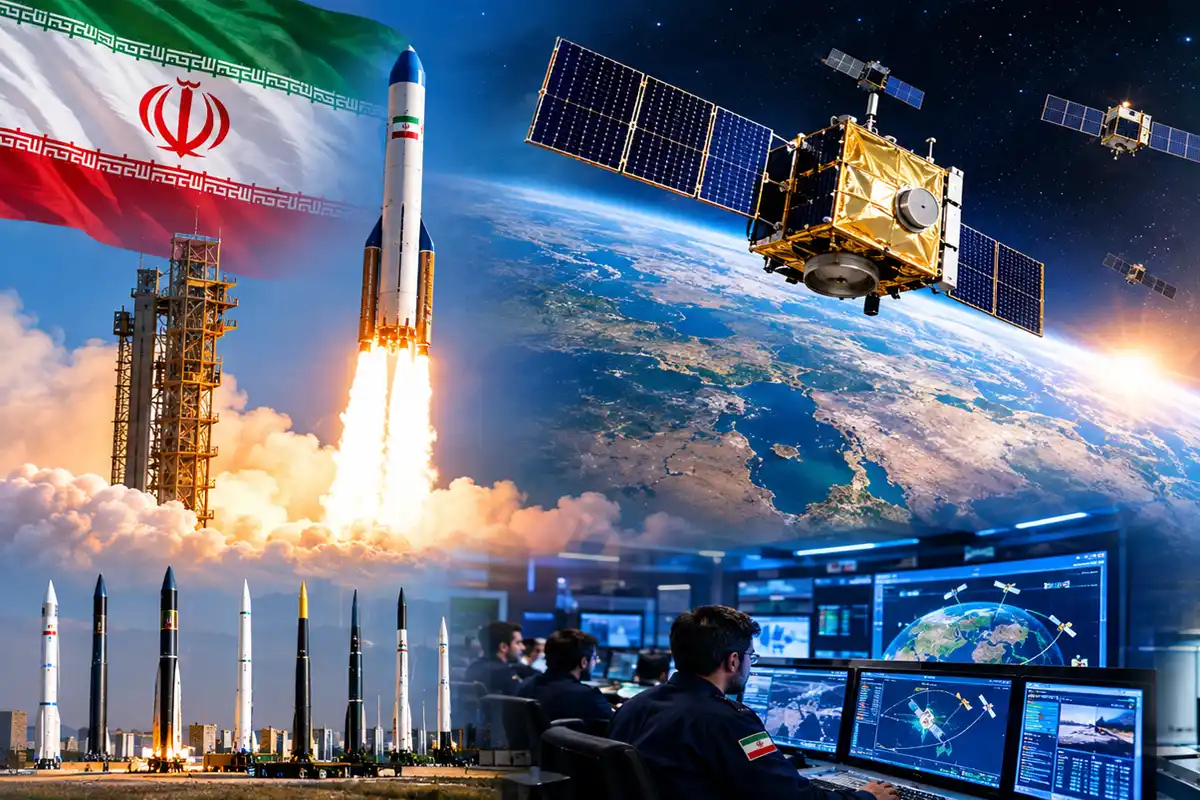
Iran’s space program has continued to develop despite decades of international sanctions, with the country building domestic launch vehicles, deploying research satellites and planning a larger communications network. From the historic Omid mission in 2009 to more recent launches using locally developed rockets, Iran has expanded its experience in satellite technology while facing continuing questions about the military applications of its space capabilities.
Omid Satellite Marked a Historic Beginning
Iran reached a major milestone on February 2, 2009, when it launched the Omid satellite aboard its domestically developed Safir rocket. The mission established Iran’s ability to place a locally built satellite into orbit using an Iranian launch vehicle.
Omid was an experimental satellite designed for research and telecommunications-related work. Although its capabilities were limited compared with modern spacecraft, the mission provided valuable experience in satellite development, launch operations and communications. It also marked an important step towards reducing Iran’s dependence on foreign launch services.
Noor Satellites Expand Military Space Activities
Iran’s Islamic Revolutionary Guard Corps (IRGC) has also developed a military-linked space programme. The Noor-1 satellite was launched in April 2020, followed by Noor-3 in September 2023.
Earth-observation satellites can provide information about geographical features, infrastructure, agricultural land and environmental changes. Their practical value depends on factors such as imaging resolution, orbital position, onboard equipment and the ability to transmit and process collected data.
The military association of these missions has attracted international attention. However, the launch of a satellite alone does not establish the full extent of its operational capabilities.
Cooperation With Russia
Iran has also relied on international partnerships to expand its satellite programme. In August 2022, Russia launched Iran’s Khayyam Earth-observation satellite aboard a Soyuz rocket.
The mission demonstrated that Iran continues to combine domestic technological development with foreign launch services. Russian assistance has provided access to launch capabilities that can be difficult to reproduce independently, particularly for missions requiring specific orbital conditions.
Such cooperation illustrates how international partnerships remain relevant even as Iran seeks greater technological self-reliance.
Qaem-100 Rocket and Chamran-1 Mission
Another important milestone came on September 14, 2024, when Iran launched the Chamran-1 research satellite using the solid-fuel Qaem-100 rocket developed by the IRGC’s Aerospace Force.
According to Reuters, the satellite weighed approximately 60 kilograms and entered an orbit around 550 kilometres above Earth. Iranian state media said its initial signals had been received after deployment.
The mission was designed to test hardware and software associated with orbital manoeuvring, cold-gas propulsion, navigation and attitude control. These technologies are important because launching a satellite is only one part of operating it successfully in space.
Why Orbital Manoeuvring Matters
A satellite must maintain the appropriate position and orientation to perform its intended tasks. Orbital manoeuvring can allow spacecraft to adjust their trajectories, while attitude-control systems help point instruments and communications equipment in the correct direction.
Developing these capabilities could support more advanced satellite operations in the future. However, the successful completion of an individual experiment does not necessarily demonstrate that a country has a fully operational satellite-servicing or inspection system.
For Iran, improving the reliability and precision of these technologies will be important as it moves towards more complex missions.
Iran Plans a 24-Satellite Network
One of the country’s major future projects is the Shahid Soleimani satellite constellation, a planned communications network comprising 24 satellites.
Iranian Communications and Information Technology Minister Sattar Hashemi said in August 2026 that the network would include 18 operational satellites and six reserve satellites. He also outlined plans to launch the first three spacecraft together before the end of the Iranian year in March 2027.
The proposed network is intended to support narrowband communications and the transmission of small data messages from connected devices.
If successfully deployed, such a system could help collect information from remote locations where conventional mobile networks are limited or unavailable. However, the project’s planned scale should not be confused with an already completed operational network.
Potential Civilian Applications
Satellite communications and Earth-observation systems can serve a range of civilian purposes. Potential applications include monitoring crops, tracking water resources, observing environmental changes and supporting emergency communications during natural disasters.
Remote monitoring can also help organisations collect information from infrastructure such as pipelines and facilities in isolated areas.
The practical benefits of Iran’s planned satellite network will depend on successful deployment, reliable ground infrastructure, service coverage and the ability to deliver useful data to customers.
Why Western Countries Remain Concerned
The development of Iran’s space launch vehicles has raised security concerns in the United States and other Western countries because some rocket technologies overlap with those used in ballistic missiles.
Both types of systems can involve propulsion, guidance and multistage rocket engineering. However, space launch vehicles and military missiles have different operational requirements, and a successful satellite launch does not by itself prove a specific long-range missile capability.
Iran maintains that its space activities support scientific research, communications and national development, while Western governments remain concerned about possible military applications.
The Next Challenge
Iran’s space program has progressed from an early experimental satellite to more complex research missions and plans for a communications constellation. Yet continued progress will depend on reliable launches, improved spacecraft, effective ground stations and sustainable funding.
The proposed Shahid Soleimani network could represent a significant next step if the planned satellites reach orbit and provide dependable services. Ultimately, Iran’s ability to turn individual launch achievements into a reliable, operational space infrastructure will determine the programme’s long-term value.