
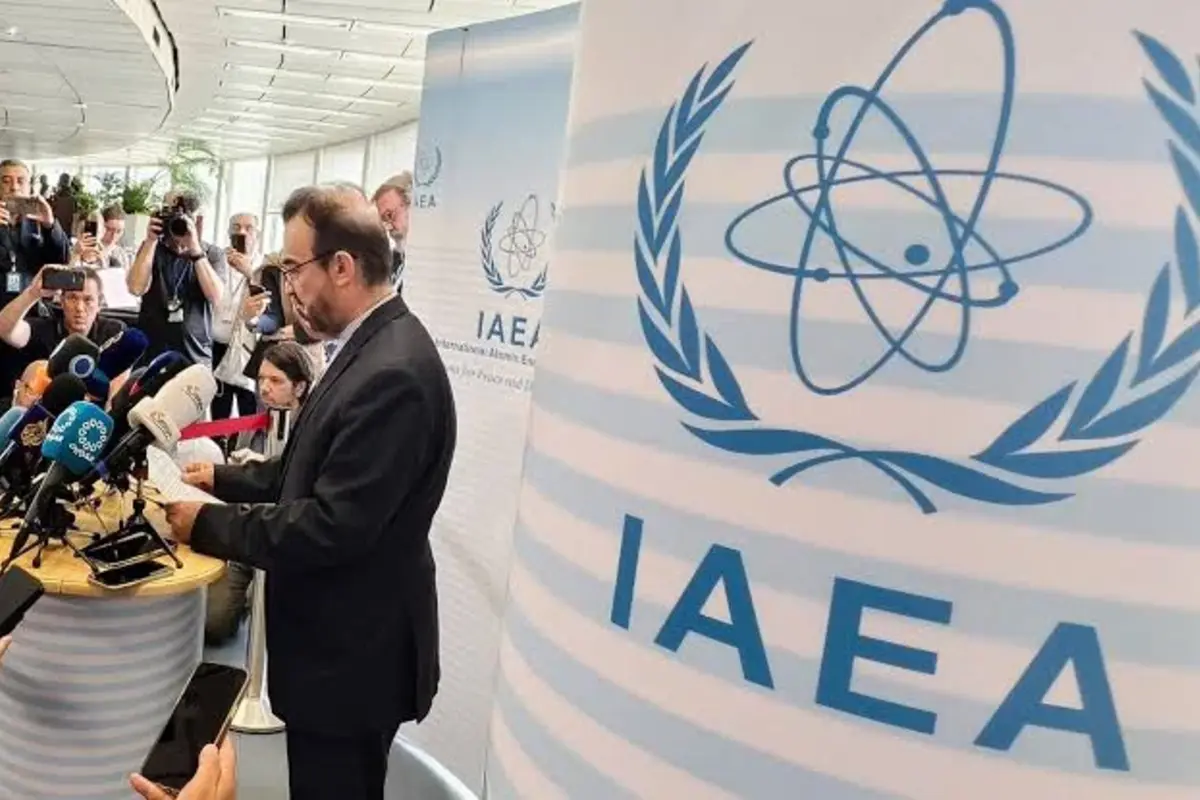
Iran has rejected unrestricted Iran IAEA inspections amid continuing military threats and growing tensions with the United States and Israel. Tehran has accused the International Atomic Energy Agency (IAEA) of failing to condemn attacks on its safeguarded nuclear facilities while continuing to demand expanded access to the country’s nuclear infrastructure.
The position was presented by Iran’s Ambassador to International Organizations in Vienna, Reza Najafi, during an address to the IAEA Board of Governors on Thursday. He argued that the agency’s demands for inspections must be considered alongside the security situation created by the June 2025 US-Israeli strikes on Iranian nuclear sites.
The remarks highlight the continuing disagreement between Tehran and the international nuclear watchdog over monitoring activities, inspection access and responsibility for the disruption of safeguards.
Iran Questions IAEA’s Monitoring Report
Najafi was responding to a report by IAEA Director General Rafael Grossi, which stated that the agency had lost continuity of knowledge over Iran’s previously declared stocks of low- and highly enriched uranium.
According to the report, monitoring continuity had been disrupted because inspections at the affected nuclear facilities remained suspended for nearly 18 months.
The agency’s concern centres on its ability to maintain an accurate and continuous understanding of Iran’s nuclear material inventories. Such monitoring is an important part of the international safeguards system, which is designed to verify that declared nuclear materials are being used for peaceful purposes.
However, Iran argues that the interruption cannot be examined separately from the military attacks that damaged its nuclear infrastructure.
Najafi maintained that the agency should take the circumstances surrounding the strikes into account before assigning responsibility to Tehran for the monitoring difficulties.
Tehran Blames US-Israeli Strikes for Inspection Disruptions
During his address, Najafi said the loss of monitoring continuity must be assessed in the context of the June 2025 attacks on Iranian nuclear facilities.
He argued that holding Iran responsible for the disruption of inspection activities amounted to reversing cause and effect.
According to the Iranian ambassador, the country was being blamed for the consequences of attacks carried out against its safeguarded facilities.
His remarks reflected Tehran’s broader objection to inspection demands that it considers disconnected from the security risks facing its nuclear infrastructure.
Iran has maintained that the physical safety of nuclear sites and personnel must be considered when determining the scope and conditions of international inspections.
From Tehran’s perspective, requiring access without addressing the consequences of military action creates an unfair situation in which the country is expected to fulfil monitoring obligations despite unresolved security concerns.
Iran Criticises IAEA Board of Governors
Najafi also criticised resolutions adopted by the IAEA Board of Governors, arguing that they failed to condemn the attacks on Iran’s nuclear facilities while continuing to demand greater inspection access.
He particularly objected to what he described as the board’s failure to adequately consider the security implications of the strikes.
The ambassador characterised the September 2026 resolution as an unlawful abuse of the board’s authority.
He argued that issues formally closed in 2015 should not be reopened for political purposes. In his view, decisions concerning Iran’s nuclear programme should be handled according to established legal and technical procedures rather than political pressure.
The criticism reflects Iran’s concern that the IAEA’s technical responsibilities are becoming increasingly connected to wider geopolitical disputes.
Tehran has called on the organisation to maintain its independence and avoid decisions that it believes could undermine confidence in its impartiality.
Dispute Over Nuclear Inspection Access
The disagreement between Iran and the IAEA centres on the balance between international monitoring requirements and national security concerns.
The agency seeks access and reliable information to maintain oversight of nuclear materials previously declared by Iran. Without regular inspections and monitoring, it becomes more difficult for the watchdog to maintain continuity of knowledge about the country’s nuclear stockpiles.
Iran, meanwhile, argues that inspection arrangements cannot ignore the damage caused by military attacks or the risks associated with allowing access to affected facilities.
This creates a difficult situation for both sides. The IAEA needs sufficient information to carry out its safeguards responsibilities, while Tehran insists that its security concerns must be addressed before unrestricted access can be expected.
The dispute also raises questions about how international monitoring can continue when nuclear facilities are affected by military conflict.
Iran Calls for Independence and Impartiality
Concluding his remarks, Najafi urged the IAEA to uphold the principles of independence, impartiality and non-discriminatory conduct.
He warned against turning technical safeguards into instruments of geopolitical pressure and called for the agency to apply its responsibilities consistently.
For Iran, the credibility of the international nuclear monitoring system depends on whether the agency can separate its technical work from political disagreements among member states.
The IAEA, on the other hand, faces the challenge of maintaining oversight despite the suspension of inspections at affected facilities and the loss of monitoring continuity described in Grossi’s report.
The dispute over Iran IAEA inspections is likely to remain a major issue in discussions between Tehran and the international nuclear watchdog.
Restoring monitoring continuity will require addressing the practical difficulties surrounding access to affected sites, the condition of nuclear facilities and the verification of previously declared materials.
However, progress may remain difficult while Iran and the IAEA continue to disagree over responsibility for the inspection disruptions and the conditions under which monitoring should resume.
The latest exchange demonstrates that Iran’s nuclear file is not only a technical matter but also part of a wider regional and international security dispute. Whether both sides can find an acceptable inspection arrangement will be important for future diplomatic efforts and international oversight of Iran’s nuclear programme.