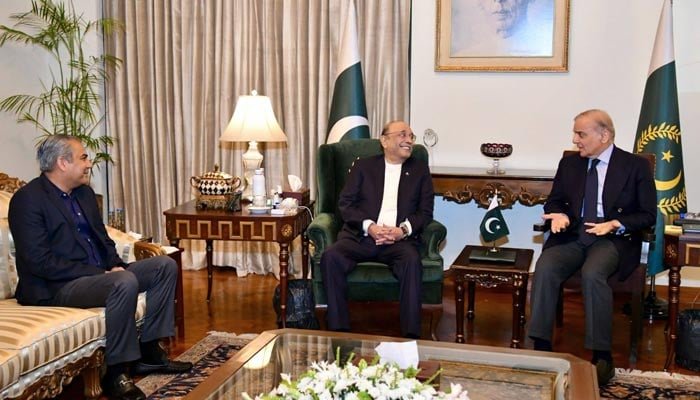
President Asif Ali Zardari and Prime Minister Shehbaz Sharif have agreed to address political disagreements through dialogue and mutual consultation as tensions continue to rise over the New Provinces Debate in Pakistan. The two leaders reached the understanding during a meeting at Aiwan-e-Sadr in Islamabad on Thursday, stressing the importance of consensus on major national decisions.
According to a statement shared by the presidency on X, the meeting covered the overall national situation, the country’s political landscape and recent developments in the Middle East. The statement said both leaders supported resolving outstanding matters through consultation rather than confrontation.
“We will sit down together on all issues and resolve them through consultation,” the presidency said.
It also noted that previous constitutional amendments had been passed through discussions and mutual understanding among coalition partners, suggesting that the same approach should guide future political and legislative decisions.
Talal Chaudhry Emphasises Consultation
Minister of State for Interior Talal Chaudhry also defended the government’s approach, saying President Zardari and Prime Minister Shehbaz wanted to move forward through dialogue.
Speaking on Geo News programme Aaj Shahzeb Khanzada Kay Saath, Talal described PPP Chairman Bilawal Bhutto-Zardari as young and emotional. He said the government had responded to Bilawal’s criticism but had avoided making remarks similar to those made by the PPP leader.
“We have responded, because we also have to answer to our people,” the minister said.
Talal questioned Bilawal’s calls for tolerance, asking why he did not show similar patience towards the positions expressed by the interior minister and other federal ministers.
He maintained that important government decisions, including appointments and legislation, were made after consultation with coalition partners. According to him, proposed legislation is first discussed with allies in relevant committees before being presented in parliament.
The minister said matters affecting the public would be resolved through democratic procedures. He also stressed that smaller political parties should not be excluded from the process, even when larger parties play a leading role in national politics.
“Such big decisions should not be taken without consensus, and they will not be,” he said.
Government Defends Proposal for Administrative Units
Addressing concerns surrounding the creation of smaller provinces, Talal said discussions about administrative units were aimed at improving governance rather than serving the interests of any particular political party or province.
He argued that the debate was about Pakistan’s administrative needs and should not be interpreted as an attempt to target Sindh or any other region.
The minister further claimed that the government had not taken any step outside the Constitution since the Pakistan Democratic Movement (PDM) administration came to power. He said decisions had consistently been made after extensive discussions with coalition partners, particularly the PPP.
His remarks came amid growing disagreement between federal ministers and Bilawal over proposals to create additional provinces.
Bilawal Warns Against Forcible Division of Sindh
The controversy intensified after Bilawal criticised federal ministers for their statements supporting smaller provinces. He accused them of being unwilling to tolerate criticism and questioned whether ordinary citizens could expect their concerns to be heard if political leaders themselves were unable to listen to opposing views.
Earlier, the PPP chairman had warned that any attempt to divide Sindh by force could lead to serious consequences.
He said that if such a move were imposed, questions would arise about the bloodshed that could occur on the streets of Karachi and Hyderabad. Bilawal described his remarks as a warning about potential unrest rather than a threat.
The PPP leader also argued that the discussion had started without proper consultation with political stakeholders, including ministers, the prime minister and representatives of affected provinces.
He urged federal leaders to discuss the proposal openly and give all relevant political parties an opportunity to express their positions.
Federal Ministers Support Smaller Provinces
Several federal ministers have defended the idea of creating smaller administrative units, arguing that they could improve governance and make public services more accessible.
Defence Minister Khawaja Asif has said that no political or administrative change can be implemented without public support. Meanwhile, Health Minister Mustafa Kamal has described smaller provinces as inevitable for improving the country’s administrative structure.
Other government representatives have also questioned the PPP’s opposition, pointing to the party’s position on the possible division of Punjab.
The disagreement has highlighted differences within the broader political alliance over how administrative reforms should be approached.
Bilawal Maintains Support for Shehbaz Government
Despite his criticism of federal ministers, Bilawal has said that he continues to support the coalition government and wants Prime Minister Shehbaz to succeed.
He also defended the 27th Constitutional Amendment, describing the establishment of a constitutional court as a historic achievement. He clarified that he was not seeking to reverse the amendment or abolish constitutional courts.
Bilawal further said the PPP’s political future did not depend entirely on holding positions such as governor or Senate chairman. He maintained that the government should focus on addressing economic difficulties, which remain a major concern for ordinary citizens.
The New Provinces Debate has therefore become more than a discussion about administrative boundaries. It has exposed differences over constitutional procedures, coalition consultation and provincial rights.
The agreement between Zardari and Shehbaz to resolve disagreements through dialogue may help ease tensions. However, reaching a consensus will require meaningful engagement with political parties and stakeholders, particularly those concerned about changes to their provinces.