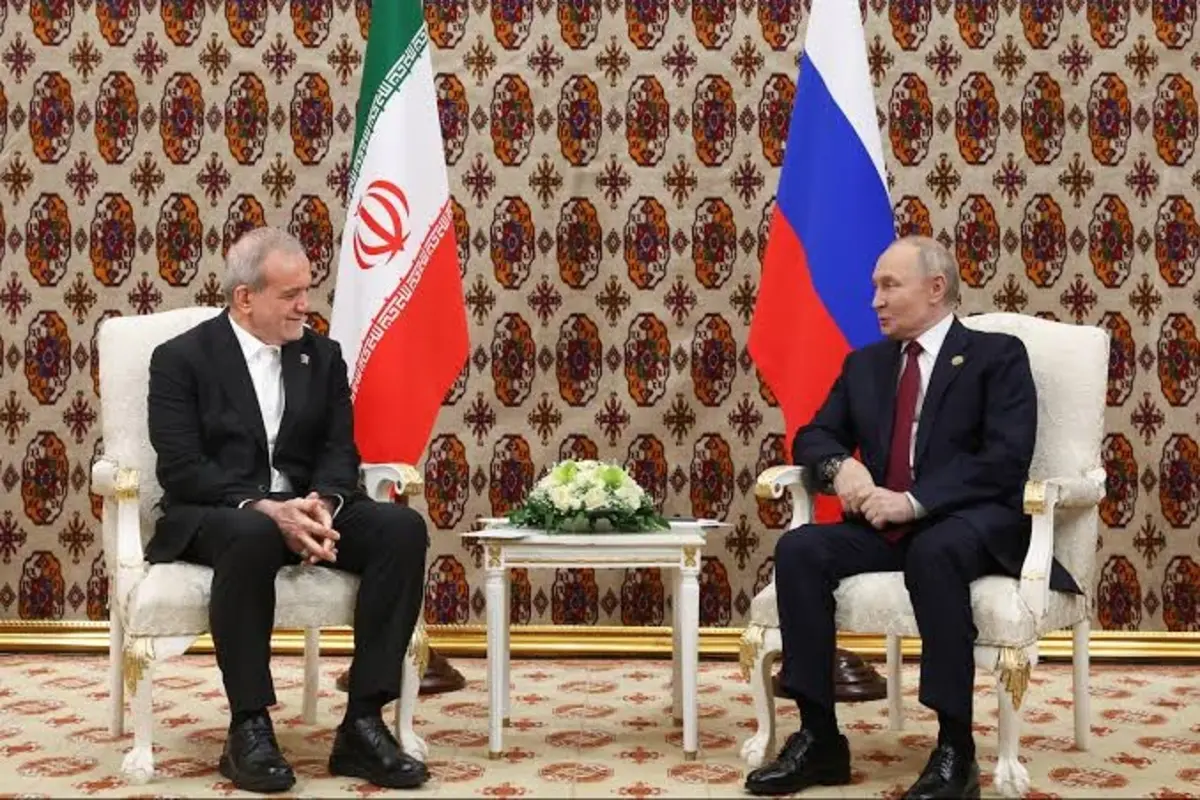
Iran Russia relations are taking on greater strategic importance as Iranian President Masoud Pezeshkian and Russian President Vladimir Putin discussed expanding bilateral cooperation and responding to what Tehran describes as growing US unilateralism. The two leaders met on the sidelines of the Shanghai Cooperation Organization (SCO) summit in Bishkek, Kyrgyzstan.
During the meeting, Pezeshkian thanked Moscow for its support and argued that the United States has no legal or international authority to impose unilateral sanctions on Iran. He also stressed the importance of cooperation between Tehran and Moscow in addressing regional and international challenges.
Pezeshkian Criticizes US Sanctions
Pezeshkian said powerful countries should not use their military and political influence to pursue their interests while ignoring international law and established international frameworks.
The Iranian president has repeatedly criticized unilateral sanctions, arguing that such measures place pressure on countries without sufficient international legal justification. During his meeting with Putin, he again emphasized Tehran’s opposition to what he considers unilateral actions by Washington.
Pezeshkian’s remarks underline Iran’s broader effort to strengthen relationships with countries that oppose or challenge US economic and political pressure.
For Tehran, closer Iran Russia relations provide an important avenue for maintaining economic and diplomatic connections while the country faces continued international pressure.
Moscow Reaffirms Support for Tehran
Putin expressed solidarity with the Iranian people amid the ongoing conflict involving the United States and Israel. He also indicated that Russia would continue its economic and trade relations with Iran despite the difficult political and security environment.
The Russian president described bilateral relations as developing at a steady pace under the existing cooperation agreement between the two countries.
Moscow’s willingness to maintain trade ties is particularly important for Iran, which has faced extensive sanctions affecting its access to international markets, financial systems and investment.
Russia, meanwhile, has its own experience of Western sanctions and economic restrictions. This shared experience has contributed to greater cooperation between the two countries in several areas.
A Strategic Partnership
Iran and Russia have increasingly described their relationship as strategic rather than simply a conventional bilateral partnership.
Pezeshkian emphasized that cooperation between the two countries extends beyond traditional diplomatic and economic relations. Both governments have an interest in coordinating their positions on regional security, international affairs and economic matters.
The latest meeting provided an opportunity for the leaders to review developments in bilateral relations and discuss ways to expand cooperation across different sectors.
The continued development of Iran Russia relations also reflects broader changes in the international balance of power. Tehran and Moscow have sought closer ties with one another while promoting a world order in which no single country dominates international decision-making.
Economic Cooperation Remains Important
Economic and trade cooperation remains one of the most important areas of the partnership.
Despite sanctions and political pressure, Russia has indicated that it intends to maintain commercial relations with Iran. Increased cooperation could potentially cover energy, transportation, investment, trade and other sectors.
For Iran, stronger economic relationships with neighboring and major regional powers can help reduce the impact of restrictions imposed by Western countries.
Russia can also benefit from expanded access to Iranian markets and transportation routes connecting Central Asia, the Caucasus and the Middle East.
As both countries face external economic pressure, their shared interest in developing alternative trade channels could provide an additional incentive for deeper cooperation.
Regional and International Challenges
The two leaders also discussed regional and international developments. The meeting took place against the backdrop of heightened tensions involving Iran, the United States and Israel.
Tehran has sought diplomatic support from partners while emphasizing the importance of international law and national sovereignty. Moscow, meanwhile, has continued to position itself as a supporter of Iran while maintaining its own diplomatic and economic interests.
The strengthening of Iran Russia relations could therefore have consequences beyond the two countries. Closer coordination between Tehran and Moscow may influence discussions surrounding regional security, energy markets and international diplomacy.
However, the extent of future cooperation will depend on economic conditions, regional developments and the ability of both governments to translate political commitments into practical agreements.
The meeting between Pezeshkian and Putin demonstrates that both countries remain committed to developing their relationship despite significant international pressure.
For Iran, Russian support offers an important diplomatic and economic partnership. For Moscow, closer ties with Tehran can strengthen its influence in a strategically important region while expanding economic opportunities.
The latest discussions suggest that Iran Russia relations are likely to remain an important part of both countries’ foreign-policy strategies.
As Tehran continues to challenge US sanctions and Moscow maintains its economic engagement with Iran, cooperation between the two sides could expand further. Whether that produces major new agreements will depend on developments in regional security, trade and international diplomacy.
The message from Bishkek is clear: Iran and Russia intend to maintain their strategic partnership and continue exploring ways to cooperate despite pressure from Washington and wider geopolitical tensions.