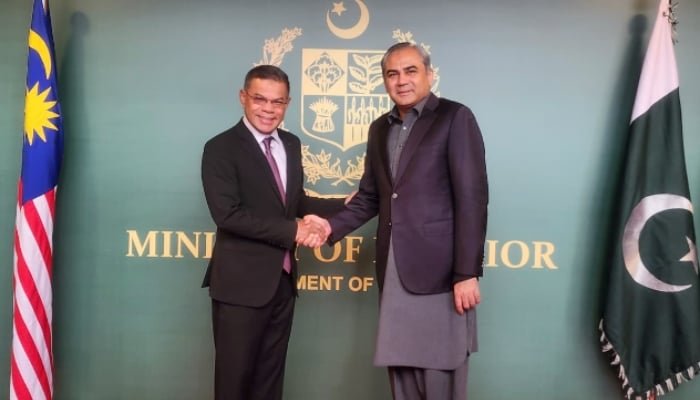
Pakistan and Malaysia have agreed to strengthen security cooperation by improving intelligence-sharing mechanisms to combat terrorism, drug trafficking, human smuggling and other emerging security threats. The agreement was reached during a meeting between Pakistan’s Interior Minister Mohsin Naqvi and Malaysian Home Minister Saifuddin Nasution bin Ismail in Islamabad, highlighting the growing importance of coordinated efforts between the two countries.
Focus on Counterterrorism and Intelligence Sharing
The meeting focused heavily on security cooperation and ways to improve coordination between Pakistani and Malaysian law enforcement agencies. Both ministers reviewed bilateral relations and discussed challenges involving terrorism, narcotics trafficking, illegal immigration and cybercrime.
The two sides agreed that stronger intelligence-sharing could help authorities identify and disrupt criminal and militant networks before they pose a greater threat. Cooperation in this area is particularly important because modern criminal networks often operate across national borders, making unilateral action more difficult.
Pakistan and Malaysia also discussed strengthening joint efforts against drug trafficking and human smuggling. Authorities believe improved communication between security agencies can help track individuals and networks involved in cross-border criminal activities.
Cooperation Between Law Enforcement Institutions
Another important part of the discussions involved professional training and institutional cooperation. Pakistan and Malaysia agreed to enhance collaboration between Pakistan’s National Police Academy and the Royal Malaysian Police College.
The proposed cooperation could include expanded training programmes, professional exchanges and the sharing of law enforcement expertise. Such initiatives can help officers learn from each other’s experiences and develop more effective approaches to tackling evolving security challenges.
The two countries also discussed cooperation in the coast guard sector. A joint working group is expected to support coordination in coast guard operations and related security matters.
This area of security cooperation could become increasingly important because maritime routes are frequently used for illegal migration, smuggling and other criminal activities. Better coordination can help authorities improve monitoring and strengthen responses to threats at sea.
Tackling Cybercrime
Cybercrime was another issue discussed during the talks. As governments, businesses and citizens become increasingly dependent on digital technology, criminal networks are also using online platforms to facilitate illegal activities.
Pakistan and Malaysia therefore have an opportunity to expand information exchange related to cyber threats, digital investigations and online criminal networks. Sharing expertise and investigative techniques could improve the ability of both countries to respond to cybercrime.
The inclusion of cybercrime in the discussions shows that bilateral security cooperation is no longer limited to traditional threats. Modern security challenges increasingly involve technology, financial networks and international communication systems.
Tourism and Visa Facilitation
The meeting was not limited to security matters. Pakistan and Malaysia also discussed tourism, travel and visa facilitation.
Mohsin Naqvi noted that Malaysia remains a preferred destination for many Pakistani travellers. He expressed hope that increased employment quotas would provide more opportunities for Pakistanis to work in Malaysia through legal channels.
Improving visa procedures could also encourage greater tourism, business travel and people-to-people contact. Easier legal travel can contribute to stronger economic and social relations while also helping authorities distinguish legitimate travellers from those involved in illegal migration networks.
For Pakistan, expanding legal employment opportunities abroad could also help reduce the appeal of informal migration channels and protect workers from exploitation.
Strengthening Bilateral Relations
The Malaysian minister’s visit comes as both countries seek to broaden their longstanding relationship. While economic and people-to-people ties remain important, the latest discussions demonstrate that security cooperation is becoming another significant pillar of bilateral relations.
Mohsin Naqvi expressed confidence that the visit would create new opportunities for collaboration. He also praised Malaysia’s economic and social development and described the country as an important partner for Pakistan.
The two governments appear particularly interested in practical cooperation rather than limiting their relationship to diplomatic discussions. Intelligence-sharing, police training, coast guard coordination and joint working mechanisms could provide concrete channels for continued engagement.
A Broader Partnership
The agreement between Pakistan and Malaysia reflects the increasingly international nature of security threats. Terrorism, narcotics trafficking, human smuggling and cybercrime frequently cross borders, requiring governments to exchange information and coordinate their responses.
The new measures could therefore give Pakistan Malaysia security cooperation a more practical and operational dimension. Regular communication between law enforcement agencies may help both countries respond more effectively to shared challenges.
At the same time, cooperation in tourism, employment and visa facilitation can strengthen the people-to-people dimension of the relationship.
The latest discussions signal a broader partnership between Islamabad and Kuala Lumpur. By improving intelligence-sharing, expanding institutional training and establishing cooperation in areas such as coast guard operations and cybercrime, Pakistan and Malaysia are seeking to build a stronger framework for addressing common security concerns while deepening their wider bilateral ties.