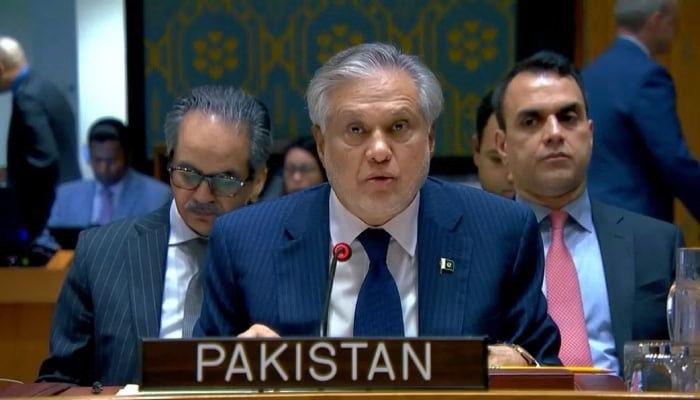
Pakistan’s Deputy Prime Minister and Foreign Minister Ishaq Dar has issued a serious warning about the dangers of prolonged instability in the region, saying the ongoing Middle East conflict risks could threaten global peace, international trade, and the wider world order. Speaking at the United Nations Security Council (UNSC), Dar emphasized the importance of diplomacy, peaceful dialogue, and respect for international law in resolving major disputes.
His remarks come at a time when tensions across the Middle East continue to rise, creating concerns about energy security, maritime trade routes, and geopolitical stability. Pakistan has increasingly positioned itself as a supporter of diplomatic engagement and regional peace efforts, particularly in relation to conflicts involving the Gulf region.
The growing Middle East conflict risks have already affected global markets, oil prices, and political relations between major world powers, making international cooperation more important than ever.
Pakistan Calls for Diplomacy Over Conflict
During his address to the UNSC, Ishaq Dar stressed that diplomacy should never be viewed as a sign of weakness. According to him, negotiations and dialogue remain the first and most responsible path toward lasting peace.
Dar stated that Pakistan, alongside China and several international partners, is actively supporting efforts aimed at reducing tensions in the Gulf and broader Middle East region. He warned that continued military confrontation could destabilize global energy supplies and weaken the international system.
The discussion around Middle East conflict risks has become increasingly urgent because the region plays a critical role in international trade and energy transportation. Any disruption to shipping routes or oil exports can quickly impact economies worldwide.
Pakistan’s foreign minister highlighted Islamabad’s efforts to help maintain peace and ensure that important maritime routes remain open and secure for international commerce.
Concerns Over Regional Stability
One of the key concerns raised by Dar was the possibility that prolonged conflict could spread instability beyond the Middle East. Political analysts believe ongoing tensions between regional and global powers could trigger wider economic and security challenges if not addressed carefully.
The latest Middle East conflict risks are particularly worrying because many countries remain economically dependent on oil and gas supplies from the Gulf region. Increased instability could lead to rising fuel prices, inflation, and pressure on already fragile economies.
Experts warn that regional wars rarely remain limited to one area. Political alliances, military cooperation, and global economic interdependence often cause conflicts to affect multiple regions at once.
This is why international organizations such as the United Nations continue to encourage diplomacy and peaceful conflict resolution mechanisms.
Pakistan Highlights Kashmir and Palestine Issues
In addition to discussing the Middle East situation, Ishaq Dar also raised long-standing international disputes involving Kashmir and Palestine. He argued that unresolved political conflicts continue to threaten regional peace and global stability.
Dar reminded the UNSC that the Kashmir dispute has remained unresolved for decades despite multiple United Nations resolutions. He warned that unilateral actions and coercive policies cannot create durable peace in South Asia.
He also expressed concern about India’s position regarding the Indus Waters Treaty, saying that any attempt to undermine the agreement could further increase regional tensions.
The broader discussion of Middle East conflict risks was also linked to the Palestinian issue. Dar said that Israeli occupation, illegal settlements, and collective punishment make sustainable peace in Palestine impossible.
Pakistan reaffirmed its support for the Palestinian people’s right to self-determination and called for a just and peaceful solution based on international law.
Criticism of Global Double Standards
A major part of Dar’s speech focused on what he described as selective application of international principles by powerful countries. According to him, trust in the global system weakens when laws are applied differently depending on political interests.
He argued that defending sovereignty in one conflict while ignoring it in another damages the credibility of international institutions. Dar warned that inconsistent policies contribute to growing global instability and deepen political divisions.
The ongoing Middle East conflict risks have intensified debates about fairness, international law, and the effectiveness of multilateral institutions such as the United Nations.
Many developing countries have increasingly called for reforms within global organizations to ensure better representation and more balanced decision-making processes.
Importance of UN Reforms
Ishaq Dar also used his speech to support reforms within the United Nations system. He stressed that changes should strengthen the voice of developing nations instead of concentrating power among a few states.
According to him, the UN remains an essential institution for maintaining global peace, but it requires renewed commitment from member states to uphold the principles of its Charter.
The conversation surrounding Middle East conflict risks has once again highlighted the importance of international cooperation and collective responsibility in preventing future crises.
Analysts believe that without stronger diplomatic engagement and fairer global governance structures, regional conflicts may continue to escalate and create broader international consequences.
Global Community Watches Closely
As tensions remain high across multiple regions, governments and international organizations continue monitoring developments carefully. Political uncertainty, economic concerns, and military confrontations are all contributing to a fragile global environment.
Pakistan’s message at the UNSC reflects growing international concern that unresolved disputes and prolonged wars could have consequences far beyond the Middle East itself.
The latest warning regarding Middle East conflict risks serves as a reminder that diplomacy, dialogue, and international cooperation remain essential for preserving peace and stability in an increasingly interconnected world.