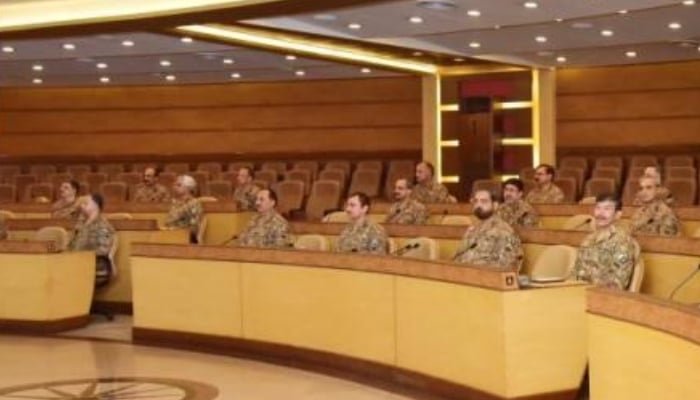
Pakistan Water Security emerged as a key national priority during the 276th Corps Commanders’ Conference held at General Headquarters (GHQ) in Rawalpindi. Chaired by Chief of Army Staff and Chief of Defence Forces Field Marshal Asim Munir, the meeting reaffirmed the country’s commitment to safeguarding its rightful share of water under the Indus Waters Treaty (IWT). The military leadership also reviewed the country’s security situation, regional developments, and measures to counter evolving threats while emphasizing Pakistan’s determination to protect its sovereignty and national interests.
The conference comes at a time of growing regional tensions following India’s decision to place the Indus Waters Treaty in abeyance after the April 2025 attack in Indian Illegally Occupied Jammu and Kashmir (IIOJK). Pakistan has consistently rejected allegations linking it to the incident and has maintained its commitment to international agreements.
Strong Commitment to Water Rights
One of the most significant outcomes of the conference was the military’s renewed focus on Pakistan Water Security. According to the Inter-Services Public Relations (ISPR), the forum reaffirmed its commitment to ensuring the availability of Pakistan’s rightful share of water in accordance with government directives and the aspirations of the Pakistani people.
The participants endorsed the National Security Committee’s directives issued on April 24, 2025, emphasizing that every necessary measure would be taken to protect Pakistan’s water rights under the Indus Waters Treaty.
Water security remains one of the country’s most critical strategic issues due to its direct impact on agriculture, energy production, and economic stability.
Reviewing National Security
Alongside discussions on water resources, the conference reviewed Pakistan’s overall security environment.
The military leadership expressed satisfaction with the operational preparedness, combat readiness, and professionalism of the Pakistan Armed Forces. Officials noted that the armed forces remain fully prepared to address both conventional and emerging security challenges.
The forum also paid tribute to the sacrifices of military personnel, law enforcement officers, and civilians who lost their lives defending the country. Their contributions were described as the foundation of Pakistan’s unity, resilience, and national security.
Concerns Over Regional Terrorism
The conference also addressed ongoing security concerns related to cross-border terrorism.
According to the ISPR statement, the participants expressed serious concern over the alleged use of Afghan territory by India-backed militant groups to launch attacks inside Pakistan.
The forum stated that organizations identified as Fitna al-Khawarij and Fitna al-Hindustan continue to pose security challenges. Military leadership emphasized that lasting regional peace depends on preventing the use of neighboring territory by terrorist organizations targeting Pakistan.
The armed forces reaffirmed their commitment to continuing intelligence-based operations under Operation Ghazab-lil-Haq to counter terrorism.
Importance of Governance
Beyond military operations, the conference highlighted the importance of improving governance in vulnerable regions.
Participants stressed the need for stronger administrative structures that can deliver essential public services, improve welfare, and eliminate criminal networks operating alongside militant groups.
Officials noted that sustainable peace requires not only security operations but also effective governance that addresses the needs of local communities.
Strengthening institutions remains an essential part of Pakistan’s long-term national security strategy.
Addressing Hybrid Warfare
The military leadership also reviewed the growing challenges posed by hybrid warfare.
The conference observed an increasing reliance on disinformation campaigns, cyber influence operations, and externally supported propaganda aimed at creating instability within Pakistan.
Participants condemned all forms of state-sponsored financing or support for proxy groups and reaffirmed that Pakistan would continue responding to hybrid threats with strategic planning and coordinated national efforts.
Modern security challenges increasingly extend beyond traditional military conflict, making information security and public awareness equally important.
Pakistan’s Regional Role
The discussion also covered Pakistan’s broader role in promoting regional peace and stability.
The forum appreciated the country’s efforts to encourage dialogue, diplomatic engagement, and peaceful conflict resolution across the region.
Military leadership reaffirmed Pakistan’s commitment to respecting international law while strengthening regional cooperation to address shared security concerns.
Officials emphasized that peaceful diplomacy remains the preferred path for resolving disputes whenever possible.
Kashmir Issue Reaffirmed
The conference also reiterated Pakistan’s long-standing position on the Kashmir dispute.
Participants strongly condemned alleged human rights violations and demographic changes in Indian Illegally Occupied Jammu and Kashmir.
The military leadership reaffirmed Pakistan’s diplomatic, political, and moral support for the people of Kashmir and stated that lasting regional stability depends on providing Kashmiris with their right to self-determination in accordance with United Nations Security Council resolutions.
The issue continues to remain an important component of Pakistan’s foreign and security policy.
Future Military Preparedness
In his concluding remarks, Field Marshal Asim Munir directed commanders to accelerate the implementation of the military’s multi-domain transformation plan.
He emphasized maintaining the highest levels of operational readiness while adapting to the changing nature of warfare, including conventional, sub-conventional, cyber, and hybrid threats.
Military leadership was instructed to continue strengthening integrated defense capabilities to ensure Pakistan remains prepared for future challenges.
The emphasis on modernization reflects the evolving security landscape facing countries worldwide.
The latest Corps Commanders’ Conference highlighted the strategic importance of Pakistan Water Security alongside national defense and regional stability. By reaffirming its commitment to protecting Pakistan’s rightful water share under the Indus Waters Treaty, reviewing military preparedness, addressing cross-border security concerns, and emphasizing governance and modernization, the country’s top military leadership presented a comprehensive approach to safeguarding national interests.
As regional developments continue to evolve, Pakistan remains focused on defending its sovereignty through a combination of diplomacy, operational readiness, institutional strengthening, and long-term strategic planning. The conference reinforced the message that protecting national resources, maintaining internal security, and promoting regional peace will remain central priorities for the country’s leadership.