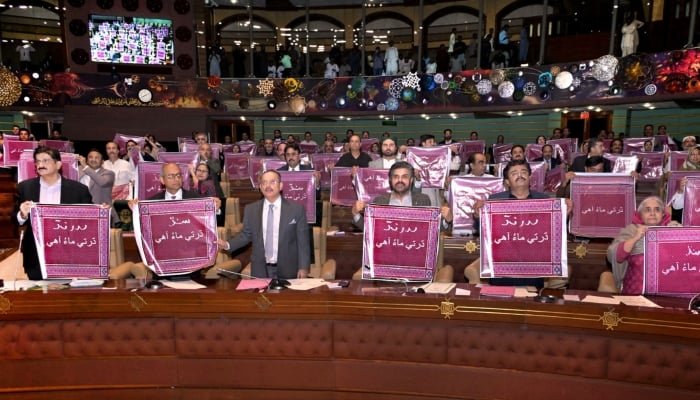
The Sindh Assembly has passed the Sindh division resolution, firmly rejecting any proposal to divide the province, change its territorial boundaries or establish separate administrative units within Sindh. The resolution was approved on Thursday amid a boycott by the Muttahida Qaumi Movement-Pakistan (MQM-P), following several days of debate over the province’s territorial integrity and local governance.
The resolution was moved by Pakistan Peoples Party (PPP) lawmaker Nisar Ahmed Khuhro after he initiated an adjournment motion opposing any move to divide Sindh. A total of 137 lawmakers from both sides of the House participated in the discussion.
Assembly Rejects Territorial Changes
The Sindh division resolution makes it clear that the provincial assembly does not support any constitutional or administrative arrangement that would alter the province’s existing boundaries.
The resolution referred to Article 239(4) of the Constitution, which requires a two-thirds majority of the relevant provincial assembly before a constitutional amendment changing the limits of a province can be presented to the President.
The House stated that Sindh would not consent to any such territorial changes. It also rejected proposals to separate any district, division or region from the province or place any part of Sindh under federal or separate administrative control.
According to the resolution, all existing regions of Sindh form an integral and inseparable part of the province.
Sindh Declared “One and United”
During the debate, lawmakers highlighted Sindh’s historical and civilisational identity. The assembly recalled the province’s role in the political history of Pakistan, including its distinction as the first provincial legislature to pass a resolution supporting the creation of Pakistan in 1943.
The House declared in clear terms that Sindh is one province and should remain united.
The Sindh division resolution also called on the federal government, Parliament and political parties to respect what the assembly described as the democratic will of the people of Sindh.
An official copy of the resolution is to be sent to the President, Prime Minister, Chairman of the Senate and Speaker of the National Assembly so that the provincial assembly’s constitutional position is formally placed on the national record.
Murad Ali Shah Defends Provincial Integrity
Sindh Chief Minister Syed Murad Ali Shah said the province had joined Pakistan as a single and united entity. He argued that its territorial integrity could not be changed against the wishes of its people or elected representatives.
The chief minister said the debate was initiated by the PPP in response to recent statements from political leaders advocating the creation of new provinces or separate administrative structures.
Murad Ali Shah also criticised what he described as contradictory positions within MQM-P and other political groups. He argued that some leaders opposed dividing Sindh while simultaneously supporting separate assemblies, chief executives and governance structures for different divisions.
The chief minister also referred to historical disputes involving Sindh, including opposition to proposals to separate Karachi from the province and resistance to the One Unit system.
He maintained that the One Unit arrangement was wrong when it was introduced and remains unacceptable from the perspective of Sindh’s political identity.
MQM-P Opposes PPP’s Approach
MQM-P strongly criticised the ruling PPP’s decision to bring the issue before the assembly. Opposition Leader Ali Khurshidi accused the government of using emotionally sensitive subjects to divert attention from what he described as poor governance and administrative failures.
Khurshidi argued that the assembly had already passed similar resolutions against dividing Sindh and questioned the need for another resolution.
He claimed that the PPP was repeatedly raising the issue to appeal to public emotions rather than addressing governance problems. He also criticised the administration of Karachi, pointing to what he described as serious municipal and administrative shortcomings.
The Sindh division resolution debate therefore became broader than the question of provincial boundaries, with lawmakers also discussing governance, decentralisation and the distribution of political power.
MQM-P Calls for Decentralisation
Khurshidi clarified that MQM-P’s position, according to his remarks, is not focused on dividing Sindh but on administrative empowerment and decentralisation.
He argued that the 18th Amendment should have resulted in greater devolution of authority to the local level. In his view, stronger local governments would allow administrative units to exercise meaningful autonomy and improve the delivery of public services.
This distinction is central to the disagreement between the PPP and MQM-P. While the ruling party has framed the issue around protecting Sindh’s territorial integrity, MQM-P has emphasised decentralisation and stronger local institutions.
The Sindh division resolution now formally records the provincial assembly’s opposition to territorial changes. With the PPP holding a two-thirds majority in the House, the resolution passed despite the MQM-P boycott.
The debate is likely to remain politically significant as discussions over new provinces, local government powers and administrative decentralisation continue across Pakistan. For Sindh, however, the assembly has clearly stated its position: the province’s existing territorial boundaries should remain intact, while questions about governance and local empowerment continue to be debated separately.