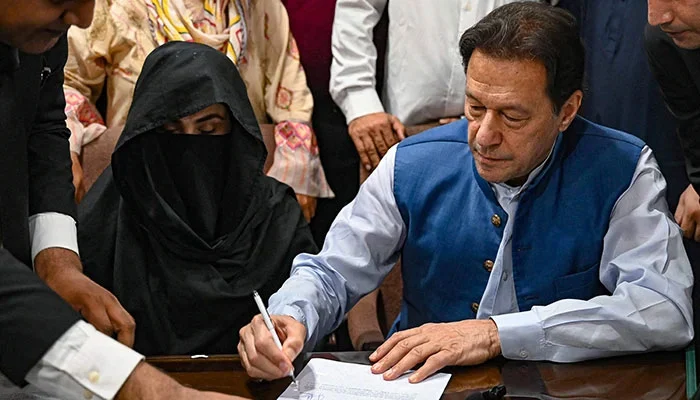
The Imran Khan Jail Conditions case has taken a new turn after the Islamabad High Court (IHC) directed Adiala Jail authorities to submit a detailed report regarding the detention of former Prime Minister Imran Khan and his wife, Bushra Bibi. The court has requested prison records and clarification on allegations that the couple has been kept in solitary confinement. The development has drawn significant public and legal attention, as the court prepares to determine whether the petitions challenging their detention conditions are maintainable.
Justice Khadim Hussain Soomro issued the directives while hearing petitions filed by Imran Khan’s sister, Aleema Khan, and Bushra Bibi’s daughter, Mubashra Khawar Maneka. The petitioners have alleged that both prisoners have been subjected to prolonged isolation in violation of prison regulations.
Court Demands Detailed Explanation
During the hearing, Justice Soomro instructed the superintendent of Adiala Jail to provide a comprehensive report explaining whether Imran Khan and Bushra Bibi have been placed in solitary confinement. If such confinement exists, the court has asked authorities to specify the legal basis, duration, and circumstances under which it was imposed.
The judge also sought a detailed account of the facilities being provided to both prisoners while in custody. This includes information about their daily living arrangements, prison conditions, and access to legal representation.
The Imran Khan Jail Conditions case will now move forward once the prison authorities submit the requested documentation.
Background of the Case
Imran Khan has remained in custody since August 2023 and continues to face multiple legal cases, including corruption and terrorism-related charges. Several of these cases were initiated following his removal from office through a parliamentary vote of no confidence in April 2022.
Bushra Bibi, Khan’s wife, is also facing legal proceedings connected to accountability cases. Both have remained at the center of Pakistan’s political and legal landscape over the past two years.
The petitions before the Islamabad High Court do not challenge the convictions themselves. Instead, they focus specifically on the treatment and detention conditions inside Adiala Jail.
Allegations Presented Before the Court
Counsel for the petitioners, Barrister Salman Safdar, argued that the Imran Khan Jail Conditions violate prison rules governing convicted prisoners.
According to the petitioners, Imran Khan has allegedly been confined for approximately 22 hours each day, while Bushra Bibi has reportedly remained isolated almost continuously for several months.
Safdar also informed the court that although he had previously been allowed to meet Imran Khan following court orders, he had allegedly been denied access to Bushra Bibi for nearly seven months.
The petitioners argue that such treatment amounts to unlawful solitary confinement and requires judicial intervention.
Government and NAB Response
The National Accountability Bureau (NAB), along with federal government representatives, opposed the petitions during earlier hearings.
NAB prosecutor Rafi Maqsood argued that Aleema Khan and Mubashra Khawar Maneka are not directly affected parties and therefore lack the legal standing required to file constitutional petitions.
He also rejected claims that Imran Khan and Bushra Bibi are being held in solitary confinement, stating that both prisoners are being managed according to prison regulations applicable to convicted inmates.
Government representatives further argued that the petitioners should have first approached prison authorities before seeking relief through the constitutional court.
Court Yet to Decide Maintainability
The Islamabad High Court has not yet ruled on whether the petitions are legally maintainable.
Instead, Justice Soomro emphasized the importance of obtaining complete factual information before making any decision. He directed the inspector general of prisons and the jail superintendent to ensure that fully informed representatives appear before the court during the next hearing.
The judge also stressed that officials must present accurate information supported by prison records rather than general explanations.
The Imran Khan Jail Conditions case has therefore entered an important procedural stage where documentary evidence may play a significant role.
Importance of Prison Rights
The case has renewed discussion regarding the rights of prisoners under Pakistani law.
Legal experts note that prison regulations establish standards regarding accommodation, legal access, medical care, and treatment of inmates. Any restrictions beyond those permitted under existing laws may become subject to judicial review.
At the same time, prison authorities retain responsibility for maintaining security, discipline, and the safe management of inmates, particularly in high-profile cases.
Balancing these responsibilities with prisoners’ legal rights remains an important aspect of judicial oversight.
Next Hearing Scheduled
The Islamabad High Court has adjourned further proceedings until August 6.
During the next hearing, the court is expected to review the reports submitted by prison authorities before deciding whether the petitions can proceed.
The documents requested by the court will likely clarify whether solitary confinement has been imposed, under which legal provisions, and whether detention conditions comply with Pakistan’s prison regulations.
The Imran Khan Jail Conditions case highlights the judiciary’s role in examining allegations related to prison treatment while ensuring that legal procedures are followed. By requesting detailed reports from Adiala Jail authorities, the Islamabad High Court aims to establish the factual circumstances before making any legal determination.
With the next hearing scheduled for August, attention will remain focused on the prison authorities’ response and the court’s eventual decision regarding the maintainability of the petitions. Regardless of the outcome, the proceedings underscore the importance of transparency, due process, and judicial oversight in matters concerning the rights and treatment of prisoners.