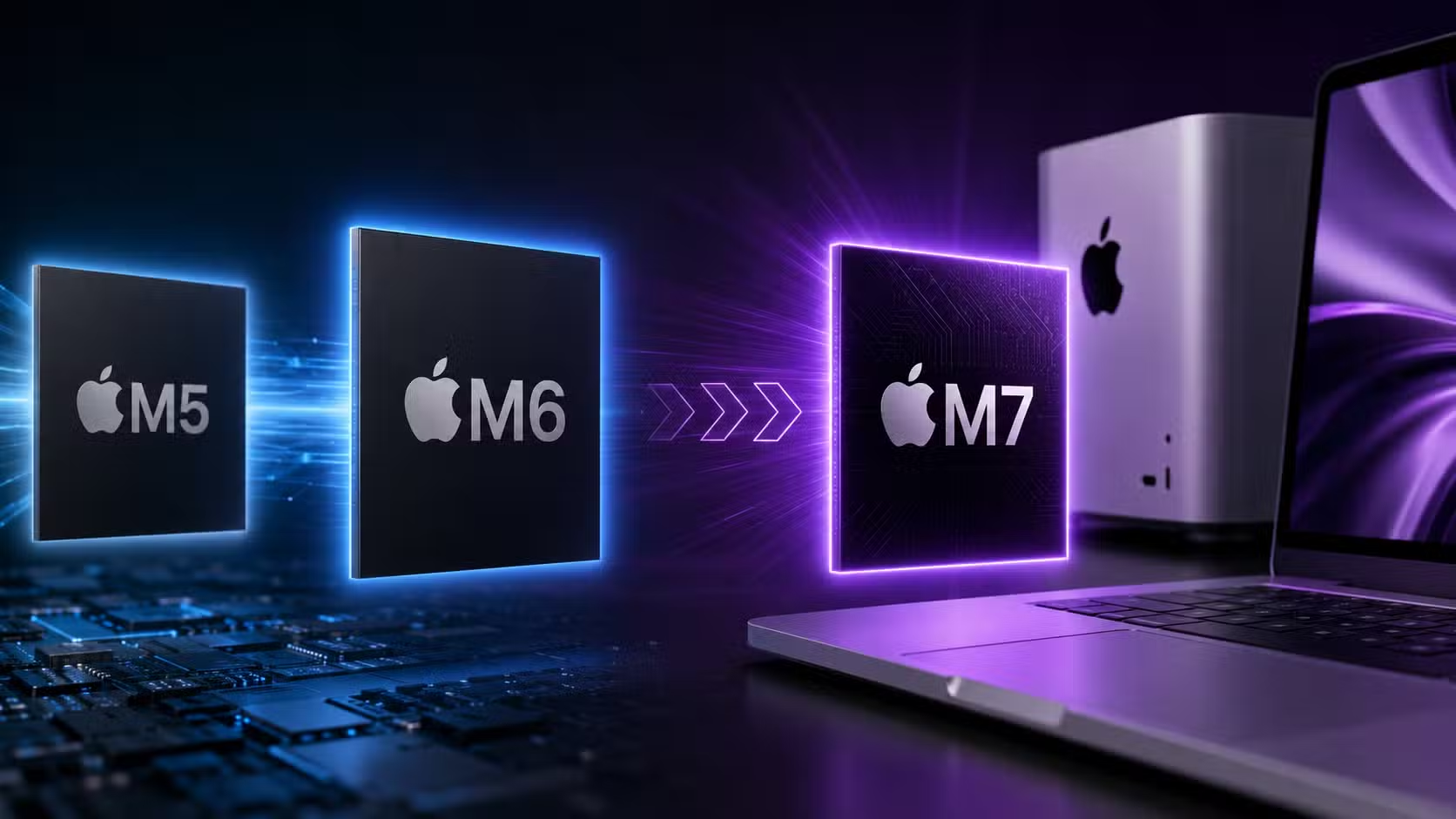
Apple M7 chips are set to become the company’s next major leap in silicon technology as Apple reportedly prepares to overhaul its Mac processor roadmap. Instead of releasing the expected M6 Pro and M6 Max processors, Apple is planning to skip those high-end variants and move directly to the more advanced M7 Pro and M7 Max lineup. The shift reflects Apple’s growing focus on artificial intelligence, improved performance, and the future of next-generation Mac devices.
Apple Changes Its Chip Strategy
According to recent industry reports, Apple is making one of the biggest adjustments to its custom chip roadmap since introducing Apple Silicon. The company is expected to release the standard M6 processor while abandoning plans for premium M6 Pro and M6 Max versions.
Instead, Apple intends to introduce the M7 family beginning in 2027. This decision highlights the company’s strategy of accelerating AI-focused hardware development while simplifying its product lineup.
The move is expected to position future MacBooks and desktop Macs as more capable machines for AI-powered workloads, content creation, software development, and professional productivity.
What to Expect From the M6 Chip
Although premium M6 models may not arrive, the base M6 processor is still expected to deliver meaningful performance improvements over its predecessor.
Reports suggest the chip will feature memory bandwidth of approximately 200GB/s, a noticeable increase compared to earlier generations. Higher memory bandwidth allows applications to process larger amounts of data more efficiently, benefiting professionals working with video editing, graphic design, software development, and machine learning.
The M6 processor is also expected to include:
- Faster CPU performance
- A redesigned GPU with up to 12 graphics cores
- Improved media engines for faster video processing
- A more powerful Neural Engine for AI tasks
These upgrades should provide smoother multitasking and improved efficiency across Apple’s ecosystem.
Apple M7 Chips Built for Artificial Intelligence
The biggest focus of Apple’s future processors appears to be artificial intelligence.
The Apple M7 chips are reportedly being designed around advanced AI capabilities rather than simply increasing raw processing power. Apple has been investing heavily in on-device AI, enabling features that run securely without relying entirely on cloud computing.
A stronger Neural Engine will likely power smarter productivity tools, enhanced photo editing, faster voice recognition, improved language processing, and more intelligent automation across macOS.
As AI becomes a central part of modern computing, Apple’s chip strategy seems designed to ensure future Macs remain competitive for years to come.
Expected Launch Timeline
Industry reports suggest Apple will begin introducing the M7 lineup as early as the first half of 2027.
The expected roadmap currently includes:
- M6 processor arriving before 2027
- M7 base chip launching in early 2027
- M7 Pro and M7 Max following later in 2027
- M7 Ultra expected between 2027 and 2028
While Apple has not officially confirmed these plans, the reported timeline indicates a faster transition toward AI-optimized processors.
M5 Ultra Still Coming This Year
Before the arrival of the M6 and M7 generations, Apple is still expected to unveil the M5 Ultra processor later this year.
The flagship chip is rumored to power an updated Mac Studio and could feature approximately:
- 36 CPU cores
- 80 GPU cores
- Support for up to 768GB of unified memory
If these specifications prove accurate, the M5 Ultra will target professionals working with demanding applications such as 3D rendering, scientific computing, AI model training, and large-scale video production.
However, industry analysts caution that supply chain constraints may affect final configurations or availability.
Why Apple Is Prioritizing AI
Artificial intelligence has become a major priority across the technology industry. Companies are redesigning both hardware and software to handle increasingly complex AI workloads.
Apple’s decision to focus on Apple M7 chips reflects this industry-wide trend. Rather than simply adding more CPU or GPU cores, Apple appears to be optimizing future processors for intelligent computing while maintaining the company’s well-known emphasis on power efficiency.
This approach may allow Macs to perform advanced AI tasks locally without sacrificing battery life or generating excessive heat.
It also aligns with Apple’s broader strategy of improving user privacy by processing sensitive information directly on the device instead of relying on external servers whenever possible.
What It Means for Mac Users
For consumers, Apple’s revised chip roadmap could bring several long-term benefits.
Future Macs may deliver faster performance, stronger AI capabilities, and better energy efficiency without requiring major increases in power consumption. Professionals using creative software, developers building AI applications, and everyday users could all benefit from faster and smarter hardware.
At the same time, users considering an upgrade may find additional value in waiting for the next generation if AI-powered features become a major selling point.
Apple’s reported decision to skip the M6 Pro and M6 Max processors signals a significant shift in its long-term silicon strategy. By accelerating development of the Apple M7 chips, the company is positioning itself for an AI-driven future where intelligent computing becomes just as important as raw processing speed.
Although Apple has yet to officially announce these processors, the reported roadmap suggests that the next few years will bring major innovations to the Mac lineup. As AI continues transforming personal computing, Apple’s upcoming chip generations could play a key role in defining the future of Mac performance and productivity.