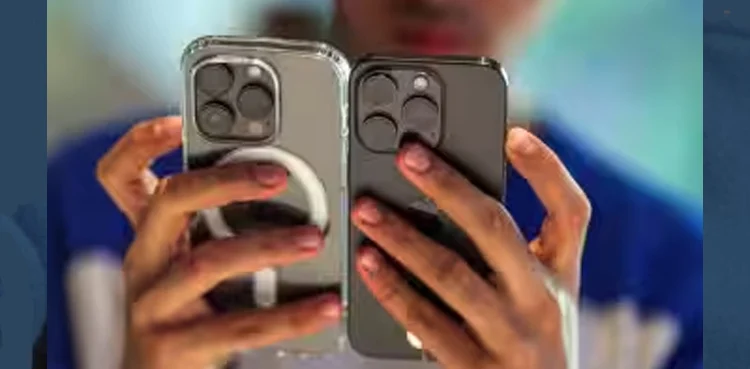

Apple’s first foldable smartphone, the iPhone Duo, has come under scrutiny after an iPhone Duo teardown by repair specialists at iFixit revealed a complicated hinge mechanism that could be connected to reports of inner display damage. The teardown also examined the phone’s battery removal process, foldable screen technology and internal components, offering a closer look at how Apple designed its first foldable device.
Despite concerns surrounding the hinge, the smartphone received a repairability score of 5 out of 10 from iFixit, suggesting that several components can be accessed and replaced without completely dismantling the device.
iPhone Duo Earns 5 Out of 10 Repairability Score
According to iFixit, the iPhone Duo is relatively straightforward to repair compared with some competing foldable smartphones. It received a score of 5 out of 10, while Samsung’s Galaxy Z Fold8 scored 4 out of 10 and the older Galaxy Z Fold7 received 3 out of 10.
The iPhone Duo teardown showed that certain components can be removed independently, reducing the need to take apart much of the phone during repairs.
For example, the external display can reportedly be detached using a suction clamp and a prying tool. This approach could simplify some repair procedures, although the overall difficulty will depend on the component being replaced and the damage involved.
Repairability is an important consideration for foldable smartphones because their complex construction can make servicing more challenging than conventional devices. A design that allows easier access to individual parts may help technicians carry out certain repairs more efficiently.
However, the score does not mean that every repair will be simple or inexpensive, particularly when the internal folding mechanism or flexible display is involved.
Dual Batteries Feature Special Removal System
Another notable discovery involved the iPhone Duo’s dual-battery arrangement. Rather than relying solely on conventional adhesive removal techniques, Apple uses an electrically assisted system known as anodic delamination.
As demonstrated in the teardown, the process involves connecting a low-voltage power source, such as a 9V battery, to silver tabs attached to the battery cells. The electrical current helps release the adhesive securing the batteries, making removal easier.
This approach could reduce the effort required to remove the battery assembly during servicing.
The battery removal process is particularly relevant for foldable phones, where internal space is limited and components must fit around the hinge and flexible display. A specialised adhesive-release system offers technicians another way to access parts without unnecessarily disturbing surrounding components.
The iPhone Duo teardown therefore highlights some of the practical design decisions Apple has made to balance a complicated form factor with repair access.
Apple Uses Technology to Reduce Display Crease
The teardown also examined how Apple attempts to make the foldable display’s crease less noticeable.
Under a microscope, iFixit inspected a matte nano-texture protective layer covering the inner screen. The surface contains thousands of microscopic bumps that scatter reflected light, making the crease less visually prominent under certain lighting conditions.
Apple also uses a modified arrangement of RGB subpixels within the OLED panel. According to the teardown findings, the subpixels are positioned at different angles to further reduce the visibility of the fold.
These techniques work together to improve the screen’s appearance when the phone is unfolded.
However, reducing the visibility of a crease is not the same as eliminating the physical fold. The flexible display must still bend as the device opens and closes, placing considerable importance on the materials and mechanisms supporting it.
Complicated Hinge Raises Display Damage Questions
The hinge mechanism was one of the most closely examined parts of the device. Reports from some early owners have described unusual stiffness while unfolding the phone, followed by popping or cracking sounds and permanent display damage.
Affected screens reportedly develop a vertical line running through the centre, along with a horizontal line extending towards the right side.
The iPhone Duo teardown revealed a complicated hinge assembly that may provide clues about these reports, but it did not establish a definitive cause.
One possible explanation is that an internal hinge component fails to move downwards as intended, causing the mechanism to become stuck. Another possibility involves the accordion-like flexible cable that runs through the hinge and could interfere with the folding movement.
At this stage, these remain possible explanations rather than confirmed engineering faults. Further investigation would be needed to determine whether the reported failures share the same underlying cause.
What the Teardown Means for iPhone Duo Owners
The findings present two important aspects of Apple’s foldable smartphone. Several internal components appear accessible for repair, while the hinge and flexible display remain areas of concern following reports of damage.
The iPhone Duo teardown provides useful insight into the device’s construction, but a repairability score alone cannot establish its long-term durability. Similarly, the complex hinge design does not, by itself, prove that it is responsible for every reported screen failure.
For potential buyers, the key questions will be how reliably the hinge performs over time, how Apple responds to confirmed display problems and how accessible repairs are in practice.
Until the cause of the reported failures is established, the teardown offers valuable technical observations rather than a final explanation. It reveals how Apple has approached foldable-screen design while leaving important questions about the hinge’s long-term performance unanswered.