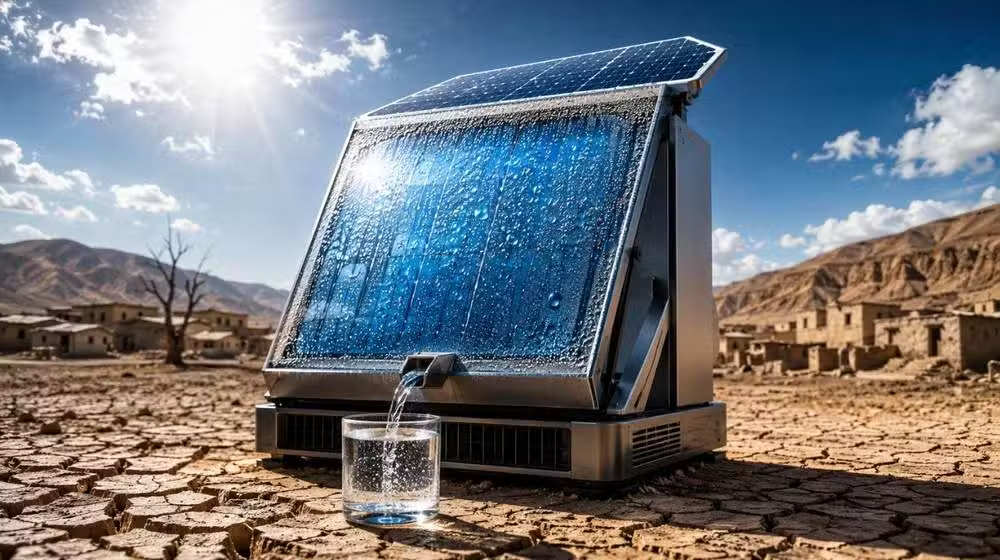
Access to clean water remains one of the world’s biggest challenges, especially in dry and drought-prone regions. Now, a breakthrough in air to water technology developed by researchers from Stanford University and MIT could offer a promising solution. Scientists have created a longer-lasting hydrogel capable of pulling moisture directly from the air and converting it into drinkable water using only sunlight.
This innovation could become a major step forward for communities struggling with water shortages. With climate change worsening drought conditions across many countries, technologies that can create safe drinking water from the atmosphere are gaining global attention.
A New Approach to Water Scarcity
The newly developed hydrogel works like a sponge. It absorbs moisture from the air during cooler periods and then releases the collected water when heated by sunlight. Researchers believe this air to water technology could eventually provide affordable drinking water in places where traditional water systems are unreliable or unavailable.
According to recent reports from the World Health Organization and UNICEF, nearly 2.1 billion people worldwide still do not have access to safely managed drinking water. This alarming figure highlights why scientists are urgently exploring alternative water sources.
Unlike large desalination plants or expensive purification systems, this hydrogel-based solution is compact, energy-efficient, and potentially low-cost. It also relies on renewable solar energy, making it environmentally friendly.
How the Hydrogel Works
The hydrogel combines lithium chloride and polyacrylamide. Lithium chloride is known for its strong ability to absorb moisture, while polyacrylamide helps create the gel-like structure needed to trap water vapor.
When exposed to humid air, the material captures moisture naturally. Once sunlight heats the hydrogel, the trapped water evaporates and can then be condensed into clean drinking water.
Researchers tested the system in Chile’s Atacama Desert, one of the driest places on Earth. The hydrogel was placed on a black aluminum panel that absorbed solar heat efficiently, helping release the collected moisture.
The early results showed strong potential for air to water technology, especially in regions where humidity exists but rainfall remains scarce.
Solving the Biggest Problem
Although the idea worked well in earlier experiments, scientists faced a major durability issue. The hydrogel began breaking down after around 30 water collection cycles. This raised concerns about long-term reliability and safety because damaged materials could contaminate the water.
After several years of research, scientists discovered that the aluminum surface beneath the hydrogel was causing chemical reactions that weakened the material. The metal released ions that created damaging radicals inside the gel.
To fix the problem, researchers applied a special anti-corrosion coating to the metal surface. This simple change dramatically improved durability.
With the coating added, the hydrogel survived more than 190 water harvesting cycles over eight months without significant damage. This improvement represents a major breakthrough for air to water technology and moves the concept closer to real-world use.
Lower Costs Could Increase Accessibility
One of the most exciting parts of the research is the potential cost reduction. Scientists estimate the system could eventually produce water for less than one cent per liter.
That price would make the technology competitive with municipal tap water in some areas and far cheaper than bottled water. Affordable pricing is critical because many regions facing water shortages also struggle with poverty and limited infrastructure.
The current prototype can produce up to two liters of water daily using a panel about the size of a bath towel. Researchers hope to increase production to five liters per day in future versions.
If successful, this air to water technology could become especially useful in remote villages, disaster zones, refugee camps, and rural communities where pipelines and desalination systems are not practical.
Environmental Benefits
Another advantage of this innovation is its low environmental impact. Traditional desalination plants consume large amounts of electricity and can harm marine ecosystems through salt waste discharge.
In contrast, the hydrogel system uses sunlight as its main energy source. It also requires fewer moving parts and less infrastructure, reducing maintenance and operating costs.
As governments search for sustainable solutions to growing water shortages, environmentally friendly systems like this could become increasingly important.
Challenges Still Remain
Despite the promising results, the technology is not ready for mass deployment yet. Researchers are still working to improve efficiency, increase water production, and reduce manufacturing costs.
There are also challenges related to scaling the system for larger populations. Producing enough water for entire cities would require significant expansion and further engineering improvements.
Still, experts believe the durability breakthrough is a major milestone. Without long-lasting materials, atmospheric water harvesting would remain too expensive for widespread use.
A Glimpse Into the Future
The success of this hydrogel project shows how innovation can help solve some of humanity’s most urgent problems. As climate pressures intensify and freshwater supplies shrink, new solutions will become essential.
This advanced air to water technology may not replace traditional water systems entirely, but it could become an important backup source for millions of people worldwide. By combining renewable energy with smart material science, researchers are opening the door to a future where clean drinking water can be collected directly from the air around us.