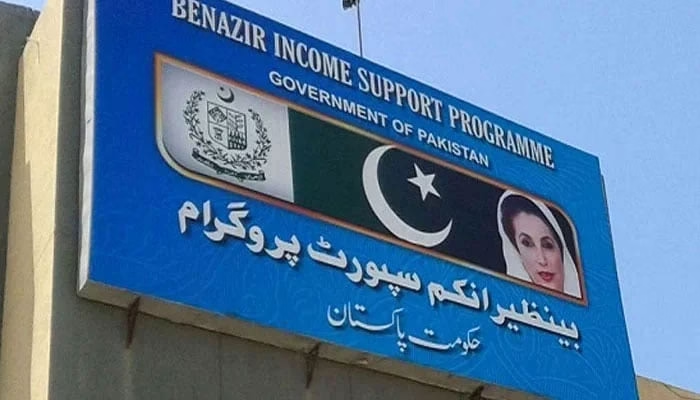
The discussion around BISP devolution to provinces has once again brought Pakistan’s social welfare structure into the spotlight. The government is currently reviewing whether administrative control of the Benazir Income Support Programme should be transferred to provincial authorities, a move that could significantly reshape how financial assistance is delivered to millions of low-income families across the country.
Minister of State for Religious Affairs and Interfaith Harmony Kheal Das Kohistani clarified that while the programme will not be abolished, its administrative structure is under consideration for restructuring. The idea of BISP devolution to provinces has emerged in the context of ongoing discussions about fiscal responsibility, governance efficiency, and post-18th Amendment decentralization.
Launched in 2008, BISP is Pakistan’s largest poverty alleviation initiative, providing cash assistance to more than 10 million low-income families, with a strong focus on empowering women. Any proposal related to BISP devolution to provinces therefore carries major implications for social protection and poverty reduction efforts nationwide.
The debate is closely linked to the broader framework of the 18th Amendment to the Constitution of Pakistan, which transferred several federal responsibilities to provincial governments. Since then, discussions have continued about which programs should remain federally managed and which should be decentralized. Supporters of BISP devolution to provinces argue that provincial governments are better positioned to manage local welfare needs due to their proximity to beneficiaries.
However, the issue is far from straightforward. Some provinces have expressed support for taking control of BISP, while others remain cautious. Concerns include administrative capacity, financial burden, and the risk of uneven implementation across regions. These disagreements highlight the complexity of BISP devolution to provinces in a country with diverse economic and governance structures.
Adding another layer to the discussion is Pakistan’s ongoing fiscal pressure. Reports suggest that international financial institutions, including the International Monetary Fund, have encouraged Pakistan to improve the efficiency of its subsidy and welfare systems. Under proposed reforms, a more targeted subsidy framework is expected to be introduced in the coming years, potentially using BISP data to identify eligible households. This makes BISP devolution to provinces part of a larger economic reform agenda.
Federal authorities argue that transferring major welfare programs to provinces could help reduce central fiscal deficits. They believe that decentralization may improve efficiency and accountability. However, critics warn that shifting financial responsibility without adequate provincial resources could weaken the effectiveness of social protection programs. The success of BISP devolution to provinces will therefore depend heavily on how responsibilities and funding are shared.
During previous National Finance Commission discussions, provinces such as Sindh and Khyber Pakhtunkhwa opposed proposals to shift federal expenditures like BISP, the Higher Education Commission, and development projects to provincial budgets. Their main concern is that such transfers could strain already limited provincial resources and create inequality in service delivery. This resistance shows that BISP devolution to provinces remains a politically sensitive issue.
At the same time, supporters of decentralization argue that local governments are better equipped to understand the needs of their populations. They believe that provincial control could lead to more efficient targeting of beneficiaries and reduced bureaucratic delays. In this view, BISP devolution to provinces could enhance transparency and improve service delivery if implemented properly.
One of the key challenges in this debate is ensuring continuity of support for vulnerable families. BISP currently plays a critical role in providing financial relief to millions of households. Any transition in management must ensure that beneficiaries do not experience disruptions. Policymakers considering BISP devolution to provinces must therefore prioritize stability and data accuracy.
Another important factor is digital infrastructure. BISP has increasingly relied on data-driven systems to identify eligible recipients and distribute payments. If provinces take over, they will need strong technological systems to manage this responsibility effectively. Without proper capacity-building, BISP devolution to provinces could face operational difficulties.
Ultimately, the decision will require broad political consensus. The federal government has stated that any final move will be made after consultations with coalition partners and stakeholders. This suggests that BISP devolution to provinces is still in the discussion phase rather than an immediate policy shift.
The debate over BISP devolution to provinces reflects deeper questions about governance, fiscal responsibility, and social protection in Pakistan. While decentralization could offer benefits in terms of efficiency and local control, it also carries risks related to funding, coordination, and equity. The outcome of this policy discussion will play a crucial role in shaping the future of welfare delivery in the country.