The recent decision to impose international measures against the Balochistan Liberation Army sanctions marks a significant development in global counterterrorism efforts. The government of Australia has officially announced counterterrorism financing sanctions on the banned group Balochistan Liberation Army (BLA) and its senior leadership, citing their involvement in violent attacks and destabilizing activities.
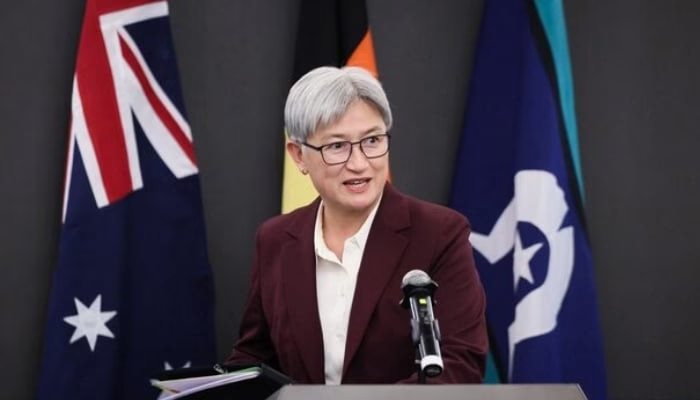
According to Australia’s Foreign Affairs Minister Penny Wong, the group has been responsible for a series of violent incidents targeting civilians, infrastructure, and security forces in Pakistan. She emphasized that Australia remains firmly committed to combating terrorism and cutting off financial networks that support extremist organizations. The announcement of the Balochistan Liberation Army sanctions reflects this broader strategy of international cooperation against terrorism.
The sanctions are designed to prevent the flow of financial resources to the group. This includes freezing assets, restricting financial transactions, and making it a criminal offense for individuals or organizations to provide support. Authorities in Australia stated that these measures are intended to disrupt recruitment, funding, and operational capabilities, which are essential elements in sustaining militant activity. The Balochistan Liberation Army sanctions therefore aim to weaken the group’s ability to function effectively.
Officials also highlighted that penalties for violating these sanctions are severe, including heavy fines and prison sentences of up to ten years. By enforcing strict legal consequences, Australia hopes to deter any indirect support or financial assistance that could reach the organization. This approach is part of a broader international effort to ensure that sanctioned groups are isolated from global financial systems.
Pakistan has long maintained that the BLA is involved in destabilizing activities within its borders. The government has repeatedly called on international bodies, including the United Nations Security Council, to take action against such groups. The introduction of the Balochistan Liberation Army sanctions by Australia is seen as a continuation of growing international recognition of these concerns.
The group has been linked to several major incidents in Pakistan’s Balochistan region, including coordinated attacks on multiple towns. These incidents have resulted in significant loss of life among both civilians and security personnel. Pakistani authorities argue that such attacks are aimed at undermining peace and development in the region.
In response to rising violence, Pakistan’s security forces have conducted extensive counterterrorism operations. These efforts have reportedly led to the elimination of hundreds of militants and the disruption of several networks. The international acknowledgment through the Balochistan Liberation Army sanctions is seen as reinforcing Pakistan’s position on the need for global cooperation in counterterrorism.
The United States has also taken similar steps in the past. The United States previously designated the BLA as a Foreign Terrorist Organisation, along with its affiliated faction, the Majeed Brigade. This classification further strengthens international efforts to limit the group’s operational reach and financial access. The alignment of multiple countries on this issue highlights the growing consensus around the threat posed by such organizations.
One of the key objectives of the Balochistan Liberation Army sanctions is to prevent the spread of extremist ideology. By restricting funding and communication channels, governments aim to reduce the group’s ability to recruit new members or expand its influence. Financial isolation is considered one of the most effective tools in modern counterterrorism strategy.
Experts note that international sanctions play a crucial role in weakening militant organizations, especially those that rely on cross-border networks. When multiple countries participate in coordinated actions, it becomes significantly harder for such groups to operate. The latest Balochistan Liberation Army sanctions reflect this collaborative approach to global security.
Despite these measures, challenges remain. Militant groups often adapt by finding alternative funding sources or shifting their operations. This makes continuous monitoring and international cooperation essential. Governments must remain vigilant to ensure that sanctions remain effective over time.
At the same time, diplomatic engagement and regional stability efforts are also important. Long-term peace in conflict-affected areas requires not only security operations but also economic development and political inclusion. While sanctions address immediate security threats, broader strategies are needed to address underlying causes of instability.
The introduction of Balochistan Liberation Army sanctions by Australia represents a significant step in strengthening global counterterrorism efforts. With support from other countries and international institutions, these measures aim to limit the group’s capabilities and reduce its threat. As cooperation between nations continues to grow, the focus remains on ensuring long-term peace, stability, and security in the region.