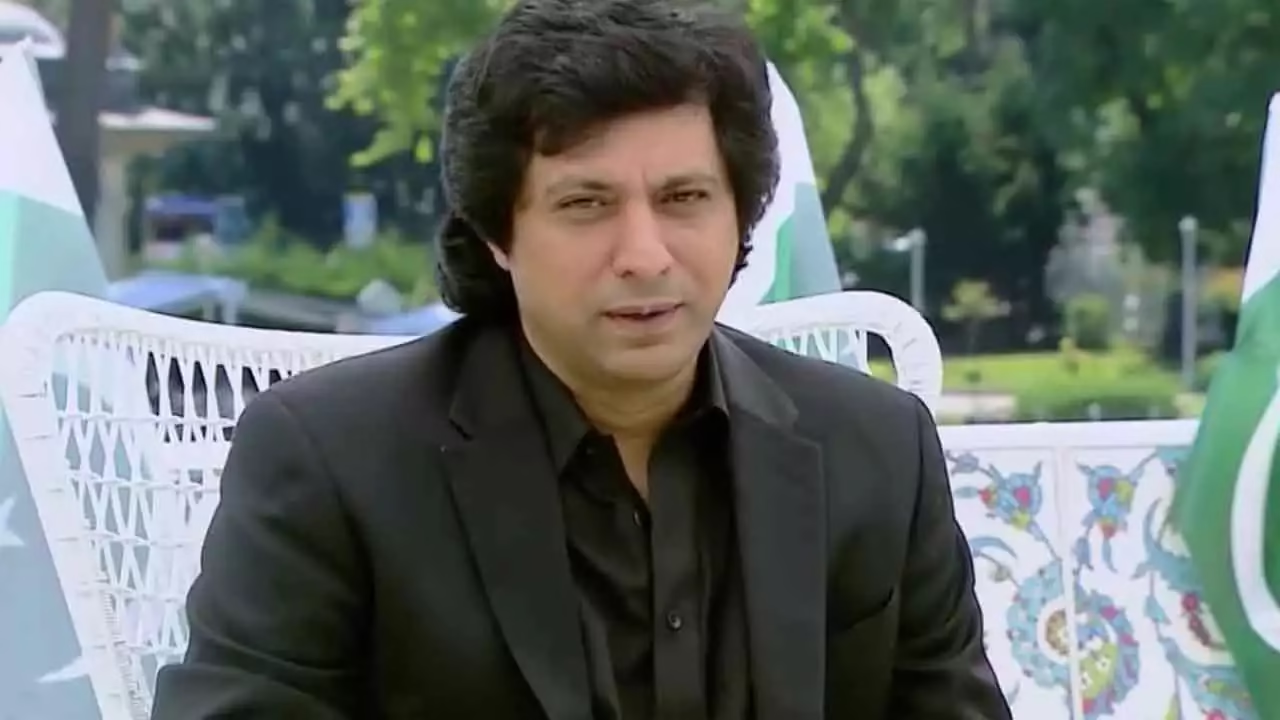
The discussion around Yashma Gill destiny debate has recently gained attention after the actress shared her thoughts on free will, faith, and destiny during a podcast appearance. In this Yashma Gill destiny debate, she revisited an earlier question she had asked Dr. Zakir Naik about whether human beings truly have choice if everything is already written, sparking renewed public interest in her spiritual journey.
Yashma Gill, known for her work in Pakistani television and film, opened up about a deeply personal phase in her life where she questioned belief systems and explored different philosophical ideas. According to her, there was a time when she leaned toward atheistic thinking, but that phase gradually changed as she began researching religion more deeply and reflecting on her own experiences.
The recent conversation that brought the Yashma Gill destiny debate back into the spotlight centers on her interpretation of destiny and human decision-making. She explained that life presents individuals with multiple “doors” or choices every day. In her view, humans actively choose which door to open, but the outcomes of those choices are already part of a divine plan. This balance between choice and destiny forms the core of her current understanding.
She also recalled her earlier question to Dr. Zakir Naik, where she asked how free will exists if destiny is already written. The response she received, as she shared, was that Allah has complete knowledge of what a person will choose, but the individual still makes the decision themselves. This explanation, she said, stayed with her and continued to influence her thinking.
The Yashma Gill destiny debate is not just about religious interpretation but also about how people reconcile logic, spirituality, and personal experience. Yashma described her current belief as one where faith and free will coexist. For her, destiny does not remove responsibility; instead, it adds meaning to human choices.
In her latest remarks, she offered a more personal analogy to explain her perspective. She compared faith to a radio signal, saying that just like a radio must be tuned to the correct frequency to hear clear sound, a person must strengthen their connection with Allah through prayer and remembrance to better understand guidance in life. This metaphor, she explained, helps her make sense of confusion and uncertainty during difficult decisions.
As the Yashma Gill destiny debate continues to circulate on social media, many people have expressed different reactions. Some appreciate her thoughtful and balanced approach to a complex subject, while others interpret her statements through their own religious or philosophical frameworks. This diversity of opinion reflects how deeply personal and widely interpreted the concepts of fate and free will are.
Yashma’s journey also highlights how public figures often become part of larger conversations beyond entertainment. Her openness about questioning beliefs, exploring atheism, and eventually returning to faith resonates with many individuals who go through similar phases of doubt and rediscovery in their own lives.
What makes the Yashma Gill destiny debate particularly engaging is that it does not offer a fixed answer. Instead, it encourages reflection. The idea that humans make choices while outcomes may be divinely written sits at the intersection of spirituality and philosophy, a space where certainty is rare but curiosity is constant.
In a broader sense, her comments also reflect a growing trend among young audiences and celebrities who are more willing to speak openly about mental, emotional, and spiritual struggles. These discussions often go beyond traditional boundaries and allow space for more nuanced thinking.
The Yashma Gill destiny debate shows how one question can evolve into a lifelong exploration of belief and meaning. Whether one agrees with her interpretation or not, her reflections invite people to think more deeply about their own choices, their understanding of destiny, and the role faith plays in everyday life.
As the conversation continues, it is clear that topics like these will remain relevant, especially in a world where people are constantly searching for balance between logic and belief, control and surrender, choice and destiny.