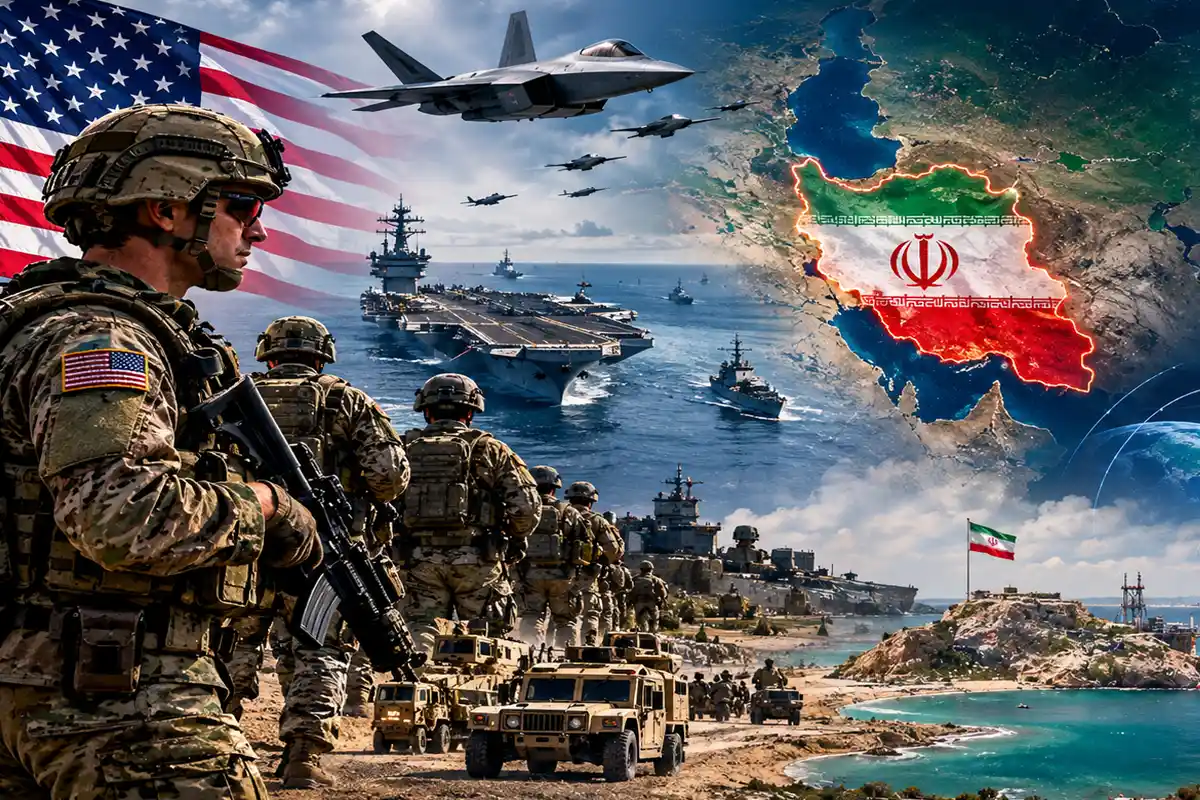
The prospect of deploying US troops in Iran for a large-scale ground operation or long-term occupation could present an enormous military challenge, according to an analysis by international relations expert Robert E. Kelly. The professor estimates that occupying Iran could require more than 500,000 personnel, a figure exceeding the US Army’s authorised active-duty strength for fiscal year 2026. However, this is an expert estimate, not an official Pentagon plan to invade or occupy Iran. citeturn872221search0turn872221search8
Why Could an Occupation Require 500,000 Troops?
A military occupation involves considerably more than defeating an opposing army. Forces must also secure cities, protect infrastructure, maintain supply routes, provide medical services and prevent attacks on military installations.
The estimate discussed by Kelly draws on lessons from the 2003 US-led invasion of Iraq and comparisons between Iraq and Iran. Iran’s larger territory, population and challenging geography could make a prolonged occupation substantially more difficult.
The number should not be treated as a precise forecast. Actual troop requirements would depend on the mission’s objectives, the level of resistance, the duration of the operation and whether local authorities or international partners provided support.
US Army Strength Limits the Options
The US Army’s authorised active-duty strength for fiscal year 2026 was approximately 454,000 personnel, according to the figures cited in the analysis. This excludes the Army National Guard, Army Reserve and Marine Corps.
Even so, the difference between the Army’s authorised strength and the estimated occupation force highlights the scale of the challenge.
The United States would not necessarily need to deploy every soldier simultaneously, and not all military personnel would be assigned to ground combat. However, committing a substantial force to Iran could affect readiness and operations elsewhere, particularly if the mission continued for years.
An extended deployment would also require regular rotations, reinforcements and extensive logistical support.
More US Forces Heading to the Middle East
The United States has also expanded its military presence in the Middle East amid tensions with Iran.
The Associated Press reported in October 2026 that Washington was deploying approximately 9,000 additional personnel aboard ships, alongside another aircraft carrier. The move was intended to strengthen the US military presence in the region as President Donald Trump considered possible further action against Iran. citeturn872221news34
However, deploying naval and Marine forces does not establish that Washington intends to launch a full-scale ground invasion.
Aircraft carriers, amphibious forces and supporting personnel can serve a range of purposes, including maritime security, deterrence and military operations. Their presence should not be confused with preparations for an occupation requiring hundreds of thousands of soldiers.
Why Kharg Island Matters
Kharg Island holds strategic importance because it serves as a major terminal for Iran’s crude oil exports.
Some analysts have discussed whether controlling the island could increase economic pressure on Tehran. Yet securing a limited island or coastal position would be very different from occupying Iran as a whole.
Any such operation would require personnel to protect facilities, maintain supply lines and defend against possible attacks. The risks would depend on the scale of the operation and Iran’s response.
Control of Kharg Island would not automatically give US forces control over Iran’s wider territory or political institutions.
Iran’s Defence Strategy and Geography
Iran’s geography presents another challenge for any invading force. The country covers approximately 1.65 million square kilometres and includes mountainous regions, extensive distances between population centres and difficult supply routes.
These conditions could complicate troop movements, communications and the delivery of fuel, ammunition and other essential supplies.
Iran also maintains military capabilities distributed across different regions. Its defence approach is sometimes associated with “mosaic defence,” a concept intended to preserve the ability of different units to operate if central command structures are disrupted.
The effectiveness of such a strategy would depend on the circumstances, but dispersed forces could complicate efforts to establish lasting control.
Lessons From the Iraq War
The 2003 invasion of Iraq offers an important comparison. US-led forces rapidly defeated Saddam Hussein’s government, but the subsequent years involved armed resistance, instability and a prolonged military presence.
The experience demonstrated that winning the initial military campaign and maintaining security afterwards are different challenges.
Iran and Iraq differ in territory, population, political structures and military capabilities, so the troop requirements cannot simply be calculated by scaling up the Iraq deployment. Nevertheless, the experience illustrates why an initial battlefield victory may not translate into a stable occupation.
Is Washington Planning to Occupy Iran?
The estimate of more than 500,000 personnel does not confirm that the US government is preparing an occupation plan.
Additional military deployments provide Washington with more operational options, but they do not independently establish a decision to invade. Military posture, political statements and expert assessments must be considered separately.
A ground operation could also carry substantial financial, diplomatic and human costs. Prolonged resistance, vulnerable supply routes and the need to secure multiple regions could extend the duration and complexity of a campaign.
The Challenge Beyond the Battlefield
The discussion about US troops in Iran highlights the potential scale of a long-term occupation rather than confirming that such an operation is imminent.
Kelly’s estimate of more than 500,000 personnel illustrates the resources that might be required for an extensive occupation, but the actual figure would depend on the mission and conditions on the ground.
For Washington, the central challenge would not simply be entering Iran. It would be determining whether military objectives could be achieved and whether any resulting security arrangement could be sustained without creating an even longer and more costly conflict.