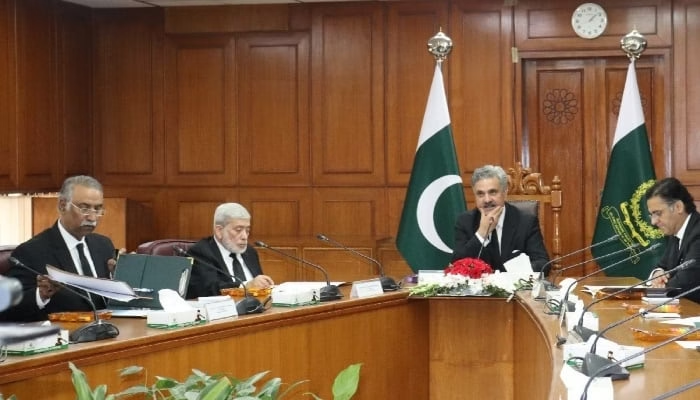
The government cannot change its budgeted petroleum levy targets without consulting Pakistan’s multilateral partners, Petroleum Minister Ali Pervaiz Malik told the National Assembly Standing Committee on Petroleum. The statement came during a discussion on fuel prices, diesel availability, regional supply disruptions and the financial burden faced by consumers.
Malik said petroleum levy targets were allocated as part of the federal budget and could not simply be revised without consultation with the country’s multilateral partners. His remarks came as lawmakers questioned the high charges on petrol and diesel and their impact on households, agriculture and transportation.
Lawmakers Question Fuel Levy
Committee members raised concerns over the level of the petroleum levy, with Saif-ul-Mulook Khokhar describing it as a heavy burden on the public.
The lawmaker questioned why such a high levy was being imposed on petrol and diesel, arguing that petroleum products were essential to everyday economic activity and that the levy provided the government with a relatively easy way to collect revenue.
PPP leader Naveed Qamar also questioned the role of the government in determining petroleum prices. He noted that parliamentarians did not directly vote on the levy because it remained within the executive’s authority.
The discussion reflected broader concerns about the effect of fuel prices on consumers and businesses, particularly when international oil markets and regional conditions are creating additional pressure.
Diesel Availability a Major Concern
Committee Chairman Mustafa Mahmood emphasized that diesel availability was particularly important because agriculture and goods transportation rely heavily on the fuel.
Diesel is widely used by agricultural machinery and commercial transport, meaning supply disruptions can have consequences beyond fuel stations. Shortages or sharp increases in diesel prices can raise transportation costs and add pressure to businesses and consumers.
Malik acknowledged the difficulties created by current market conditions, saying regional tensions had affected the supply of petrol, diesel and crude oil.
The minister described the resulting disruption as a major crisis and said the government was aware of the difficulties facing the public.
Pricing Formula Under Discussion
The committee also discussed how petroleum prices are determined.
Qamar questioned the government’s involvement in the pricing process and referred to changes in the pricing formula. He said the system had moved from a 30-day pricing cycle to a 15-day formula and was then moving toward daily pricing.
Malik responded that the Oil and Gas Regulatory Authority (OGRA) determines petroleum product prices. He also said information related to the pricing mechanism and the petroleum levy was available through OGRA’s official website.
The minister warned that a dramatic increase in diesel prices would generate significant public reaction. He also said the government had taken steps to improve the fuel supply chain and prevent profiteering.
Local Refining Supports Fuel Supply
Malik provided details about domestic refining capacity during the committee meeting.
According to the minister, around 70% of diesel is refined locally. He said PARCO was operating at full capacity, while Pakistan Refinery was operating at 84% and National Refinery at 85%.
The government is also working with refineries to improve fuel quality.
Malik said four refineries had signed agreements to produce Euro V-compliant fuel, while discussions were continuing with another refinery.
The move toward higher-quality fuel is part of broader efforts to modernize Pakistan’s petroleum sector and improve the quality of locally available petroleum products.
Winter Fuel and Gas Planning
The government is also preparing for increased energy requirements during the winter months.
Malik said authorities were working on a winter plan on a daily basis. He added that gas supplies had been maintained for consumers during meal times despite difficult conditions.
Winter typically creates additional pressure on Pakistan’s energy system as demand for gas and other fuels rises. Maintaining supplies therefore remains an important challenge for the government and energy-sector authorities.
Petroleum Supply Chain to Be Digitalised
Another major development highlighted by Malik was the government’s plan to completely digitalise the fuel supply chain.
Digital monitoring could provide authorities with greater visibility over fuel movement, distribution and availability. It could also help identify irregularities and improve coordination between suppliers, refineries and distribution networks.
For consumers, the effectiveness of such measures will ultimately depend on whether they help maintain reliable supplies and reduce opportunities for profiteering.
Revenue Pressure and Public Concerns
The debate over the petroleum levy highlights the difficult balance between government revenue requirements and the cost faced by consumers.
While the levy provides an important source of non-tax revenue, higher fuel charges can increase transportation and production costs throughout the economy. At the same time, reducing levy collections could create challenges for the government’s budget targets.
Malik’s comments indicate that any major change to the levy targets would require consultation with Pakistan’s multilateral partners.
As regional tensions continue to affect energy markets, lawmakers are likely to keep monitoring fuel availability, pricing and the impact of petroleum charges on the public. The government’s ability to maintain supplies, improve domestic refining and modernise the fuel supply chain will remain central to managing these pressures.