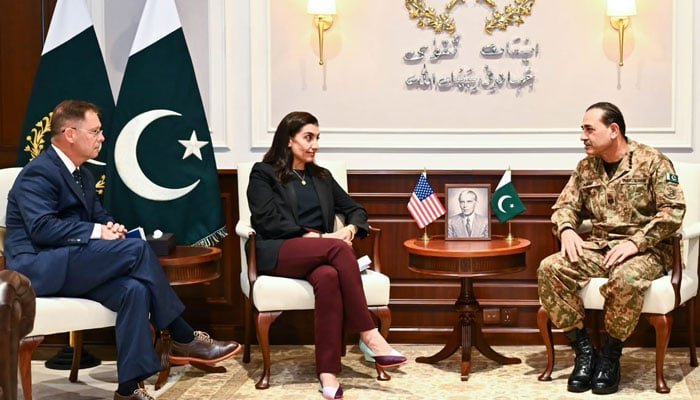
Chief of Defence Forces and Chief of Army Staff Field Marshal Asim Munir has shared Pakistan’s perspective on the Asim Munir Afghan war assessment during a meeting with a visiting US delegation in Rawalpindi. The delegation from the US Afghanistan War Commission met Munir at General Headquarters on Monday as part of its review of America’s two-decade engagement in Afghanistan.
The meeting focused on Pakistan’s role during the conflict, regional security developments and the challenges that emerged during the prolonged US engagement in Afghanistan. According to the Inter-Services Public Relations (ISPR), Munir stressed the importance of including Pakistan’s experience and a broader regional perspective when examining the strategic, diplomatic and operational dimensions of the war.
US Afghanistan War Commission Visits GHQ
The US delegation was led by commission co-chairs Shamila N. Chaudhary and Dr Colin F. Jackson. Their visit to Pakistan is part of the commission’s wider effort to examine major decisions and developments connected to the United States’ involvement in Afghanistan.
The Afghanistan War Commission was established by the US Congress in 2021 to conduct a comprehensive review of the US military, intelligence, diplomatic and foreign-assistance engagement in Afghanistan from June 2001 to August 2021. US forces completed their withdrawal from the country in August 2021, ending nearly two decades of military involvement.
During the meeting, the Asim Munir Afghan war perspective was presented as part of the regional experience that Pakistan believes should be considered when evaluating the conflict.
Pakistan Highlights Its Regional Experience
According to ISPR, Munir explained Pakistan’s perspective on the security dynamics that shaped the Afghan conflict and highlighted the challenges Pakistan faced throughout the prolonged war.
The Pakistani military has long maintained that developments in Afghanistan had a direct impact on Pakistan because of the countries’ shared border and close regional security links.
Munir emphasised that the conflict should not be assessed only through the experience of countries directly involved in military operations. Pakistan’s experience, he said, was relevant to understanding the broader regional consequences of the war.
The commission’s discussions therefore included Pakistan’s support during the conflict, the regional security environment and developments inside Afghanistan.
US Delegation Acknowledges Pakistan’s Role
The visiting delegation acknowledged what ISPR described as Pakistan’s longstanding role and sacrifices during the Afghanistan conflict. The delegation also appreciated Pakistan’s continued contribution to regional peace and stability.
The acknowledgement is significant because Pakistan’s role in the Afghan war has been viewed through different perspectives over the years. Islamabad has maintained that it made substantial sacrifices while supporting international efforts in Afghanistan and dealing with the conflict’s security consequences.
The latest meeting gives Pakistani officials an opportunity to present those concerns directly to a US commission tasked with reviewing the 20-year engagement.
Security Challenges After the US Withdrawal
The Asim Munir Afghan war discussions also come against the backdrop of continuing security concerns along Pakistan’s western border.
Since the Taliban returned to power in Afghanistan in 2021, Pakistani authorities have repeatedly raised concerns about militant groups operating from Afghan territory. Islamabad has urged Afghanistan’s Taliban authorities to prevent its territory from being used for attacks against Pakistan.
Pakistan has particularly highlighted security challenges in Khyber Pakhtunkhwa and Balochistan, where authorities have reported militant attacks and cross-border security concerns.
The Taliban authorities have rejected accusations that Afghanistan is allowing its territory to be used against neighbouring countries, making the issue part of a continuing dispute between Islamabad and Kabul.
Afghanistan Remains a Regional Security Issue
Although the US military withdrawal ended America’s longest war, the conflict continues to influence regional security discussions.
Pakistan shares a long border with Afghanistan and has repeatedly argued that developments inside the country have consequences for its own internal security. The issue of militant activity, border management and cross-border attacks remains particularly important for Islamabad.
Against this background, the Asim Munir Afghan war briefing gives the US commission access to Pakistan’s account of the conflict and its aftermath.
The commission’s work could provide a broader assessment of the decisions taken during the US engagement, including military operations, diplomacy and relationships with regional countries.
A Broader Review of the 20-Year Conflict
The meeting between Munir and the US delegation comes as Washington continues examining the lessons of its Afghanistan experience.
The US intervention began following the September 11, 2001 attacks and developed into a lengthy military and political campaign involving American forces, NATO allies, Afghan security forces and regional partners. The war resulted in extensive human, financial and political costs before the US withdrawal in 2021.
For Pakistan, the consequences extended beyond the battlefield in Afghanistan. Islamabad faced security, economic and diplomatic pressures during the conflict and has continued to deal with instability along its western border.
The Asim Munir Afghan war perspective presented to the commission therefore adds a regional dimension to the US review.
The Rawalpindi meeting also demonstrates that Pakistan remains an important part of discussions about the consequences of the Afghanistan war. As the US commission continues its assessment, Islamabad is seeking to ensure that its security experience, sacrifices and regional concerns are included in the broader historical record.