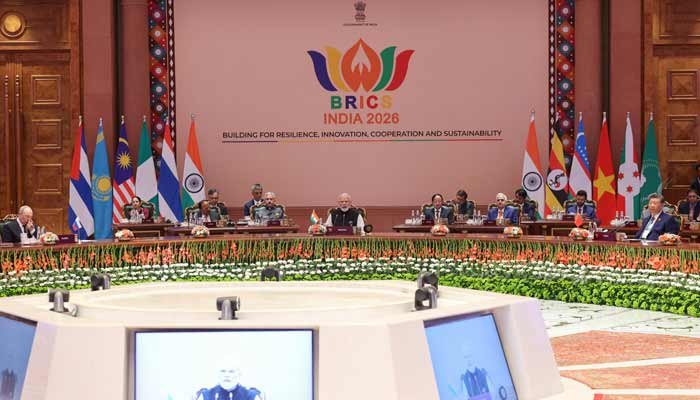
The BRICS Middle East statement has called for restraint and diplomatic efforts as tensions continue to escalate across the region. Leaders of the 11-member group, including China, Russia, Iran and India, issued the joint statement on Saturday during a summit in New Delhi, urging countries to avoid actions that could further worsen the conflict.
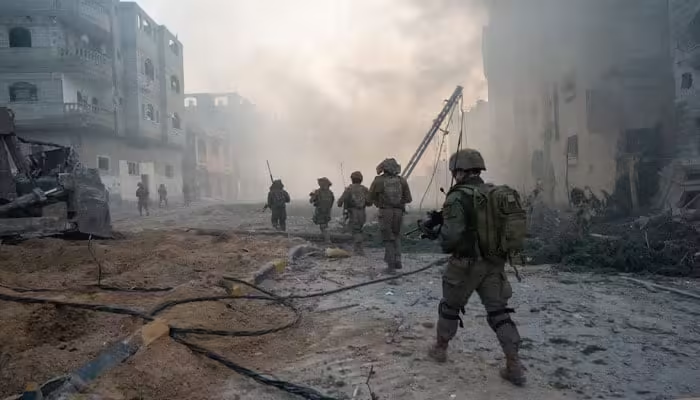
The appeal came after weeks of intense diplomatic divisions among BRICS members over the war that began with US-Israeli strikes on February 28. The group said the continuing escalation in the Middle East and West Asia was deeply concerning and called for maximum restraint.
BRICS Urges Maximum Restraint
In its joint statement, the group expressed concern over the worsening situation and urged all sides to avoid steps that could lead to further escalation.
The BRICS Middle East statement reflects the difficulties faced by the organization as several of its members have different positions on the ongoing conflict. China, Russia and Iran have maintained close diplomatic positions on several regional issues, while India has attempted to maintain working relationships with different sides.
The statement followed intense diplomatic efforts by India, which hosted the summit in New Delhi. Earlier in May, BRICS foreign ministers had failed to reach agreement on a joint statement because of disagreements among member states, including Iran, Saudi Arabia and the United Arab Emirates.
The ability of leaders to reach a common position at the summit therefore represented an important diplomatic development for the group.
Condemnation of Attacks on Civilian Infrastructure
The BRICS Middle East statement also strongly addressed attacks on civilian infrastructure and nuclear facilities.
BRICS leaders expressed serious concern about what they described as deliberate attacks on civilian infrastructure and peaceful nuclear facilities operating under International Atomic Energy Agency safeguards.
The group emphasized that nuclear safety, security and safeguards must remain protected even during armed conflicts. According to the statement, protecting nuclear facilities is essential to prevent harm to people and the environment.
The position reflects growing international concerns about the consequences of military action around sensitive nuclear sites and other critical infrastructure.
Xi Jinping Warns Against Wider Instability
Chinese President Xi Jinping also addressed the Middle East conflict while speaking at the opening of the two-day summit.
According to China’s state news agency Xinhua, Xi said the war did not serve the common interests of the international community.
His remarks reinforced the broader message of the BRICS Middle East statement, which emphasized the importance of international cooperation and efforts to reduce tensions.
Xi also highlighted the wider global environment, describing it as increasingly affected by polarization and distrust. The BRICS statement similarly called for stronger international action to support global peace and security.
Major Leaders Attend New Delhi Summit
The summit brought together several influential leaders from countries with significant political and economic interests in the Middle East.
Indian Prime Minister Narendra Modi hosted the meeting, while Russian President Vladimir Putin and Iranian President Masoud Pezeshkian also attended.
The participation of Pezeshkian was particularly significant because Iran is directly connected to the current regional conflict. Saudi Arabia and the United Arab Emirates also have important roles within the wider BRICS framework, adding complexity to the group’s diplomatic discussions.
UAE Crown Prince Sheikh Khaled Bin Mohamed Bin Zayed Al Nahyan attended the summit, while Egyptian President Abdel Fattah al-Sisi was also present. Saudi Foreign Minister Prince Faisal bin Farhan was expected to join later on Saturday.
Focus on Global Trade and Energy
Beyond the immediate conflict, BRICS leaders stressed the importance of protecting international trade, supply chains and energy flows.
The BRICS Middle East statement called for cooperation to maintain the smooth movement of global trade and energy in accordance with international law.
This concern is particularly important because continuing instability in the Middle East can affect shipping routes, oil supplies and international markets. Any prolonged disruption could create additional pressure on countries that depend heavily on imported energy and international supply chains.
BRICS Seeks Greater Global Influence
BRICS was established in 2009 as a platform for major emerging economies seeking a stronger voice in international institutions traditionally dominated by Western powers.
The BRICS Middle East statement demonstrates the group’s attempt to present a collective diplomatic position on one of the world’s most serious ongoing crises.
Although differences remain among its members, the agreement in New Delhi shows that BRICS can still find common ground on issues such as civilian protection, nuclear safety, international trade and regional stability.
The statement does not resolve the disagreements surrounding the conflict, but it provides a clear call for restraint. As tensions continue, the group’s emphasis on diplomacy and international cooperation could become increasingly important in efforts to prevent the crisis from spreading further.