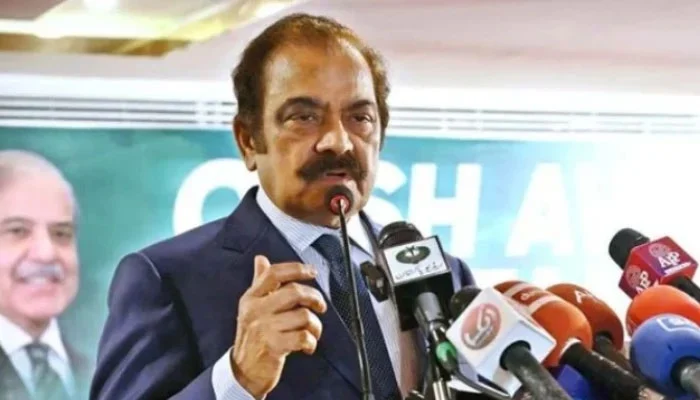
The debate over new provinces in Pakistan has gained fresh momentum after Adviser to the Prime Minister on Political Affairs Rana Sanaullah said a referendum on the creation of new provinces could be held if approved by a joint session of Parliament. He stressed that Parliament is the appropriate forum for discussing the country’s administrative structure and deciding whether new provinces should be created.
Speaking to journalists in Lahore on Saturday, Sanaullah said the issue had not yet been presented before the federal cabinet. He added that the Pakistan Muslim League-Nawaz (PML-N) was still consulting internally and would announce its position once the matter formally reaches Parliament.
Sanaullah said the question of whether provinces should be created must ultimately be decided by Parliament. According to him, once the issue comes before lawmakers, political parties will have an opportunity to present their respective positions. He expressed confidence that decisions made through Parliament would be accepted by all political parties.
The PML-N leader also said his party would consider the views of its district and union council-level workers before finalising its position. This indicates that the party intends to gather opinions from its grassroots organisation before taking a formal stance on the proposal.
His remarks echoed those of Federal Minister for Parliamentary Affairs Tariq Fazal Chaudhry, who said parliamentary debate on new provinces in Pakistan is expected to take place in October. The parliamentary discussion could become an important stage in determining whether the country should create additional provinces or pursue alternative administrative reforms.
The debate gained momentum after Interior Minister Mohsin Naqvi criticised Pakistan’s governance structure in July. Naqvi argued that the system had deteriorated significantly and called for fundamental reforms involving new administrative units and greater devolution of powers.
He later clarified that his criticism was not directed at any particular government but reflected what he described as deterioration over several decades. Naqvi subsequently said the creation of new administrative units should depend on the wishes of the people, describing the proposed reforms as a “reset” aimed at correcting weaknesses in the existing system.
The discussion expanded further when Planning and Development Minister Ahsan Iqbal called for a national debate on Pakistan’s administrative structure. He proposed considering between 12 and 15 provinces as part of a broader reform process.
Opposition parties have also entered the discussion. PTI Chairman Barrister Gohar Ali Khan recently announced plans for an All Parties Conference (APC) to discuss the creation of new provinces in Pakistan.
The announcement followed a meeting between a PTI delegation and Jamiat Ulema-e-Islam-Fazl chief Maulana Fazlur Rehman. The two sides discussed the opposition’s parliamentary role and other political matters.
Gohar said the proposed joint opposition platform would be used for consultations on parliamentary sessions and issues concerning prisoners. He also indicated that discussions on cooperation between opposition parties had already taken place in the Senate and National Assembly.
The issue comes as the PML-N and Pakistan Peoples Party are also working to manage differences on several political matters. Sanaullah said tensions between the coalition partners had eased considerably following disagreements that emerged during the recent Jammu and Kashmir Legislative Assembly elections.
However, the debate over new provinces in Pakistan could test political consensus because different parties may have different views about administrative boundaries and whether creating additional provinces would actually solve governance problems.
For now, no final decision has been taken. Sanaullah’s comments suggest that Parliament will play a central role if the proposal moves forward, while the planned opposition APC could add another dimension to the national discussion.
With parliamentary debate expected in October, the coming weeks could provide a clearer picture of how Pakistan’s major political parties view new administrative units and whether a broader political consensus can emerge around future governance reforms.