The Makkah Defence Alliance has entered a new phase after Türkiye announced the renaming of the tripartite defence pact involving Pakistan, Saudi Arabia and Türkiye. Turkish Foreign Minister Hakan Fidan said the alliance will focus on strengthening collective defence, regional stability and cooperation among the three countries.
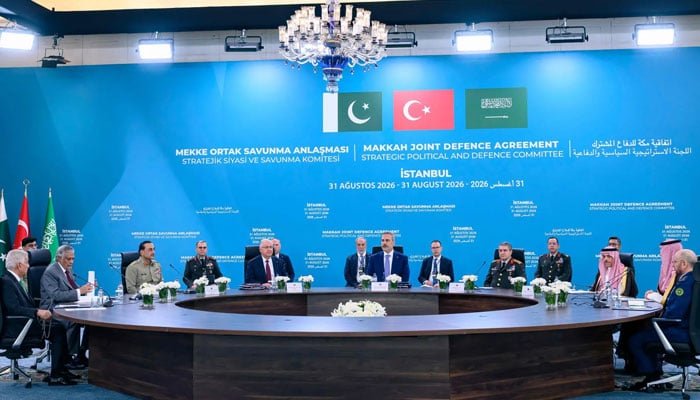
The announcement came after the first meeting of the Strategic Political and Defence Committee under the pact in Istanbul. The meeting brought together senior foreign and defence officials from Pakistan, Türkiye and Saudi Arabia to discuss the alliance’s future structure, shared responsibilities and regional security challenges.
Alliance Gets a New Name
Speaking after the meeting, Fidan announced that the agreement would now be known as the Makkah Defence Alliance, replacing its previous name, the Makkah Joint Defence Agreement. He said the secretariat of the alliance would be established in Riyadh, while Pakistan would provide the first secretary general.
The change in name reflects an effort to develop a more structured framework for cooperation. According to Fidan, the three countries are also preparing a roadmap that could allow other friendly nations to join the arrangement in the future.
The Turkish foreign minister stressed that the alliance is not directed against any particular country. Instead, he described it as an initiative designed to strengthen regional security and create mechanisms through which participating countries can respond collectively to emerging challenges.
Focus on Collective Defence
A major objective of the Makkah Defence Alliance is to improve the collective defence capabilities of Pakistan, Saudi Arabia and Türkiye. The countries intend to increase coordination between their armed forces and strengthen their ability to respond to potential security threats.
The agreement includes a collective deterrence principle under which an armed attack against one member would be treated as an attack against all three. This provision has drawn comparisons with NATO’s collective-defence framework, although the alliance has its own regional objectives and structure.
The committee is expected to examine ways to improve military coordination, develop shared responsibilities and strengthen cooperation between the three countries’ defence institutions.
Defence Industry Cooperation
Defence production and technology are also expected to become important areas of cooperation.
Fidan said the agenda includes joint production, research and development and broader cooperation in the defence industry. Such collaboration could provide opportunities for the three countries to combine their respective industrial and technological capabilities.
For Pakistan, stronger defence-industry cooperation with Türkiye and Saudi Arabia could potentially create opportunities in areas such as military technology, research, equipment production and defence-related innovation.
The Makkah Defence Alliance could therefore develop beyond a traditional military agreement and become a wider platform for strategic and industrial cooperation.
Pakistan’s Role
Pakistan was represented at the inaugural Strategic Political and Defence Committee meeting by Deputy Prime Minister and Foreign Minister Ishaq Dar, Defence Minister Khawaja Asif and Chief of Army Staff and Chief of Defence Forces Field Marshal Syed Asim Munir.
Pakistan’s participation reflects its longstanding strategic relationships with both Türkiye and Saudi Arabia. Islamabad has maintained close political, economic and defence ties with the two countries for decades.
Pakistan’s selection to provide the first secretary general is also significant because it gives Islamabad an important role in shaping the alliance’s early institutional development.
Meanwhile, Saudi Defence Minister Khalid bin Salman met Field Marshal Munir on the sidelines of the meeting. Their discussions focused on regional developments and prospects for further military and defence cooperation.
Türkiye and Pakistan Strengthen Defence Links
The Istanbul meeting also provided an opportunity for Pakistan and Türkiye to discuss bilateral defence cooperation.
Khawaja Asif held talks with Turkish Defence Minister Yasar Guler, with both sides agreeing to strengthen cooperation in the defence sector. The discussions came as the three countries work to establish practical mechanisms for the new alliance.
Türkiye has developed a growing defence industry and has expanded its international partnerships in recent years. Pakistan has also sought greater cooperation in defence production and military technology, making the relationship strategically important for both sides.
A Wider Regional Security Role
The emergence of the Makkah Defence Alliance comes at a time of heightened tensions across the Middle East and wider region. The three participating countries have faced growing concerns about regional instability, terrorism and potential military escalation.
Fidan said the alliance’s broader objective is to contribute to peace, stability and prosperity. He also emphasized cooperation against terrorism, an issue that remains a major security concern for countries across the region.
The decision to keep the alliance open to other friendly states could eventually expand its regional significance. However, the success of the initiative will depend on how effectively its members translate political commitments into practical cooperation.
The immediate priority for the Makkah Defence Alliance will be establishing its secretariat and defining clear mechanisms for joint activities. The first secretary general and the secretariat in Riyadh are expected to play an important role in coordinating future meetings and implementing decisions.
The alliance will also need to develop detailed procedures for defence coordination, intelligence cooperation, counterterrorism efforts and defence-industry projects.
Its future expansion will depend on the roadmap being prepared for additional countries to participate.
For Pakistan, Saudi Arabia and Türkiye, the new framework represents an effort to deepen an already strong relationship while creating a coordinated response to regional security challenges. If the three countries can build effective institutions and practical defence cooperation, the Makkah Defence Alliance could become an important new element in the region’s evolving security landscape.
The Istanbul meeting marks the beginning of that process. The coming months will show whether the alliance can transform its ambitious goals into lasting cooperation among its founding members.