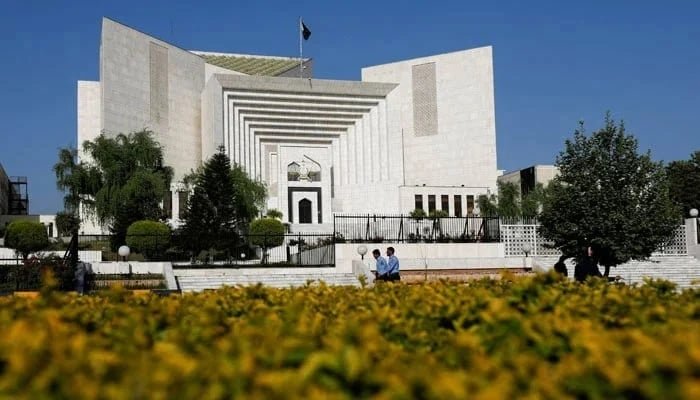
The Supreme Court has rejected an application seeking an early hearing of a contempt petition filed by Dr Uzma Khan, sister of Pakistan Tehreek-e-Insaf (PTI) founder Imran Khan, over his transfer to a hospital for medical examination. The court has already scheduled the petition for September 16, with the development adding another chapter to the ongoing legal dispute surrounding the former prime minister’s medical treatment.
Dr Uzma filed the contempt petition on August 25 after authorities transferred Imran Khan from Adiala Jail to the Pakistan Institute of Medical Sciences (Pims) instead of Shifa International Hospital. The move followed an August 18 directive of the Supreme Court, which had ordered that Khan be taken to Shifa International Hospital for a medical examination.
Supreme Court Sets September 16 Hearing
The Supreme Court has fixed the contempt petition for hearing on September 16 before a three-member bench. The bench will comprise Justice Shahid Waheed, Justice Naeem Akhtar Afghan and Justice Shakil Ahmed.
Dr Uzma subsequently submitted another application requesting that the case be heard urgently. She argued that her brother’s health was deteriorating during his imprisonment and described the matter as extremely important because it involved his health and life.
However, sources said the request for an immediate hearing was not maintainable because the contempt petition had already been scheduled. They added that cases are generally taken up according to their turn under the court’s established procedure.
The sources also pointed out that around 94 contempt petitions are currently pending before the Supreme Court, making it difficult to move individual cases ahead of others without sufficient grounds.
Dispute Over Hospital Transfer
The controversy began after the Supreme Court issued its August 18 order directing authorities to transfer Imran Khan to Shifa International Hospital for a medical examination.
Instead, Khan was taken to Pims. The government maintained that doctors from Shifa International Hospital were present at Pims during the examination, while Information Minister Attaullah Tarar defended the decision on security grounds.
The difference between the court’s order and the government’s chosen medical facility became a major point of disagreement between PTI supporters and the authorities.
PTI criticized the decision, arguing that the government’s action amounted to a failure to comply with the Supreme Court’s instructions. Government officials, however, maintained that security considerations surrounding the incarcerated former prime minister required a different arrangement.
Government Challenges Earlier Court Order
The government has also taken legal steps against the August 18 order. A day after the directive was issued, the federal government submitted a review petition before the Supreme Court.
The petition was subsequently returned by the registrar’s office with objections. The Islamabad chief commissioner later filed another petition seeking an early hearing of the government’s review request.
This means the issue is now being considered from several legal angles. On one side, Dr Uzma’s contempt petition questions whether authorities complied with the court’s direction. On the other, the government is seeking reconsideration of the original order.
The upcoming hearings could therefore determine how the court views both the implementation of its earlier directive and the government’s security-based justification.
Imran Khan’s Ongoing Legal Battle
Imran Khan has remained incarcerated since August 2023 after facing convictions in several cases. His party has repeatedly described the legal proceedings against him as politically motivated, while authorities have maintained that the cases are being handled according to law.
Since his removal from office following a no-confidence vote in April 2022, the former prime minister has faced numerous legal challenges. His imprisonment and court proceedings have remained among the most politically sensitive issues in Pakistan.
His health has also become a recurring issue in the legal and political debate. PTI leaders and members of his family have repeatedly called for appropriate medical treatment and access to independent doctors.
The government, meanwhile, has said that medical facilities remain available to Khan and that security considerations must be taken into account whenever he is moved outside prison.
The Supreme Court is now expected to hear Dr Uzma’s contempt petition on September 16. The three-member bench will have an opportunity to examine the circumstances surrounding Khan’s transfer to Pims and determine whether the government’s actions complied with the court’s earlier instructions.
The court may also consider the arguments presented by both sides regarding medical treatment, security arrangements and the interpretation of its August 18 order.
For now, the rejection of the urgent-hearing request does not mean the contempt petition itself has been dismissed. The case remains scheduled for hearing, where the court will consider the issues raised by Dr Uzma.
The dispute highlights the continuing tension between judicial directives, government security concerns and the medical rights of an incarcerated political leader. With several related petitions already before the court, the September 16 hearing could provide important clarity on how such orders should be implemented when medical and security considerations overlap.