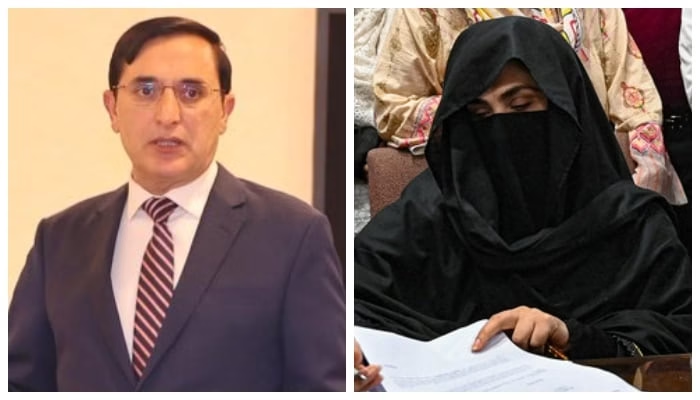
The Mir Raza murder inquiry has formally begun in Karachi, with the judicial commission formed by the Sindh government issuing notices to key parties in the case. The development comes amid continued demands for transparency from the family of the young businessman, whose death has raised serious questions about the circumstances surrounding his disappearance and death.
Judicial Commission Begins Proceedings
The commission has summoned Mir Raza’s family and their lawyer, Jibran Nasir, on August 28. A notice has also been issued to the Sindh government’s focal person as the panel begins examining the case.
The commission has reportedly been tasked with preparing its findings within 30 days. Its mandate includes examining the constitutional and legal aspects of the investigation, determining the facts surrounding the death and assessing the matter with a focus on transparency.
The start of the Mir Raza murder inquiry represents a significant step in the investigation, although the family has expressed reservations about the timing and formation of the commission.
Family Challenges Commission in Court
Jibran Nasir, who represents Mir Raza’s family, has criticized the Sindh government’s decision to establish the judicial commission. He said the family was not consulted before the panel was formed and questioned why its terms of reference had not been made public.
The family has also approached the Sindh High Court against the formation of the inquiry panel. According to the petition, establishing the commission at this stage could negatively affect the ongoing case.
The objections highlight the importance of ensuring that any additional inquiry works alongside the existing legal investigation rather than creating uncertainty about responsibility or procedure.
For the family, transparency remains a central concern as authorities continue investigating what happened to the young businessman.
How Mir Raza Died
Mir Raza, an IBA graduate and businessman, was found dead in Karachi’s Gulistan-e-Jauhar after disappearing on July 28. His family has consistently rejected suggestions that his death was suicide and maintained that he was murdered.
The post-mortem findings have added further questions to the case. According to the medical report, Mir Raza had been shot in the back, while marks of violence were also identified on his body.
The report documented black marks and injuries on his feet. Blood stains were also reportedly found on tissues in the lower part of his body.
A significant injury was identified on the right thigh, including a fracture and an approximately 12-centimetre wound. The report also recorded a deep injury and fracture in the jaw area.
These findings have increased the family’s demand for a detailed and transparent investigation into the circumstances surrounding his death.
Questions Surrounding the Investigation
The Mir Raza murder inquiry faces the difficult task of establishing a clear account of events, including what happened between his disappearance and the discovery of his body.
The judicial commission is expected to examine available evidence and review the legal and constitutional aspects of the investigation. Its findings could potentially help clarify unanswered questions, although the commission’s work will need to be assessed alongside the proceedings already taking place before relevant authorities and courts.
The family’s concerns about the commission’s formation also demonstrate the sensitivity of the case. When a family disputes the circumstances of a death, confidence in the investigation becomes particularly important.
Why Transparency Matters
A transparent investigation is essential in a case involving allegations of murder and disputed circumstances. The purpose of an inquiry should be to establish facts through evidence rather than relying on speculation or competing public narratives.
For the Mir Raza murder inquiry to produce meaningful results, investigators will need to carefully examine medical evidence, circumstances surrounding his disappearance, available forensic material and other relevant information.
The commission’s 30-day timeframe means that its work will be closely watched. However, the quality and credibility of its findings will ultimately depend on the evidence examined and the transparency of the process.
The commission’s first major step will be hearing from the parties who have received notices. The appearance of Mir Raza’s family and Jibran Nasir could provide the panel with an opportunity to hear their concerns directly.
At the same time, the family’s petition before the Sindh High Court could influence how the commission proceeds. Any judicial decision regarding its formation or mandate will be important for determining the future course of the inquiry.
The Mir Raza murder inquiry has therefore entered a critical stage. The family wants answers, while authorities face pressure to demonstrate that every aspect of the case is being examined properly.
The central question remains what happened to Mir Raza and how he sustained the injuries documented in the medical examination. A thorough, independent and evidence-based investigation will be necessary to establish the facts and provide the family with the clarity it is seeking.