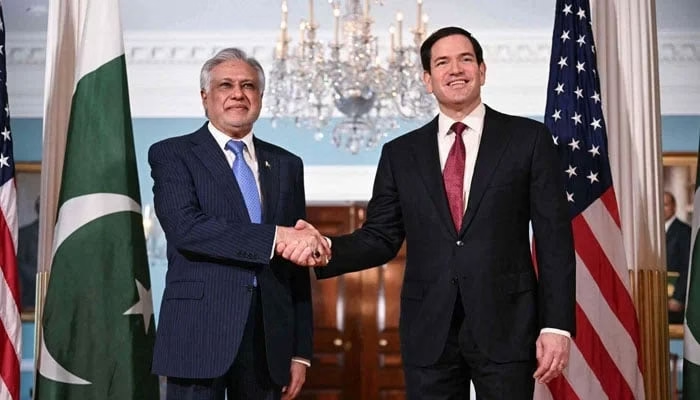
The latest round of Pakistan US Iran Peace Talks has once again placed Pakistan at the center of important diplomatic efforts in the Middle East. Deputy Prime Minister and Foreign Minister Ishaq Dar is expected to meet United States Secretary of State Marco Rubio in Washington to discuss regional peace, bilateral relations, and the ongoing tensions involving Iran and the US.
The meeting comes at a critical time as the Middle East continues to face uncertainty after recent military exchanges between Washington and Tehran. Pakistan’s diplomatic role has become increasingly important as global powers look for ways to avoid further escalation in the region.
According to Pakistan’s Foreign Office, the discussions between Ishaq Dar and Marco Rubio will focus on strengthening cooperation in different sectors while also reviewing current regional and international developments. However, one of the most important aspects of the visit is Pakistan’s continued involvement in mediation efforts between the United States and Iran.
Over the past few months, Pakistan has actively worked to reduce tensions between both countries. The Pakistan US Iran Peace Talks began gaining momentum after hostilities broke out earlier this year following coordinated strikes involving the US, Israel, and Iran.
The conflict created serious concerns worldwide because of its impact on regional security, oil supply routes, and global economic stability. One of the biggest fears was the possibility of disruption in the Strait of Hormuz, a strategic shipping route responsible for transporting a significant portion of the world’s oil supply.
Although a temporary ceasefire was achieved in April through Pakistan’s mediation efforts, long-term peace has remained uncertain. Diplomatic talks held in Islamabad between American and Iranian delegations showed progress but did not result in a permanent agreement.
Despite the challenges, Pakistan has continued its backchannel diplomacy and communication with both sides. Officials believe that maintaining dialogue is essential to avoiding another large-scale military confrontation in the Middle East.
The recent rise in tensions again highlighted how fragile the situation remains. Iran reportedly targeted a US military base in Kuwait after American forces launched strikes near Bandar Abbas, claiming they were responding to Iranian drone activity.
US officials described their actions as defensive and intended to maintain the ceasefire. Iran, however, warned that any future attacks would trigger a stronger response. These developments have raised concerns among global leaders who fear the conflict could expand further if diplomatic solutions fail.
This is why the upcoming Pakistan US Iran Peace Talks in Washington are receiving significant international attention. Analysts believe Pakistan is currently one of the few countries maintaining working relationships with both Tehran and Washington at the same time.
Pakistan’s balanced diplomatic approach has allowed it to act as a bridge between the two sides. Rather than publicly favoring one country over another, Islamabad has focused on encouraging negotiations, dialogue, and peaceful engagement.
Experts say this strategy has improved Pakistan’s image internationally as a country capable of contributing positively to regional peace efforts. It has also strengthened Pakistan’s diplomatic relevance at a time when geopolitical tensions continue to shape global politics.
Apart from regional peace, Ishaq Dar’s visit also aims to strengthen Pakistan-US relations in trade, investment, security, and economic cooperation. The United States remains one of Pakistan’s key international partners, and both countries continue to engage on multiple strategic issues.
At the same time, Pakistan has carefully maintained diplomatic communication with Iran due to shared borders, economic interests, and regional security concerns. Balancing these relationships has not always been easy, but Pakistan’s recent efforts have shown its willingness to play a constructive role in difficult international situations.
The Pakistan US Iran Peace Talks are also important for global energy markets. Any instability involving Iran and the Strait of Hormuz directly affects international oil prices and financial markets worldwide.
Investors and governments are closely monitoring developments because further escalation could increase inflation, disrupt trade routes, and create additional pressure on already fragile global economies.
For Pakistan itself, peace in the Middle East is essential due to its economic ties with Gulf countries and dependence on energy imports. A stable region benefits Pakistan economically, politically, and strategically.
Diplomatic observers believe the coming days could be crucial in determining whether current negotiations move toward a more permanent understanding or whether tensions rise again. While challenges remain, continued communication between all parties offers hope for reducing conflict.
Pakistan’s role in facilitating dialogue has already earned recognition from several international observers. By focusing on diplomacy instead of confrontation, Islamabad is attempting to position itself as a responsible regional actor capable of contributing to peace and stability.
As Ishaq Dar prepares for talks with Marco Rubio, expectations remain high regarding the future direction of the Pakistan US Iran Peace Talks. Whether these discussions lead to major breakthroughs or gradual progress, they represent another important step toward preventing further instability in one of the world’s most sensitive regions.