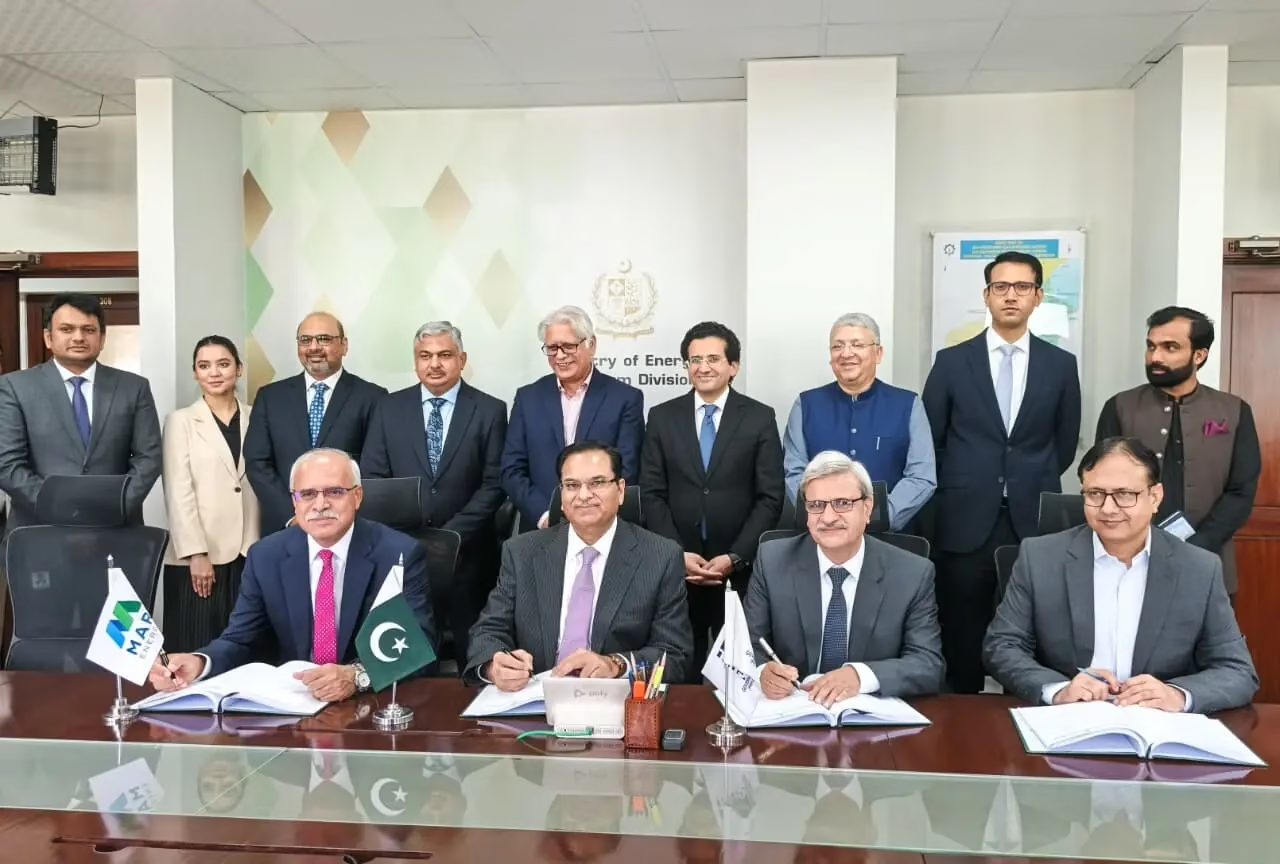
Pakistan has officially reopened its offshore energy frontier after nearly two decades, marking a significant development for the country’s energy sector. The latest Pakistan offshore exploration initiative was formalized after the government signed Production Sharing Agreements (PSAs) and Exploration Licences (ELs) for multiple offshore blocks under the Offshore Bid Round 2025.
The signing ceremony was witnessed by Federal Minister for Petroleum Ali Pervaiz Malik, who described the development as a major milestone in Pakistan’s efforts to attract investment, strengthen energy security, and reduce dependence on imported fuel.
The newly awarded blocks are located in the Indus and Makran offshore basins near the coastal regions of Sindh and Balochistan. According to officials, the Pakistan offshore exploration program attracted bids covering approximately 54,600 square kilometres of offshore territory, resulting in the award of 23 exploration blocks.
Two offshore blocks, Offshore Deep-C and Offshore Deep-F had already been awarded earlier to a consortium including Mari Energies Limited, Turkish Petroleum Overseas Company, and Fatima Petroleum Company Limited. With the signing of the remaining agreements, the contractual framework for the entire offshore bid round is now complete.
Officials believe the new Pakistan offshore exploration initiative could transform the country’s long-term energy outlook. Pakistan currently spends billions of dollars annually on energy imports, placing heavy pressure on foreign exchange reserves and the national economy.
Speaking at the ceremony, Ali Pervaiz Malik stated that the agreements demonstrate growing investor confidence in Pakistan’s offshore potential. He highlighted that Pakistan possesses an offshore frontier spanning more than 282,000 square kilometres, yet only 18 exploratory wells have been drilled since independence.
This limited exploration means much of Pakistan’s offshore territory remains untapped and potentially rich in hydrocarbon resources. The government hopes the new projects will encourage both domestic and international energy companies to invest in future exploration activities.
The latest Pakistan offshore exploration push also reflects broader reforms introduced by the government to create a more transparent and investor-friendly environment. Officials pointed to the introduction of Offshore Petroleum Rules and a revised Model Production Sharing Agreement aimed at improving competitiveness and increasing investor confidence.
Among the participating companies, Mari Energies Limited emerged as the most active participant, securing involvement in 23 offshore blocks, including 18 as operator. Meanwhile, Oil and Gas Development Company Limited and Pakistan Petroleum Limited each received eight exploration blocks.
Other companies participating in the initiative include Prime Global Energies Limited, United Energy Pakistan Limited, and Orient Petroleum Incorporation.
According to official estimates, the awarded blocks represent an initial investment of approximately $82 million during the first three-year exploration phase. However, total investment could rise to nearly $1 billion if projects advance to the drilling stage.
The Pakistan offshore exploration program will initially focus on geological and geophysical studies, including seismic data collection, processing, and interpretation. These activities are designed to help companies better understand the hydrocarbon potential of offshore basins before committing to expensive drilling operations.
If exploration results prove promising, Phase II will involve drilling exploratory wells in selected offshore areas. Commercial discoveries could lead to even larger investments in infrastructure, field development, and production operations.
Energy experts believe successful offshore discoveries could significantly improve Pakistan’s economic position. Increased domestic oil and gas production may help reduce the country’s import bill, strengthen energy independence, and stabilize industrial energy supplies.
The renewed focus on Pakistan offshore exploration is also expected to create employment opportunities and support technological development within the country’s energy sector. Offshore exploration projects often require advanced engineering, specialized equipment, and highly trained technical professionals.
Officials also stated that participating companies have committed to social welfare and capacity-building initiatives in coastal regions of Sindh and Balochistan. These efforts may include community development projects, training programs, and local infrastructure improvements.
The Petroleum Division has indicated that the government plans to engage additional international energy companies in future exploration phases. Several global oil and gas firms are reportedly reviewing Pakistan’s offshore geological data for potential investment opportunities.
Despite the optimism, offshore exploration remains a high-risk and capital-intensive industry. Discoveries are never guaranteed, and exploration projects can take years before commercial production becomes possible. However, authorities remain hopeful that Pakistan’s offshore frontier holds significant untapped potential.
The reopening of Pakistan offshore exploration after nearly twenty years represents a major strategic move for the country’s energy future. If successful, the initiative could help Pakistan strengthen energy security, attract foreign investment, generate employment, and reduce dependence on costly imported fuels in the years ahead.