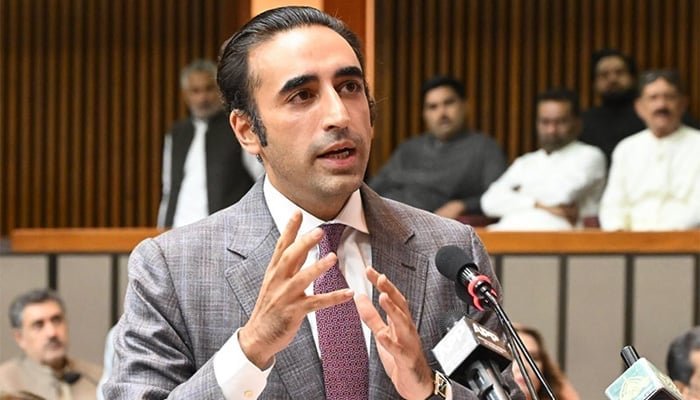
Pakistan Peoples Party (PPP) Chairman Bilawal Bhutto has strongly criticised federal ministers over the growing debate on creating new provinces, warning that any attempt to force the division of Sindh could create serious political and social consequences. Responding to criticism from government representatives on Wednesday night, he said political leaders appeared unwilling to accept opposing views and were turning a discussion about governance into a confrontation.
The debate over new provinces has intensified after several federal ministers supported the idea of creating smaller administrative units to improve governance. However, Bilawal has opposed the proposed division of Sindh, arguing that such a major decision should not be taken without consultation and public consensus.
Bilawal Criticises Federal Ministers
Reacting to statements made by federal ministers earlier in the day, Bilawal said their response showed that they were uncomfortable with criticism.
“It appears they [federal ministers] have decided to pick a fight with me for speaking the truth,” he remarked.
The PPP chairman questioned how ordinary citizens could expect their concerns to reach the government if elected politicians themselves were unwilling to listen to differing opinions.
He said he was offering suggestions as a major political stakeholder and urged leaders to approach the debate with caution.
Bilawal also questioned the manner in which discussions about new provinces had started, saying the process had taken place without consulting ministers, the prime minister or other relevant political stakeholders.
He argued that if the government wanted to discuss such an important constitutional and political issue, it should do so openly rather than relying on selected voices while expecting everyone else to remain silent.
Federal Ministers Support Creation of Smaller Provinces
Several federal ministers had criticised Bilawal’s opposition to dividing Sindh, arguing that smaller provinces could improve administrative efficiency and governance.
Defence Minister Khawaja Asif maintained that no political or constitutional change could take place without public support. He stressed that the views of citizens should carry importance in decisions concerning provincial boundaries.
Federal Minister for Health Mustafa Kamal described the creation of smaller provinces as inevitable, arguing that Pakistan needed administrative changes to function more effectively.
Other government representatives, including Talal Chaudhry, also questioned the PPP chairman’s position. They referred to the party’s stance on the possible division of Punjab and argued that democratic governance required practical administrative solutions.
The differing positions have turned the issue into a wider political debate involving constitutional authority, public opinion and the future administrative structure of Pakistan.
Warning Against Division of Sindh
Bilawal referred to political developments in Sindh during the 1980s and 1990s, saying attempts had previously been made to create divisions within the province.
He warned that similar risks could emerge if the issue was handled through political pressure rather than consultation.
The PPP chairman clarified that his earlier comments were intended as a warning rather than a threat. He said forcing such a decision could create unrest that might become difficult to control.
“I was sounding the alarm, not issuing a threat. I was warning about the consequences if such a move was forced through,” he said.
Bilawal questioned who had the authority to declare that Pakistan’s existing system had collapsed and decide that it needed to be reset.
He also used a reference to the Pakistan Cricket Board (PCB) to question whether an institution outside the relevant political decision-making process could determine that the entire system required restructuring.
Bilawal Defends the 27th Constitutional Amendment
During his remarks, Bilawal also discussed constitutional reforms and defended the establishment of a constitutional court under the 27th Amendment.
He described the development as a historic achievement and made it clear that he would not withdraw his support for the amendment.
He also clarified that he was not demanding the abolition of the constitutional courts or reversal of the amendment.
Instead, the PPP chairman called for a broader political and democratic reset aimed at rebuilding trust between the government and opposition parties.
As part of this proposal, he suggested returning reserved seats to the opposition.
Bilawal stressed that the proposal was a suggestion rather than a red line. He said the PPP had continued supporting the government even when those seats were not in its hands and would not suffer a major political setback if they were not returned.
He described the proposal as a possible starting point for improving relations between political parties.
PPP Will Continue Supporting Shehbaz Sharif Government
Despite expressing reservations about how the government was treating its coalition partners, Bilawal said the PPP would continue supporting Prime Minister Shehbaz Sharif.
He said he wanted the prime minister to succeed and believed the public expected political leaders to focus on resolving the country’s economic difficulties.
The PPP chairman questioned whether his party’s political future depended on holding positions such as governor or Senate chairman. His remarks suggested that cooperation should be based on broader political objectives rather than the distribution of government offices.
He also questioned the treatment of PTI founder Imran Khan, asking whether a person could not be considered a political prisoner simply because he was both a politician and an inmate.
Bilawal added that he found it difficult to accept a situation in which every former prime minister ended up facing imprisonment or accusations of corruption.
I want to see a day when someone becomes prime minister of Pakistan and does not end up in jail,he said.
Political Consensus Remains Key to New Provinces Debate
The latest exchange between Bilawal and federal ministers highlights the growing differences over the creation of new provinces in Pakistan.
While supporters argue that smaller administrative units could improve governance, opponents warn that changes to provincial boundaries require careful consultation and public agreement.
Bilawal has made it clear that he will resist what he considers a forced division of Sindh. At the same time, he has called for political dialogue, stronger democratic trust and greater attention to economic challenges.
The debate is likely to remain an important political issue as government representatives and opposition leaders continue presenting their positions on Pakistan’s administrative and constitutional future.