Govt Insists on PM Office Meeting
The Achakzai Shehbaz Sharif meeting has become a point of disagreement after the federal government rejected the opposition leader’s demand for a neutral venue for negotiations with the prime minister. The government has insisted that the proposed meeting must take place at the Prime Minister’s Office, ruling out arrangements at an alternative location.
Rana Sanaullah, Adviser to the Prime Minister on Political Affairs, clarified the government’s position on Saturday, saying that the Prime Minister’s House was state property rather than the personal property of any individual.
He maintained that Prime Minister Shehbaz Sharif would meet National Assembly Opposition Leader Mahmood Khan Achakzai at the PM Office and described the demand for a different venue as unacceptable.
Sanaullah said similar demands had been raised in the past and argued that insisting on an alternative location was inappropriate. He also said the government was ready to welcome Achakzai whenever he agreed to visit the office.
The disagreement comes as political tensions remain high between the government and opposition groups, with negotiations affected by disputes over recent government measures and the conditions for restarting talks.
Shehbaz Renews Invitation for Negotiations
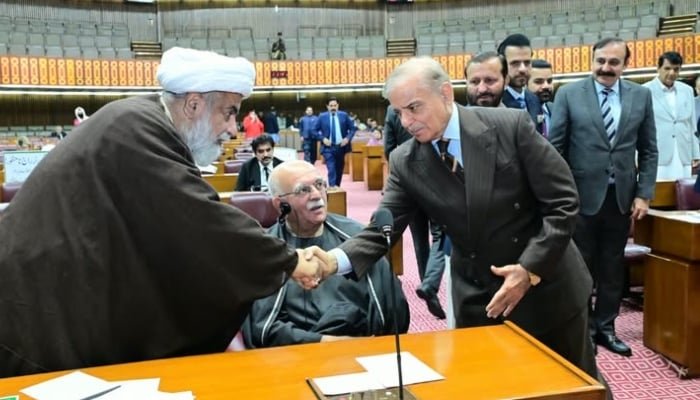
Prime Minister Shehbaz Sharif renewed his invitation to opposition representatives to resume negotiations during a joint sitting of parliament last week. He met Achakzai during the session and exchanged a warm handshake with him, signalling an opening for renewed political engagement.
The prime minister also expressed concern about the delay in appointing the Chief Election Commissioner (CEC) and members of the Election Commission of Pakistan (ECP). According to Sanaullah, Shehbaz had written two letters to Achakzai concerning the appointments and was awaiting a response.
The appointment process has become another issue requiring cooperation between the government and opposition leadership. Sanaullah urged Achakzai to communicate when he would be willing to visit the PM Office.
However, the Achakzai Shehbaz Sharif meeting remains uncertain as the two sides have not resolved their disagreement over the venue.
The renewed invitation reflects the government’s stated willingness to hold discussions, although the opposition’s response and the conditions for negotiations will influence whether formal engagement resumes.
Opposition Alliance Ends Talks With Centre
The political dispute follows a joint parliamentary session held on October 15, during which treasury lawmakers approved the imposition of an emergency and governor’s rule in Khyber Pakhtunkhwa by a majority vote.
Following the development, the opposition alliance Tehreek Tahaffuz Aiyeen-e-Pakistan (TTAP) announced that it was ending negotiations with the federal government over what it described as unconstitutional measures.
The decision has complicated efforts to bring the government and opposition back to the negotiating table.
The opposition’s objections and the government’s insistence on proceeding with its arrangements have created a difficult environment for political dialogue. The disagreement over the meeting venue adds another obstacle to attempts to restore communication between the two sides.
For negotiations to move forward, both parties will need to address not only the location of the proposed meeting but also the substantive political disagreements that led to the suspension of talks.
Govt Offers Unconditional Talks With PTI
Sanaullah also addressed the possibility of negotiations with Pakistan Tehreek-e-Insaf (PTI), the party founded by former prime minister Imran Khan.
He said the government was willing to hold unconditional talks with PTI but ruled out negotiations if the party made the withdrawal of the emergency a prerequisite for discussions.
According to the adviser, PTI had not previously given negotiations a meaningful opportunity. He also said the government intended to allow the arrangements established under the emergency to operate for an appropriate period.
Sanaullah linked the possibility of political dialogue to cooperation in the fight against terrorism, saying discussions could take place if PTI supported counterterrorism efforts.
The government’s position indicates that it wants negotiations to proceed without certain conditions being imposed in advance. PTI’s response to that approach will be important in determining whether discussions can restart.
Talal Chaudhry Urges PTI to Discuss Terrorism
Separately, Minister of State for Interior Talal Chaudhry said the federal government had not prevented PTI from organising a long march.
Speaking to the media in Jaranwala, Chaudhry said the party could hold a long or short march but urged its leadership to focus negotiations on terrorism.
He stressed that terrorism should be condemned in all its forms and referred to attacks against politicians and members of religious parties. He also made claims about PTI’s record and its founder’s reported remarks concerning the banned Tehreek-e-Taliban Pakistan (TTP).
Chaudhry further alleged that the banned group had issued a statement opposing governor’s rule and expressing support for PTI. These were claims made by the minister as part of his criticism of the opposition.
He said the purpose of governor’s rule was to eliminate terrorism in Khyber Pakhtunkhwa and asserted that state institutions would take action against those supporting terrorist organisations.
The Achakzai Shehbaz Sharif meeting dispute highlights the challenges facing political negotiations in Pakistan. While the federal government says it is ready to meet the opposition leader at the PM Office and has offered unconditional talks with PTI, disagreements over governor’s rule, terrorism and the venue remain unresolved.
Whether negotiations resume will depend on the willingness of political stakeholders to engage despite their differences. The coming discussions could influence relations between the government and opposition, particularly as security concerns and constitutional disputes continue to shape the political debate.