Pakistan Announces Shift to E-Passports
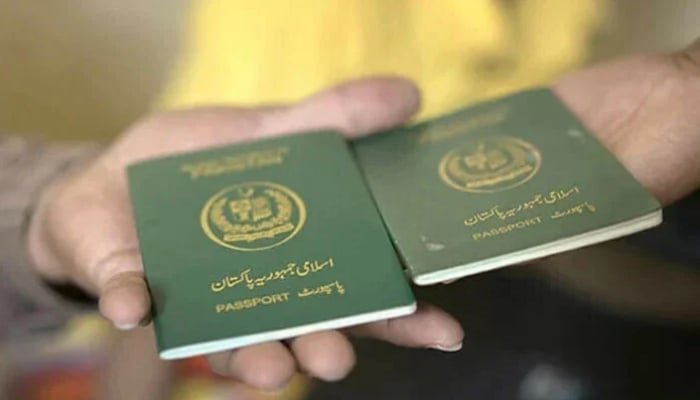
Pakistan e-passports are set to replace traditional Machine Readable Passports (MRPs), with the federal government announcing plans to discontinue the issuance of MRPs within a month. The Ministry of Interior informed the National Assembly that passport offices across the country and Pakistani missions abroad would issue only electronic passports once the transition takes effect.
However, existing machine-readable passports will remain valid until their respective expiry dates. This means current passport holders will not automatically need to replace their documents simply because the government introduces the new system.
The announcement was made during a question-and-answer session in the National Assembly on Friday, following a question raised by MNA Malik Shakir Bashir Awan.
The planned transition represents a significant change in Pakistan’s passport system as the country moves towards technology increasingly used in international travel and immigration procedures.
How E-Passports Will Improve Passport Security
Electronic passports, commonly known as e-passports, contain an embedded electronic chip that stores identity information and other relevant passport data. The technology allows compatible border-control systems to verify information electronically and helps authorities detect certain forms of document tampering.
Responding to supplementary questions in parliament, Minister for Parliamentary Affairs Dr Tariq Fazal Chaudhry said the government was working to introduce the new system within approximately one month.
He explained that Pakistan was adopting e-passports in response to technological changes in international immigration systems. The minister also highlighted the security advantages of electronic chips, saying they would make forgery impossible.
Although e-passports offer stronger security features, no identification system can eliminate every possible form of fraud. Their effectiveness depends on secure document production, appropriate verification procedures and the systems used by immigration authorities.
The introduction of Pakistan e-passports is intended to modernise travel documentation and bring the country’s passport services closer to current international practices.
Will Existing Machine-Readable Passports Remain Valid?
One of the most important details in the announcement concerns people who already hold machine-readable passports.
According to the Interior Ministry, MRPs issued before the transition will remain valid until their printed expiry dates. The planned change concerns the issuance of new passports rather than the immediate cancellation of existing documents.
This distinction is important for travellers who may have international trips, visa applications or other travel arrangements planned in the coming months.
Passport holders should continue checking their documents’ expiry dates and any passport-validity requirements imposed by their destination countries. Some destinations require passports to remain valid for a specified period beyond the intended date of arrival.
Travellers should also follow official announcements for information about application procedures, fees, processing times and the availability of the new documents.
Challenges Could Delay the Rollout
Despite the government’s target of introducing the new system within a month, the minister acknowledged that operational challenges could affect the schedule.
Pakistan’s large population and the workload faced by passport offices may complicate the transition. Authorities will need to ensure that the new system can handle applications efficiently while maintaining access to passport services throughout the country.
A smooth transition will also require coordination between domestic passport offices and Pakistani diplomatic missions overseas.
The availability of equipment, technical systems, trained staff and secure processing arrangements will be important to the rollout.
While the government has expressed its commitment to introducing Pakistan e-passports as soon as possible, the exact implementation schedule may depend on these practical considerations.
Government Reports Arms Licence Figures
During the same National Assembly proceedings, the government also provided information about arms licences issued over three years.
According to figures submitted by the Ministry of Interior and Narcotics Control, the federal government issued 13,922 prohibited-bore and non-prohibited-bore arms licences during 2024, 2025 and 2026.
In a written response to a question from MNA Naveed Aamir, Interior Minister Senator Mohsin Naqvi said the licences had been issued under Rules 4 and 6 of the Pakistan Arms Rules, 2023.
The figures were presented separately from the discussion about passport modernisation.
Parliament Questions Tourism Statistics
Members of the National Assembly also raised concerns about the classification of Afghan nationals as Pakistan’s largest source of tourists.
Deputy Speaker Syed Ghulam Mustafa Shah questioned the figures presented by the Ministry of Inter-Provincial Coordination, arguing that not everyone entering Pakistan from Afghanistan should automatically be classified as a tourist.
Pakistan Peoples Party MNA Dr Nafisa Shah noted that Afghanistan topped the ministry’s list, followed by the United Kingdom. She also questioned whether Pakistan was doing enough to attract international visitors to historical sites such as Harappa and Mohenjo-daro.
She argued that the country’s cultural heritage could help attract tourists and generate foreign exchange.
Minister of State Awn Chaudhry, meanwhile, said he would review concerns regarding petrol allowances and other official benefits to ensure they aligned with the government’s austerity policy.
Pakistan’s planned transition to electronic passports marks an important step towards modernising travel documentation and strengthening identity verification. The government intends to stop issuing new machine-readable passports within a month, although existing MRPs will remain valid until expiry.
The success of Pakistan e-passports will depend on effective implementation, reliable passport services and clear guidance for applicants. For travellers, the key message is that existing passports do not need to be replaced immediately solely because of the announced transition. Official updates will provide the clearest guidance as the new system is introduced.