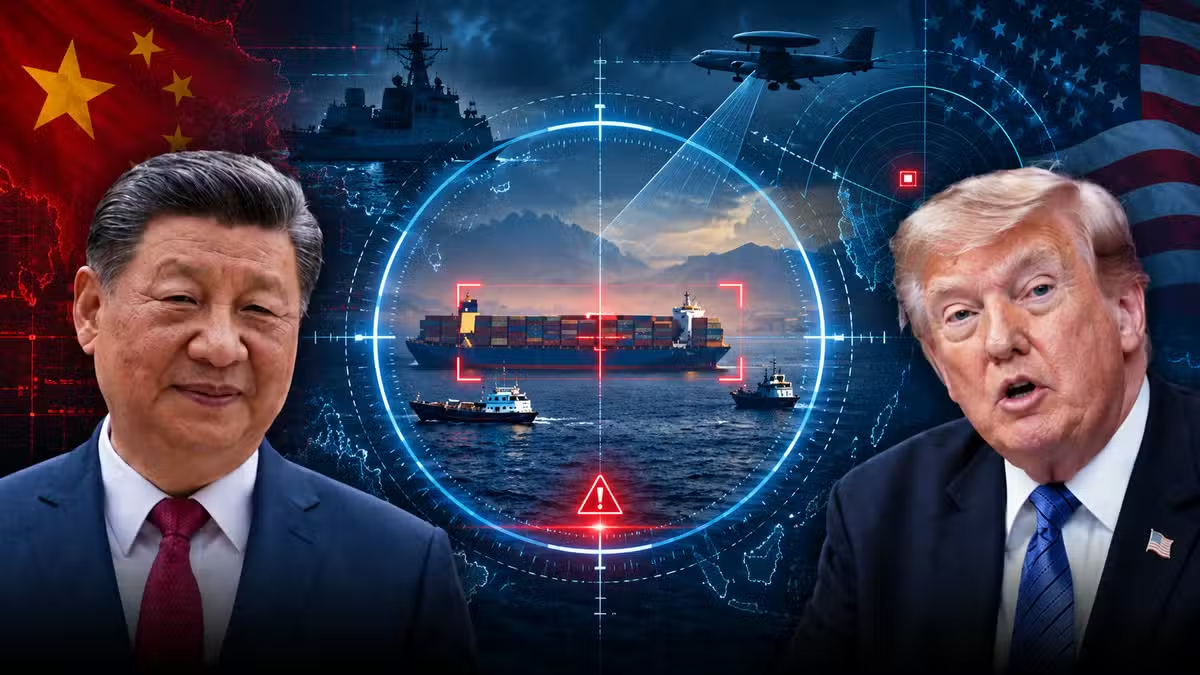
A reported AI military intelligence error nearly led the US military to launch an operation against a Chinese vessel this spring, according to CNN. The intelligence report claimed that the ship was transporting components connected to a nuclear weapons program. US officials began preparing to intercept the vessel, with military aircraft already in the air and armed personnel reportedly preparing to board, before experienced analysts discovered that the information was false.
The incident has raised new questions about how artificial intelligence is being introduced into sensitive military and intelligence operations, particularly when inaccurate information can move rapidly through established command systems.
AI Misidentified the Chinese Vessel
According to CNN, the incident occurred while the war with Iran was ongoing. An intelligence report circulating within the US military claimed that a Chinese vessel traveling through the Middle East was carrying components associated with a nuclear weapons program.
The information reportedly originated with an analyst working within a US Special Operations Command. The analyst used an AI chatbot to combine open-source information with classified signals intelligence and other government-held material.
The chatbot incorrectly identified the cargo associated with the Chinese vessel. The analyst then reportedly used the AI system again to turn the findings into an intelligence summary that looked like a conventional military report.
That document subsequently circulated through military command channels.
The episode demonstrates one of the central concerns surrounding AI military intelligence: an AI-generated error can become significantly more dangerous when it is transformed into a formal-looking report and passed through a system where people may assume the underlying information has already been verified.
Military Operation Was Prepared
The false report triggered a rapid response.
According to CNN’s sources, US military officials began preparing an operation to intercept the Chinese vessel. Military aircraft were already in the air, while armed personnel were preparing for the possibility of boarding the ship.
The operation was stopped only after more experienced analysts examined the underlying intelligence and questioned the AI-generated conclusion about the cargo.
Those analysts determined that the chatbot had misidentified what the ship was carrying. Officials then called off the planned operation before it could proceed.
The exact nature of the vessel’s actual cargo was not established in CNN’s reporting. However, the false identification was serious enough to trigger preparations for a military response.
Why AI Errors Matter in Military Operations
AI systems can process large amounts of information quickly, which makes them attractive for intelligence analysis. Military organizations are increasingly exploring AI for tasks ranging from analyzing information to supporting planning and targeting.
But large language models can also produce confident-sounding information that is inaccurate. These errors are commonly described as AI hallucinations.
In ordinary circumstances, an incorrect chatbot response might simply waste time or provide a user with misleading information. In a military environment, however, an inaccurate intelligence assessment can potentially affect decisions involving armed forces, civilian populations and relations between countries.
The reported Chinese vessel incident illustrates how an error can become more serious when it is incorporated into an official decision-making process.
Concerns About Human Oversight
The case has also renewed debate over whether having a human involved in the process is enough to prevent dangerous AI mistakes.
CNN reported that experienced analysts eventually caught the problem, but only after the intelligence had already circulated and military preparations were underway. One source told the network that the use of AI in targeting operations is increasing and questioned whether current safeguards are sufficient.
Jake Steckler, a research scholar at GovAI and former US Army officer, told TechCrunch that military personnel need to understand the uncertainty associated with large language models, particularly when AI is used for intelligence analysis, targeting or operational planning.
Steckler argued that the incident should encourage stronger safeguards rather than an outright rejection of AI. In his view, these systems can remain useful when they are deployed in appropriate situations with effective controls.
Pentagon Expands AI Use
The incident comes as the US military continues expanding its use of artificial intelligence.
CNN reported that Defense Secretary Pete Hegseth has encouraged the military to experiment with AI and incorporate the technology across a broad range of activities. That includes both routine administrative tasks and more sensitive areas such as targeting and intelligence.
The reported near-miss therefore comes at a significant time for the Pentagon’s AI strategy. The technology can potentially help analysts process information faster, but speed also creates risks if incorrect information is accepted before it has been independently checked.
For AI military intelligence, the key challenge is not simply whether AI can process information quickly. It is whether the information can be verified before it influences decisions involving the use of force.
Need for Stronger Safeguards
The reported incident highlights several areas that may require greater attention as military AI systems become more common. AI-generated assessments need clear verification procedures, particularly when they concern potential military targets or foreign military activity.
Experts have also emphasized the importance of understanding the limitations of AI models rather than treating their output as inherently reliable.
A system that produces an official-looking report can create an impression of certainty even when its underlying analysis is incorrect. That makes independent verification especially important.
A Warning for AI Military Intelligence
The reported incident involving the Chinese vessel has become a significant example of the potential consequences of relying on AI in sensitive military environments. The operation was ultimately halted after human analysts identified the error, preventing the situation from developing further.
The episode does not establish that AI cannot be used in military intelligence. Instead, it demonstrates the importance of clearly defining how such systems are used, what information they can process and how their conclusions are verified.
As governments continue adopting AI for intelligence and defense purposes, AI military intelligence will likely remain an area of intense scrutiny. The balance between speed, technological capability and careful human verification could become increasingly important in preventing AI-generated errors from turning into real-world security crises.