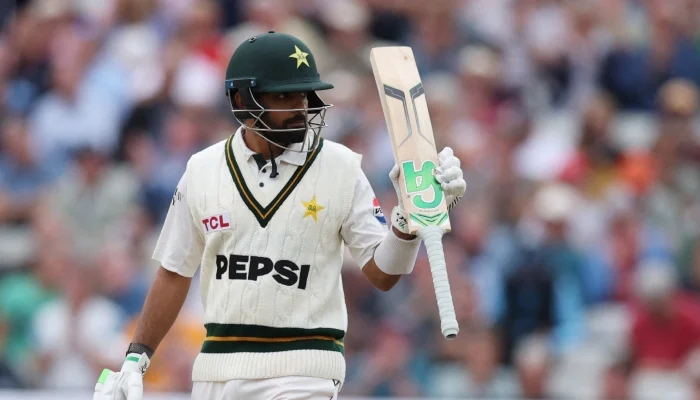
Pakistan Test captain Babar Azam has called on the national team to critically assess its performance after England completed a 3-0 series whitewash in the recently concluded Test series. Following the disappointing result, Babar said the team must acknowledge its mistakes, identify its strongest combination and make better decisions for different playing conditions.
Pakistan entered the series after drawing 1-1 against the West Indies, but the tour of England quickly became difficult. The Green Shirts suffered a heavy innings-and-103-run defeat in Leeds, putting them under pressure from the opening match.
The situation became even more challenging at Lord’s, where Pakistan suffered another significant defeat. The results eventually led to a major mid-series overhaul, with seven players being replaced along with head coach Sarfaraz Ahmed and bowling coach Umar Gul.
Despite those setbacks, Pakistan showed greater determination in the third Test. The visitors began strongly, particularly when Mohammad Abbas took two wickets during England’s first over. Debutant Razaullah also impressed with the bat and gave the team a much-needed boost.
However, England recovered and eventually won the match by eight wickets. The victory completed England’s first-ever home Test series whitewash against Pakistan.
Babar Wants Team to Admit Mistakes
Speaking at the post-match presentation, Babar Azam said Pakistan needed to sit down, accept its mistakes and determine its best XI.
The captain also confirmed that he intended to continue leading Pakistan in Test cricket. Babar had missed the opening Test because of injury but returned to captain the side in the remaining matches.
He acknowledged that team selection cannot always remain the same because different series bring different conditions. According to Babar, players must be selected based on the environment and requirements of each match.
While the overall series result was disappointing, he praised the younger players who were given opportunities during the tour.
Young Players Provide Positive Signs
One of the brighter aspects of the series for Pakistan was the performance of its emerging players. Babar Azam specifically highlighted debutant Razaullah, describing the 21-year-old as a very good talent.
Razaullah made an impressive start to his Test career, taking four wickets and scoring 92 runs across his two innings. His performance was particularly encouraging because he was not considered a widely established international name before the tour.
Babar admitted that he did not know much about Razaullah before the series. He explained that the youngster had been playing as an opener for Peshawar, and the team learned more about his batting abilities during the preparation process.
The youngster’s performance could give Pakistan another option as it works to build a stronger Test squad for future series.
Fast Bowlers Preferred in England
Questions were also raised about Pakistan’s decision to play without a specialist spinner. Babar rejected the suggestion that the absence of a spin option was a major problem.
He explained that the English pitches were grassy and appeared more suitable for fast bowling. As a result, Pakistan opted to play with three fast bowlers.
The decision reflected the importance of adapting team selection to local conditions. England’s pitches offered assistance to seamers, making pace bowling a major part of Pakistan’s strategy.
Mohammad Abbas demonstrated the potential impact of that approach in the final Test by taking two early wickets and giving Pakistan significant encouragement.
Belief Was High, But England Responded
Pakistan began the final Test with renewed confidence after Abbas’s early breakthrough. Babar Azam said belief was high after the two wickets in England’s first over.
However, England’s batters responded effectively and prevented Pakistan from turning its strong start into a winning position. Their eventual eight-wicket victory underlined the difference between Pakistan’s promising moments and England’s overall consistency.
For Pakistan, the challenge now is to turn individual performances into a more reliable team effort.
What Comes Next for Pakistan?
The 3-0 defeat leaves Pakistan with several questions to answer regarding selection, consistency and preparation. The major changes already made during the series demonstrate how urgently the team was searching for the right combination.
Babar’s call for an honest assessment could therefore be an important step. Rather than focusing only on the whitewash, Pakistan will need to identify what worked, what failed and which players deserve continued opportunities.
The performances of younger players such as Razaullah provide some encouragement, while the fast-bowling unit also showed moments of promise.
For Babar Azam, continuing as Test captain means he will now face the responsibility of rebuilding confidence and finding the strongest combination for future conditions. The England series exposed weaknesses, but it also gave Pakistan an opportunity to discover new talent and rethink its approach to Test cricket.
The next phase will be about learning from the defeat and ensuring that the lessons from England translate into stronger performances in future series.