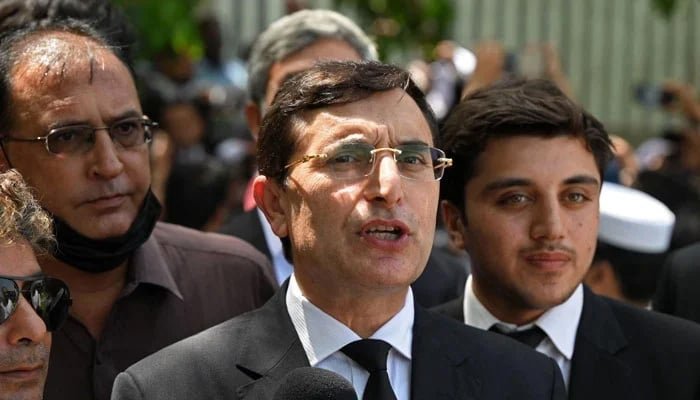
Pakistan Tehreek-e-Insaf (PTI) Chairman Barrister Gohar Khan has warned that any Sindh division carried out without the consent of the province’s people could weaken the federation. Speaking to journalists outside the Supreme Court, Gohar said the creation of new provinces was a serious constitutional and political matter that required broad consultation rather than hurried or controversial legislation.
His remarks come as debate over Pakistan’s administrative structure has intensified, with political parties expressing different views about whether new provinces or administrative units should be created.
Gohar Calls for Broad Consultation
Gohar argued that decisions involving the creation of provinces should be taken after comprehensive consultations with political parties, elected representatives and the people concerned.
He referred to the process surrounding the 18th Amendment as an example of the kind of serious consultation that should precede major constitutional changes. In his view, the Sindh division debate should not be settled through rushed legislation or decisions made without public consent.
“Without the consent of the people, if Sindh is divided, the federation will become weaker,” Gohar said.
He also warned that dividing Punjab, Sindh or Balochistan without the agreement of their populations and elected representatives could create additional political complications.
The PTI chairman said such major changes should not be treated as experiments and stressed that the unity of the federation must remain a central consideration.
Debate Over New Provinces Intensifies
The discussion about restructuring Pakistan’s administrative map has gained momentum in recent weeks. Interior Minister Mohsin Naqvi recently said new administrative units would eventually be created and argued that the process could not be stopped. He has also called for a broader “reset” of the country’s system.
Planning Minister Ahsan Iqbal, meanwhile, proposed a national debate over the creation of 12 to 15 provinces. He argued that Pakistan’s existing four provinces had become increasingly centralised and suggested that administrative restructuring could improve governance.
These proposals have added momentum to a debate that has remained politically sensitive for years.
The question has become particularly contentious in Sindh, where the possibility of dividing the province has faced strong resistance from the provincial government and other political stakeholders.
The Sindh Assembly has already rejected proposals to alter the province’s boundaries or establish new administrative units, while Pakistan Peoples Party (PPP) leaders have repeatedly maintained their opposition to the division of Sindh.
Unity Remains Central to Debate
For Gohar, the Sindh division issue is closely linked to the strength of Pakistan’s federation. He argued that any attempt to redraw provincial boundaries without public agreement could deepen political tensions instead of improving administration.
The PTI leader’s position reflects the broader argument that constitutional changes involving provincial structures require political consensus. Supporters of new provinces, however, maintain that smaller administrative units could improve governance, reduce centralisation and bring government services closer to citizens.
The disagreement therefore involves more than geography. It also concerns political representation, administrative authority and the relationship between provincial and federal governments.
Gohar Also Raises Political Dialogue
During his media interaction, Gohar also criticised the federal government over the pace of political dialogue. He said previous negotiations had largely remained limited to offers and called for meaningful progress.
He also emphasized the importance of meetings with PTI founder Imran Khan, who has remained in prison since August 2023. Gohar said Monday should be a day for meetings with the former premier and called for PTI’s political leadership and family members to be allowed to meet him.
He specifically highlighted meetings involving Tehreek Tahaffuz-e-Aiyeen Pakistan Chairman Mahmood Khan Achakzai and Vice Chairman Allama Raja Nasir Abbas, describing their interaction with Imran Khan as particularly important.
Gohar also said Achakzai, who serves as opposition leader in the National Assembly, had written to Prime Minister Shehbaz Sharif regarding an Election Commission of Pakistan matter and urged the premier to take notice of the communication.
PTI Mobilises in Sindh
Gohar also spoke about PTI’s political activities in Sindh. He said large numbers of people had turned out to welcome Khyber Pakhtunkhwa Chief Minister Sohail Afridi during his visit to Karachi, despite what he described as hurdles during the visit and return.
Afridi had arrived in Karachi accompanied by PTI Sindh President Haleem Adil Sheikh as the party continued its mobilisation campaign ahead of a planned nationwide protest on September 27.
Gohar said the reception demonstrated public dissatisfaction with the existing political status quo.
The debate over the Sindh division proposal is likely to remain politically sensitive as different parties push competing visions for Pakistan’s administrative future.
While some political leaders support creating additional provinces to improve governance, others insist that such decisions must have the consent of the people and elected representatives of the affected regions.
For Gohar, the central concern is that any attempt to redraw provincial boundaries without consensus could weaken rather than strengthen the federation. The discussion is therefore expected to continue through political negotiations, public debate and constitutional considerations.
The future of the Sindh division debate may depend on whether political forces can find common ground between demands for administrative reform and the principle of provincial consent.