The Jamaat-e-Islami (JI) has submitted six proposals to the government concerning the JI petroleum levy, while agreeing to continue negotiations even as its protest campaign remains ongoing. JI leader Liaquat Baloch said the party had raised concerns over the amount collected through the petroleum levy and the growing burden of higher fuel prices and inflation on ordinary citizens.
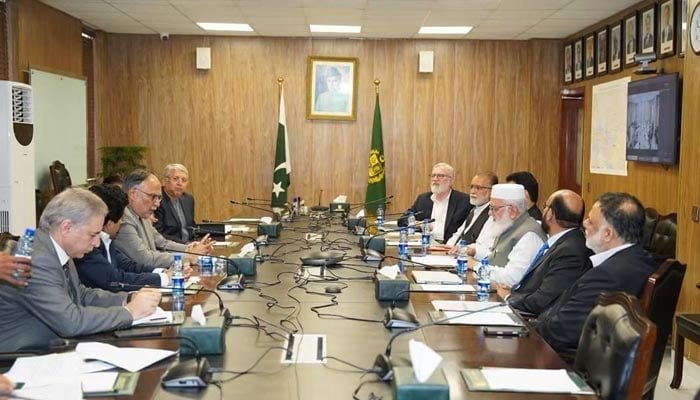
Baloch made the remarks after a meeting between JI representatives and a government delegation in Islamabad. The talks focused on the petroleum levy, rising petrol prices and possible measures to provide relief to the public.
Government Agrees to Review Proposals
Federal Minister for Planning and Development Ahsan Iqbal led the government delegation during the meeting. Prime Minister’s Adviser Rana Sanaullah, Petroleum Minister Ali Pervaiz Malik and Bilal Azhar Kiani were also among the senior officials who participated in the discussions.
Following the meeting, Iqbal said the government had asked JI to present workable suggestions regarding the JI petroleum levy issue. He said the proposals would be forwarded to the relevant ministries and institutions for consideration.
According to the minister, the government does not want protests to continue in the country and remains interested in resolving public concerns through dialogue. He said the government was willing to consider measures that could provide relief without ignoring the country’s economic realities.
Iqbal added that different ministries would need to examine the proposals before the government could determine which measures were practical.
JI Keeps Protest Campaign Active
The negotiations came after JI organized a nationwide strike against the petroleum levy and inflation. The strike received a mixed response across the country. Markets and businesses partially closed in some areas of Sindh and Khyber Pakhtunkhwa, while commercial activity largely continued in Punjab and Balochistan.
JI has also maintained sit-ins in provincial capitals and other cities for more than 20 days as part of its campaign against expensive fuel and rising living costs.
Despite continuing its protest, Baloch said negotiations remained the ultimate way forward. He acknowledged that protests alone could not resolve the country’s economic problems and welcomed the government’s decision to give dialogue priority.
He said rising electricity, gas and petrol prices were increasing frustration among citizens and creating greater pressure on households already struggling with higher expenses.
Six Proposals Await Government Review
Baloch said the party had formally presented six proposals during the negotiations and that the government had requested three days to study them.
The JI petroleum levy proposals will now be examined by relevant government ministries and institutions. After receiving their feedback, the government plans to hold another round of negotiations.
Iqbal said the government would welcome proposals that were economically workable and would explain why any suggestions that could not be implemented might have to be rejected.
The planned second round of talks could therefore determine whether the two sides can reach common ground on fuel prices and the levy.
IMF Pressure and Economic Challenges
Baloch also acknowledged that the government was facing pressure from the International Monetary Fund (IMF). He said many economic decisions were being taken because of financial constraints and national requirements.
The government has similarly emphasized that it must balance public relief with broader economic conditions. Iqbal said certain national economic realities could not simply be ignored when discussing fuel prices and other economic policies.
The minister explained that changes in international conditions had also affected petrol prices. According to him, fuel prices had declined when relations between the United States and Iran improved, while renewed tensions contributed to the need for price increases.
These international developments have added another layer of difficulty to an already sensitive domestic debate over fuel costs.
Government Promises Further Consultation
Iqbal said the government wanted economic recovery to translate into meaningful relief for the public. He stressed that the administration would examine practical proposals and work with relevant institutions before making decisions.
The minister also clarified that the government does not determine the State Bank of Pakistan’s policy rate, as the central bank operates independently. He said its formal policy board makes decisions on the policy rate after taking inflation and other economic indicators into account.
The clarification came amid wider public concerns about economic conditions and the cost of living.
The next three days could be important for the JI petroleum levy negotiations. The government is expected to seek feedback from relevant ministries and institutions before meeting JI representatives again.
For JI, maintaining pressure through protests while participating in negotiations allows the party to pursue its demands through both public mobilization and dialogue. For the government, the challenge is to determine whether any of the six proposals can provide relief without creating additional economic difficulties.
The JI petroleum levy dispute has therefore moved into a potentially important phase. While neither side has announced a final agreement, the decision to continue negotiations signals an effort to find a solution through discussion.
With inflation, fuel prices and household expenses remaining major public concerns, the outcome of the next round of talks could have significant political and economic importance. Both sides now face pressure to turn their discussions into practical measures that address public concerns while taking the country’s financial constraints into account.