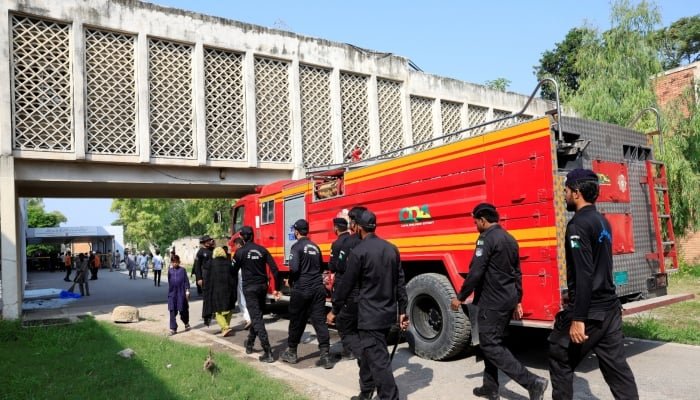
The PIMS nursery fire in Islamabad has resulted in a devastating loss of newborn lives, with 14 infants reportedly dying after a fire broke out in the gynaecology ward of the Pakistan Institute of Medical Sciences (PIMS). The tragedy has shocked the public and renewed questions about fire safety, emergency preparedness and the resources available at one of the capital’s most important public hospitals.
According to officials, the nursery at the Mother and Child Health Care Centre (MCH) had 16 newborns when the incident occurred. Only one infant was rescued, while 14 babies lost their lives. The circumstances surrounding the deaths and the exact cause of the fire are expected to remain a major focus of investigation.
The PIMS nursery fire is particularly distressing because newborns are among the most vulnerable patients in any healthcare facility. Infants receiving care in a nursery often require constant monitoring and may not be capable of responding to an emergency without assistance from medical staff. A fire in such an environment can therefore become extremely dangerous within minutes.
PIMS Plays a Major Role in Public Healthcare
PIMS is one of Islamabad’s largest government hospitals and provides healthcare services to a large number of patients. Its facilities serve people from the capital as well as patients who travel from other parts of the country seeking affordable treatment.
The Mother and Child Health Care Centre is particularly important because it provides maternity and neonatal services. Families depend on such facilities for treatment that might otherwise be financially difficult to obtain in private hospitals.
The tragedy has therefore raised concerns about whether the infrastructure and emergency systems available in such critical wards are sufficient to protect patients during unexpected incidents.
PIMS MCH Budget Increased
Budget documents provide another important part of the discussion surrounding the PIMS nursery fire. For the financial year 2026-27, Rs1.069 billion has been allocated to the PIMS Mother and Child Health Care Centre. This is higher than the Rs855.6 million allocated during the previous financial year.
The allocation includes substantial amounts for employee salaries and allowances. Around Rs356.9 million has been allocated for salaries, while Rs332.7 million has been earmarked for employee allowances.
The budget also provides Rs270 million for operating expenses. However, only Rs11 million has been allocated specifically for repair and maintenance, while Rs7 million has been set aside for machinery and equipment.
These figures do not by themselves establish whether insufficient funding contributed to the incident. However, they highlight the importance of examining how hospital budgets are distributed and whether critical safety requirements receive adequate priority.
Fire Safety Needs Greater Attention
The PIMS nursery fire has highlighted the importance of having strong emergency systems in areas where patients cannot evacuate themselves. Neonatal wards require specialized evacuation plans because newborns may be inside incubators, connected to medical equipment or dependent on continuous care.
Hospitals need functioning fire alarms, smoke detection systems, emergency lighting, accessible exits and suitable firefighting equipment. Staff must also receive regular training so that they know exactly how to respond when an emergency occurs.
Regular fire drills can be particularly important in maternity and neonatal facilities. Staff should understand who is responsible for evacuating infants, who contacts emergency services and how patients can be moved safely without creating additional risks.
Questions About Resources and Accountability
The loss of so many newborns is likely to generate questions about the condition of the ward, emergency response procedures and the availability of trained personnel and equipment.
At the same time, it is important not to draw conclusions about responsibility before the relevant authorities complete their investigation. A proper inquiry should establish how the fire started, how quickly it was detected, how staff responded and whether all required safety systems were functioning.
The findings should be made public so that families and citizens can understand what happened and what measures will be taken to prevent a similar tragedy.
Lessons Beyond PIMS
The PIMS nursery fire should also encourage authorities to examine fire safety standards in hospitals across Pakistan. Public healthcare facilities often operate under significant pressure, with large patient numbers and limited resources.
Safety, however, must remain a fundamental part of healthcare planning. Investment in modern equipment, infrastructure maintenance, emergency training and regular inspections can help reduce risks and improve the ability of hospitals to respond to disasters.
The deaths of newborns at PIMS represent an immense tragedy for their families. Beyond determining what happened, the priority now should be ensuring that the lessons from the PIMS nursery fire lead to meaningful improvements.
For families entering a hospital with the hope of saving a loved one, basic safety should never be something they have to question. The tragedy should serve as a powerful reminder that medical care and patient safety must go hand in hand.