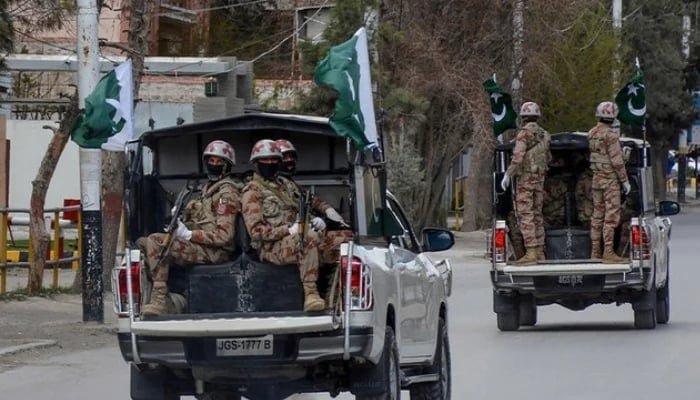
Pakistan’s security forces and police have killed 49 militants in a series of intelligence-driven operations across Khyber Pakhtunkhwa (KP) and Balochistan, according to the military’s media wing. The operations targeted groups that Pakistan identifies as India-backed militant organisations and were carried out as part of the country’s ongoing counterterrorism campaign.
Operations Across KP and Balochistan
According to the Inter-Services Public Relations (ISPR), security forces conducted multiple intelligence-based operations in several districts of KP. The operations resulted in the deaths of 12 militants in Bannu, North Waziristan, Orakzai and Khyber.
Officials said security personnel recovered a substantial quantity of weapons and explosives during the operations. The recovered material reportedly included improvised explosive device (IED) detonating equipment, ammunition, weapons and motorcycles.
The authorities said the recovery of such material was significant because it could potentially have been used in attacks against security personnel and civilians.
The 49 militants killed in the wider operation included fighters targeted in Balochistan, where security forces conducted 10 intelligence-based operations.
37 Militants Reportedly Killed in Balochistan
ISPR said 37 militants were killed during operations in Mastung, Mach, Khuzdar and Panjgur districts of Balochistan. The military described the targeted group as belonging to what it calls Fitna al-Hindustan.
Security forces reportedly recovered weapons, explosive drums and remote detonation equipment during the operations. The material was subsequently destroyed, according to the military’s statement.
The scale of the operations highlights the continued focus of Pakistan’s security agencies on militant networks operating in both provinces. Authorities have repeatedly identified KP and Balochistan as major areas of concern in the country’s counterterrorism efforts.
The latest counterterrorism operations also follow several other intelligence-based missions carried out earlier in the week.
Earlier Operations in Balochistan
Earlier operations under Operation Rad-ul-Fitna-3 in Ziarat, Harnai and Surab reportedly resulted in the deaths of at least nine militants.
Security sources said weapons, ammunition, magazines, hand grenades, walkie-talkies, a motorcycle and other equipment were recovered from the militants killed during those operations.
The repeated intelligence-led actions indicate that security agencies are continuing to target suspected militant hideouts, weapons networks and operational infrastructure rather than relying solely on conventional security deployments.
KP and Balochistan Remain Major Security Hotspots
The latest security operations in Pakistan come against the backdrop of a broader increase in militant violence since 2021. KP and Balochistan have experienced a particularly high concentration of attacks and fatalities.
A report by the Centre for Research and Security Studies (CRSS) identified the two provinces as Pakistan’s primary violence hotspots during the second quarter of 2026.
According to the report, KP and Balochistan together accounted for almost 96% of violence-related fatalities recorded across the country during that period.
KP was the most severely affected province, recording 475 deaths, or more than 61% of the nationwide total. Balochistan accounted for another 265 fatalities, representing approximately 34%.
The two provinces also recorded the overwhelming majority of reported violent incidents. KP registered 151 incidents, equivalent to 57% of the national total, while Balochistan recorded 94 incidents, or around 35%.
These figures demonstrate the scale of the security challenge confronting authorities in the two regions.
Importance of Intelligence-Based Operations
The latest counterterrorism operations demonstrate the growing reliance on intelligence to identify and target militant networks. Intelligence-based operations can allow security agencies to locate suspected hideouts and disrupt planned attacks before they take place.
The recovery of explosives, IED equipment and weapons is also an important element of these missions. Removing such materials from militant networks can potentially prevent future attacks and reduce the operational capacity of armed groups.
At the same time, continued violence in KP and Balochistan shows that military operations alone cannot completely resolve the underlying security challenge. Sustained intelligence cooperation, effective policing, border management and measures addressing local grievances remain important components of a long-term strategy.
A Continuing Security Challenge
The 49 militants killed in the latest operations represent another significant development in Pakistan’s ongoing fight against militancy. The operations across multiple districts show that security forces are maintaining pressure on groups they identify as threats to national security.
However, the continued concentration of violence in KP and Balochistan underscores the need for a comprehensive and sustained approach. While security operations can disrupt militant networks, lasting stability will also depend on strengthening civilian institutions, improving development opportunities and maintaining effective law enforcement.
Authorities are expected to continue intelligence-led operations as they seek to prevent further attacks and dismantle militant infrastructure in some of Pakistan’s most affected regions.