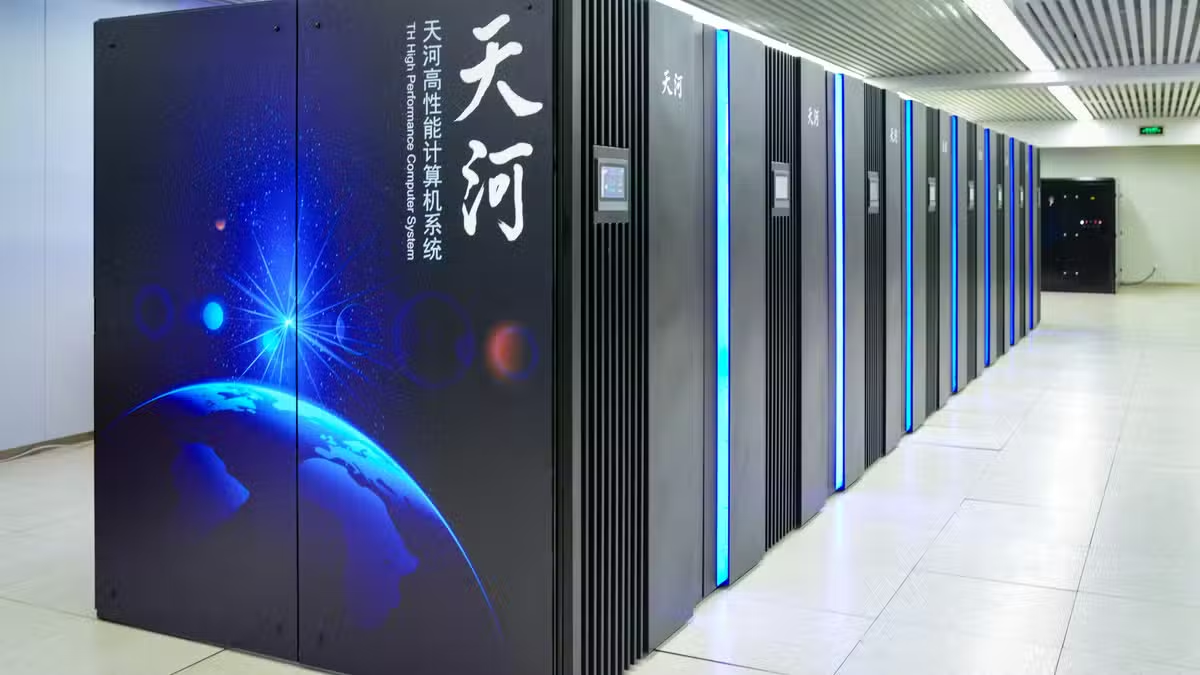
China’s fastest supercomputer has reclaimed the top position in global high-performance computing, marking a major milestone in the international technology race. The newly unveiled LineShine system has become the world’s most powerful supercomputer, surpassing competitors from the United States and establishing China as a leader in next-generation computing technology.
The achievement is significant not only because it places China back at the top of the global rankings but also because it demonstrates the country’s growing ability to develop advanced computing systems using domestic technologies. As nations invest heavily in artificial intelligence, scientific research, and data-intensive applications, supercomputers are becoming strategic assets that shape technological leadership.
LineShine Takes the Top Spot
The latest TOP500 ranking, which tracks the world’s most powerful supercomputers, placed LineShine at number one. Installed at the National Supercomputer Centre in Shenzhen, the system achieved an impressive performance of 2.198 exaflops.
This means the machine can perform more than two quintillion calculations per second, making it the first system on the ranking to exceed two exaflops of sustained double-precision computing performance using only central processing units (CPUs).
By comparison, the United States’ El Capitan supercomputer achieved 1.809 exaflops, placing it second on the list. This development marks the first time since 2017 that China has held the title of the world’s fastest supercomputer.
A Unique CPU-Only Design
One of the most remarkable aspects of China’s fastest supercomputer is its hardware design. Unlike many modern supercomputers that rely heavily on graphics processing units (GPUs), LineShine uses a CPU-only architecture.
The system is powered by custom-designed 304-core processors and contains nearly 13.8 million processing cores running simultaneously. These processors are connected through a proprietary high-speed network that enables efficient communication across the entire machine.
This approach demonstrates that multiple paths can lead to exascale computing. While many organizations focus on GPU acceleration, China has shown that advanced CPU technologies can still achieve world-leading performance.
Importance for Artificial Intelligence
The rise of China’s fastest supercomputer comes at a time when artificial intelligence is driving unprecedented demand for computing power. Modern AI models require massive amounts of processing capacity for training, simulation, and data analysis.
Supercomputers like LineShine can accelerate research in machine learning, climate modeling, healthcare, engineering, and national security. They provide scientists and researchers with the computational resources needed to solve highly complex problems that would otherwise take years to process.
As AI continues to evolve, access to powerful computing infrastructure will become increasingly important for technological competitiveness.
Performance and Energy Efficiency
Although LineShine leads the world in overall performance, energy efficiency remains an important consideration.
The system consumes approximately 42.2 megawatts of power during operation. While this is substantial, it reflects the enormous computational capability delivered by the machine.
El Capitan remains slightly more efficient in terms of performance per watt, but China’s fastest supercomputer still demonstrates an impressive balance between speed and energy consumption.
Researchers and engineers continue to seek ways to improve efficiency as computing demands grow. Future generations of supercomputers are expected to focus not only on raw performance but also on sustainability.
The Global Supercomputing Race
The latest rankings highlight intense competition among major technology powers.
Currently, five systems worldwide have crossed the one-exaflop threshold. These include machines located in China, the United States, and Germany. Each system represents years of research, engineering, and investment.
The race to build faster computers is no longer just about scientific prestige. Supercomputers play a critical role in national security, economic development, technological innovation, and industrial competitiveness.
The success of China’s fastest supercomputer demonstrates how rapidly the global balance of technological capability can shift.
Overcoming Technology Restrictions
Another reason this achievement has attracted attention is that it comes amid ongoing restrictions on access to certain advanced semiconductor technologies.
Despite these challenges, China has continued to develop its own high-performance computing ecosystem. The CPU-only design of LineShine highlights the country’s efforts to reduce dependence on foreign technologies and build domestic alternatives.
While many technical details remain undisclosed, the system’s performance suggests significant progress in processor design, system integration, and large-scale computing infrastructure.
The arrival of China’s fastest supercomputer signals a new chapter in the evolution of high-performance computing. As governments, universities, and technology companies invest billions of dollars into AI and scientific research, demand for exascale computing will continue to grow.
Future systems are expected to become even more powerful, combining advanced processors, specialized AI hardware, and innovative architectures. Competition among nations will likely intensify as computing power becomes increasingly tied to economic and technological influence.
LineShine stands as a symbol of China’s growing capabilities in advanced computing. Its record-breaking performance demonstrates that innovation in supercomputing remains active and that the race for technological leadership is far from over.